Exhibition on Screen: James McNeill Whistler
Director – David Bickerstaff – 2026 – UK – Cert. U – 90m
*****
A look at the work of 19th Century painter Whistler, seen through the lens of the 2026 Tate Britain exhibition – out in UK cinemas from Tuesday, 15th September
Before watching this latest Exhibition on Screen feature, I was able to visit Tate Britain’s stunning James McNeill Whistler show, which sits very much at the film’s core. The film had the effect of making me want to go back for further visits.
Exhibition on Screen’s film opens with shots of a Victorian concert hall interior where the unseen Whistler (voice: Bret Jones) is addressing the room with his spoken lecture on art, something the film will return to towards its close. After a montage of brushes, painting surfaces and palettes, establishing shots of Tate Britain take us straight into the current Whistler show. “People sometimes think of Whistler as being based in French art, and sometimes as being based in British art,” explains Carol Jacobi, Curator of British Art 1850-1915, Tate Britain, “whereas…he was very much an independent…and very much leading the avant-garde in both those countries.”
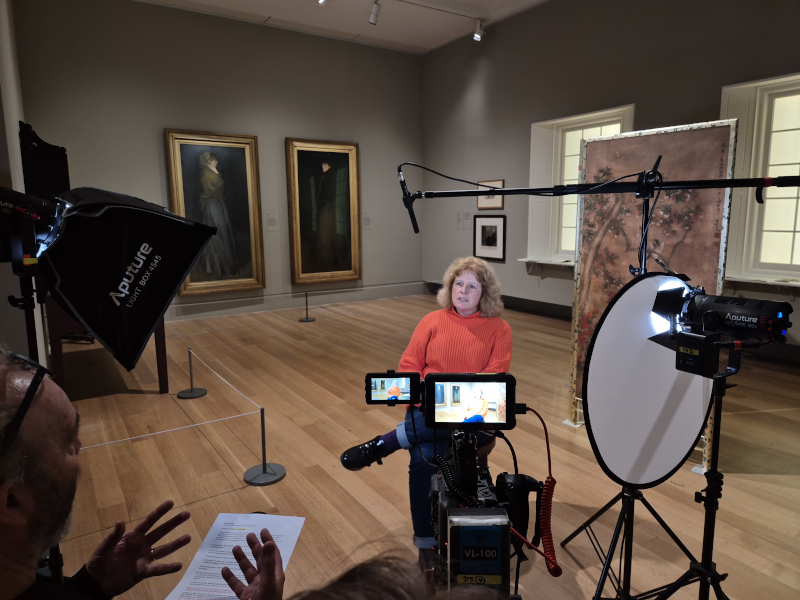
Susan Grace Galassi, Curator Emeritas, The Frick Collection, New York, who considers Whistler one of the greatest American artists, notes that he didn’t distinguish between fine or applied art, that he was as great a painter as he was a printmaker. Stephen Calloway, art historian and curator espoused Whistler’s highly aware self-promotion of his own image as an artist – the way he dressed, presented himself, stood, walked, talked.
He was very much a dandy, comments Rachel Campbell-Johnston, art critic and writer. “He was also irascible, quick to fly into a temper.” With Whistler, she suggests, the cult of personality was born. His monogram of a butterfly with a sting in its tail encapsulates his personality. Elegant, beautiful, dangerous. He had a habit of falling out with friends such as Pre-Raphaelite Dante Gabriel Rossetti or F.R. Leyland, who commissioned The Peacock Room, of which, more later. A provocateur who loved to play with ideas and theories, an outsider from America with a unique perspective on modern life. In his own writings, he noted his birthplace has been quoted as Russia, France, America, England. As for America, Pomfret, Connecticut, Boston, and even Lowell, Massachusetts have been cited, although he was a Southerner.
In fact, like a deceitful social media manipulator a century ahead of the technology, he was indeed born in Lowell, Massachusetts. As Patricia de Montfort, Art Historian, University of Glasgow explains, his father was a surveyor and railway engineer. In 1843, the family moved to St. Petersburg as father was appointed chief engineer in the construction of the St. Petersburg to Moscow railway. At age nine, Whistler had art lessons from A. O. Koritskii and later studied at the Academy of Fine Arts in St. Petersburg. He learned French.
When his father died when Whistler was 15, the family returned to the US where, needing to become the responsible male in the family, he want to West Point Military Academy, from which he was ejected after three years because he wasn’t very interested or very good at anything, except draughtsmanship which he took seriously and studied diligently. He learned not only to draw but also, as a military surveyor, to etch. Joining the Coastal Survey, he executed beautiful and exact drawings of coastlines. Henry Murger’s book La Vie Boheme, about four struggling artists trying to obtain what they wanted in Paris’ bohemian world resonated. Desiring freedom from his restrictive, pious upbringing, Whistler headed for Paris, in 1855 the crossroads of world culture.
Campbell-Johnston points to that year’s Salon d’Exposition, with around 5 000 paintings on display, as an image of realist painter Gustave Courbet’s Bonjour, Monsieur Courbet (1854) fills the screen. Whistler fell in step with Courbet’s idea. Instead of looking at peasants and everyday life in the French countryside as Courbet had done, Whistler was interested in the urban experience, and its darker side – he hung around in backstreets, bars, looking at prostitutes, doing etchings of the well-known dancer Finette who later modified the Can-Can. However, his interest lay in not aristocrats but the ordinary, common people.
Familiar with art history and such painters as Rembrandt and Velázquez, riffing off Courbet’s self-portrait with a pipe with an image of himself smoking a cigarette, to be found in the Tate Britain exhibition. Other early, tiny paintings in the show include the flower seller Mme Gérard (c. 1858-9), who has one good eye. When you look at this painting, says Campbell-Johnston, you feel as if she is looking at you. Inspired by poet and critic Charles Baudelaire, he achieved great success at age 23 making etchings of aspects of urban life. He exemplified, says Stephen Calloway, printing images himself, rather than going to a printer; one of the first to do so.
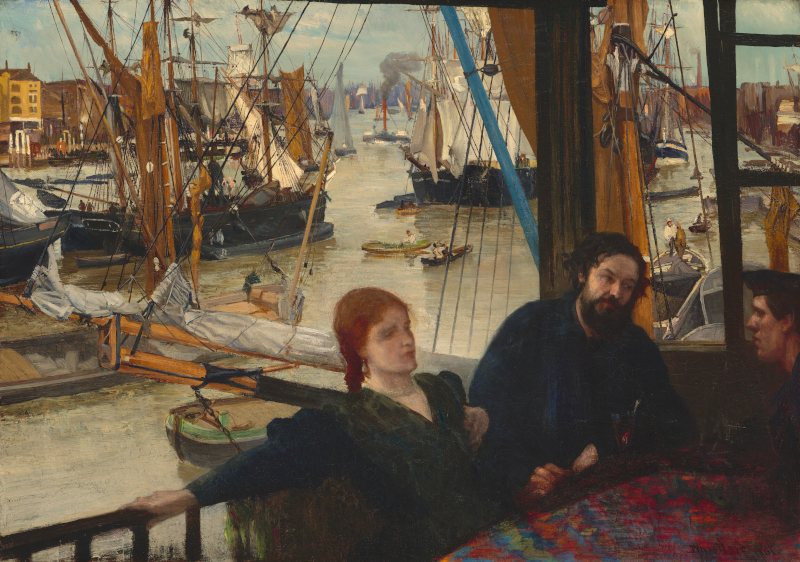
When he came to London, he fell in love with the river. He tended to like the more disreputable East End areas such as Rotherhithe and Wapping. His Wapping (1860-64) shows a woman and two men at a table, with behind them an extraordinary and detailed picture of the ships on the Thames. He rejects any idea that a painting should tell a story or even have a moral. It’s contemporary with Manet’s Dejeuner sur L’herbe (1863), another image of two artists and a model.
He moved to the then decrepit Chelsea, “perfect for an artist in search for the beauty of real life”, says Calloway. Campbell-Johnston describes his painting of river bridges, with workmen standing around chatting, as everybody knows they do. He looks at the Thames in all its manifestations. He was working towards a style anticipating modernism, unprecedented in art.
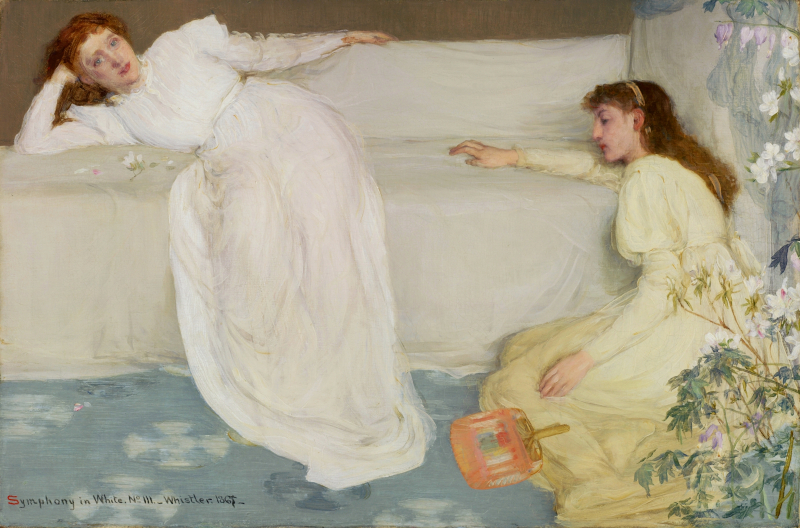
Aiming for design, colour and sheer beauty. Symphony in White No.3 (1865-7) balances two girls in white dresses against a foregrounded light blue floor. Many of his paintings used titles like Symphony, Nocturne, Harmony, Arrangement: the painting should be taken as a painting, not its subject.
As Campbell-Johnston points out, he presented his art in a holistic manner – the painting sat in a frame, the frame sat in a room, the whole arrangement was part of the artwork. Nowhere is this more evident than in The Peacock Room (1876-7) a commission he took over when it had been part completed by another artisan for Kensington’s F.R. Leyland, showcasing Leyland’s collection of blue Japanese porcelain on specially designed shelving.
Whistler turned the whole thing into a bravura exercise in interior design as he decorated the whole room from top to bottom with motifs from the porcelain in both Leyland’s and his own collections, along with motifs from Japanese fabrics Whistler had himself procured. Like Japanese prints, such items were appearing in the European market at the time. Whistler threw out expensive, 17th century Spanish wall wall coverings. Two peacocks on a panel Art and Money or The Story of the Room towers above the room. One peacock represents the artist, retreating, feathers down, while the other, representing the patron, stands in a pool of coins that are falling from his belly. It’s his money, and he’s hanging on to it!
After Leyland’s death, major US Whistler collector Charles Lang Freer bought the room and had it transported to the US. Something that’s not in the film, which satisfyingly films the original room not the facsimilie in Tate Britain’s show, the current exhibition gets round this by presenting the room as life size photographs on the walls so that you get a real sense of the installation in its space. It can never quite match the experience of the actual room, which is still in the US, but it does a pretty good job and it’s good to see it in the context of the exhibition. The Tate have added a room-specific audio commentary detailing, in their own words, the feud between artist and patron as the letters about money and payment went back and forth between the two.
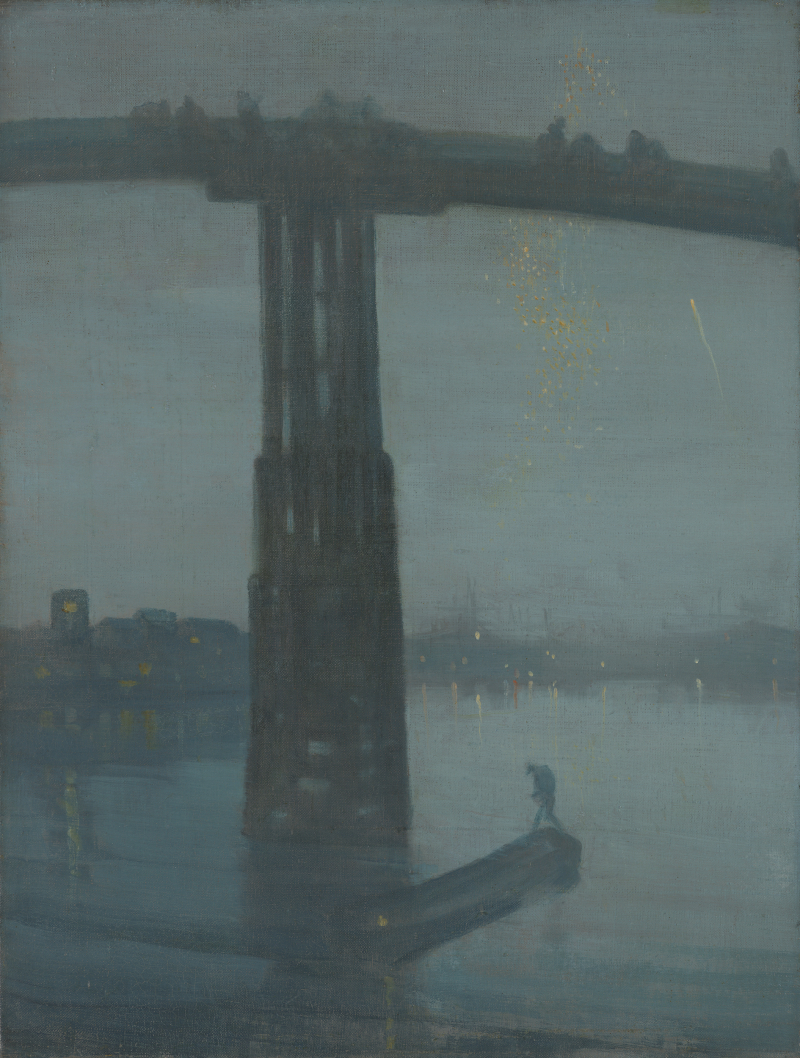
Whistler’s paintings of the Thames he described in terms of “breath on a pane of glass”. Incredible, beautiful paintings which have their roots in his draughtsmanship for the Coastal Survey. He used house brushes, but there’s nothing slapdash about it. There is also a section on his tall thin portraits of people standing. Whistler was notorious for having his models stand for a long time, and one teenager has a grumpy expression indicating that she was far from happy with the fact.
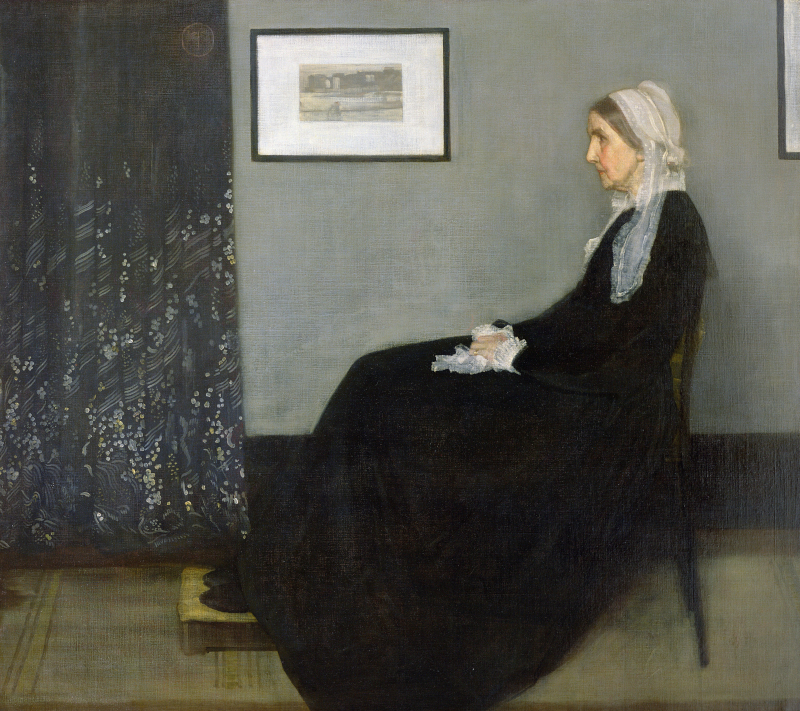
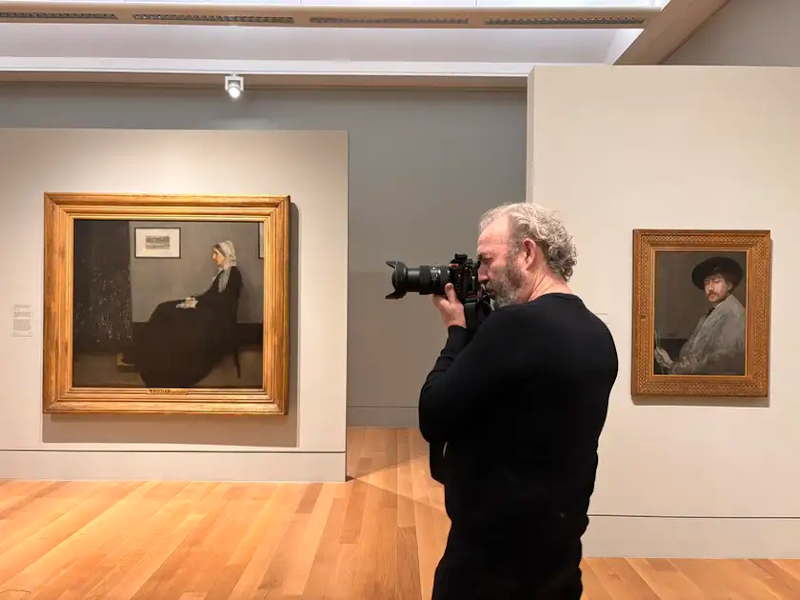
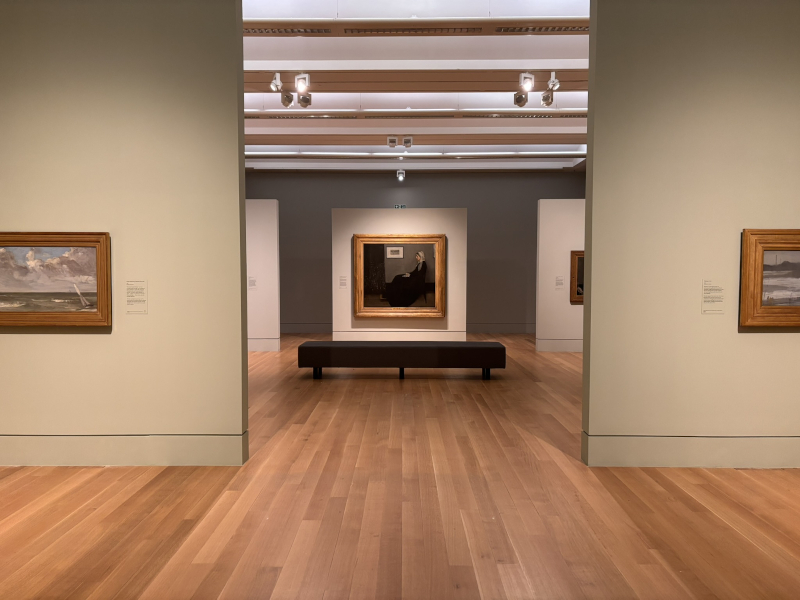
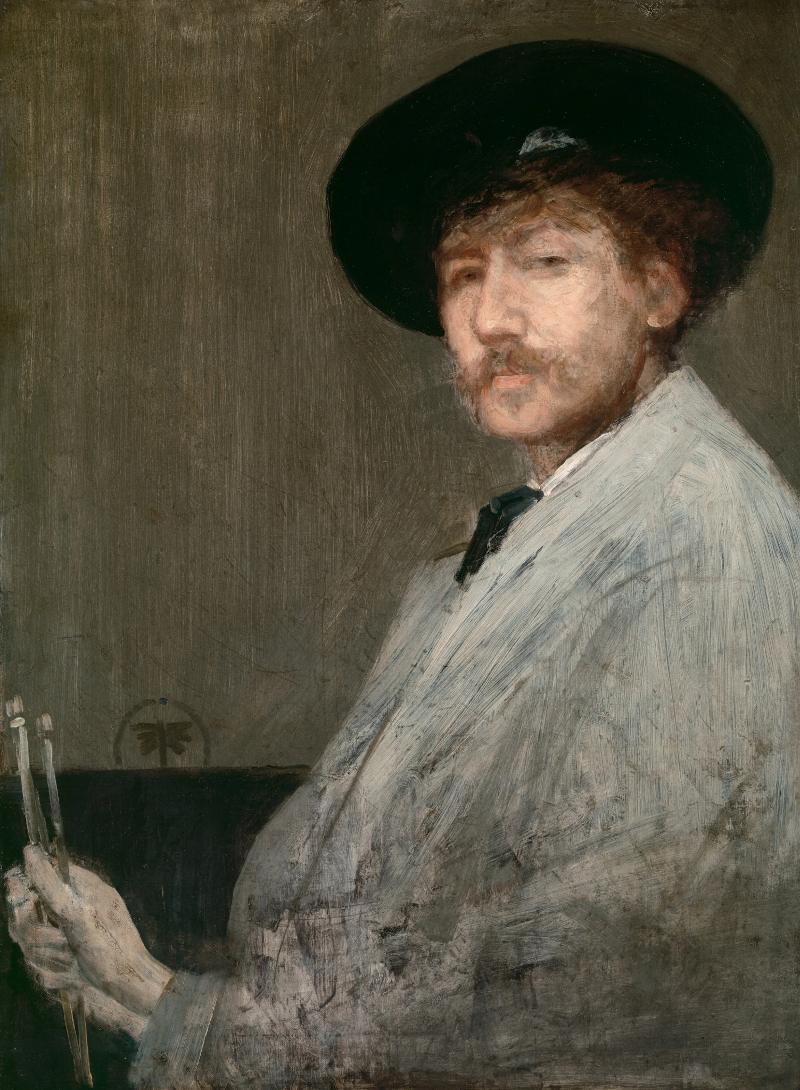
The centrepiece is inevitably the large painting of Whistler’s mother aka Arrangement in Grey and Black No. 1 (1871) flanked by two smaller paintings of surviving Whistler brothers Dr. McNeill Whistler (1871-3) and the similarly sized self-portrait Arrangement in Grey: Portrait of the Painter (1872).
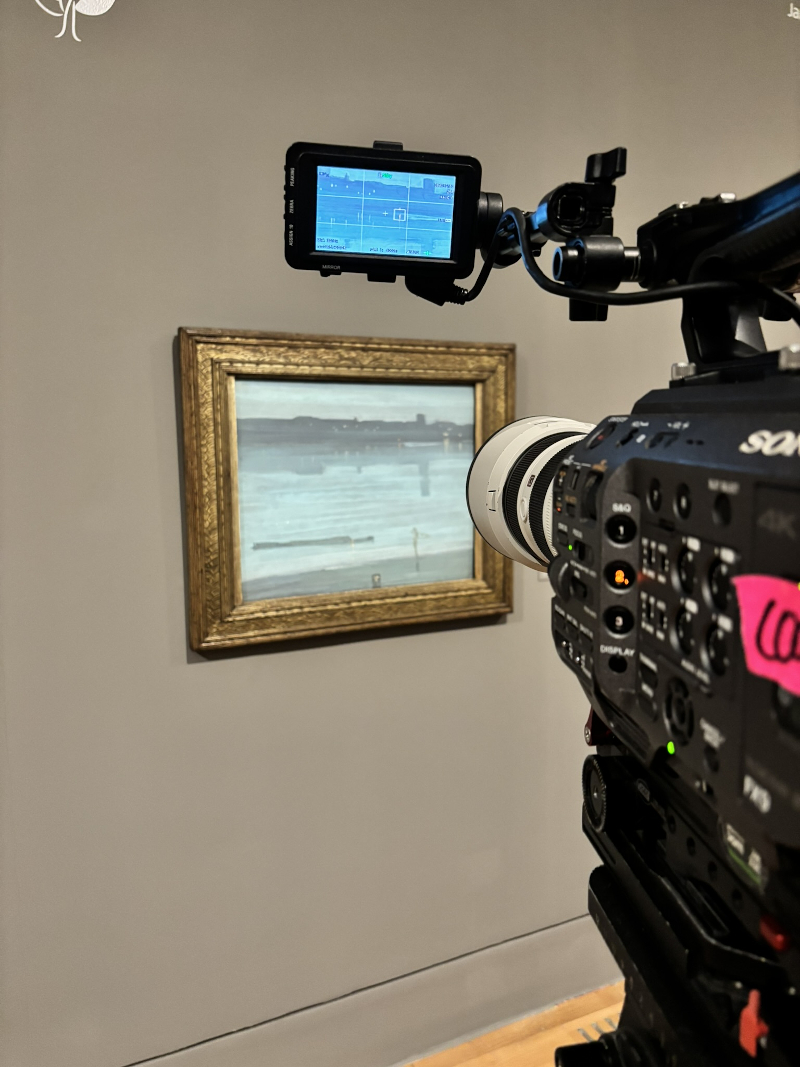
The documentary flits around between the Tate Britain show and other museums around the world, but it will add a lot to your visits to the show which ends in almost a couple of weeks. Bickerstaff and his four cameramen (one being himself) deliver some extraordinary panning shots of the Tate show which move to bring in a brief glimpse of one painting here, another there. The whole thing is beautifully pieced together by the editor, here again Bickerstaff himself, and composer Asa Bennett delivers a gorgeous score to give the thing even more life. My feelings about the Exhibition on Screen series is that some are better than others: their James McNeill Whistler sees Phil Grabsky’s team right at the top of their game: it’s one of their very best outings.
Exhibition on Screen: James McNeill Whistler is out in cinemas in the UK from on Tuesday, 15th September. Check your local cinema for details or click here.
The James McNeill Whistler exhibition at Tate Britain runs from Thursday, 21st May to Sunday, 27th September 2026.
Trailer: