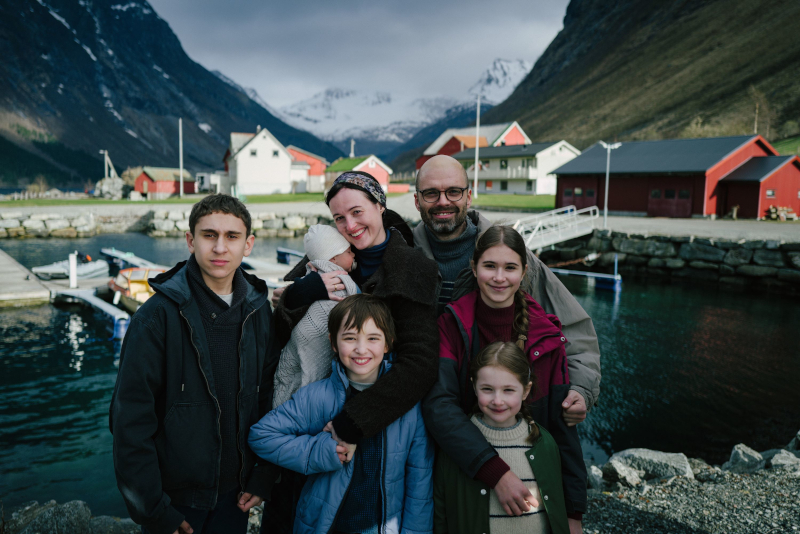
Fjord (Fjord)
Director – Cristian Mungiu – 2026 – Romania, Norway, France, Denmark, Finland, Sweden – Cert. 15 – 146m
*****
A Romanian-Norwegian family encounters insurmountable cross-cultural issues when they move to Norway – out in UK cinemas on Friday, November 13th
The Gheorgious, a couple comprising a Romanian man Mihal (Sebastian Stan from A Different Man, Aaron Schimberg, 2024; I, Tonya, Craig Gillespie, 2017; Captain America: The Winter Soldier, Anthony and Joe Russo, 2014) and his Norwegian-born wife Lisbet (Renate Reinsve from Backrooms, Kane Parsons, 2026; Sentimental Value, 2025; The Worst Person in the World, 2021, both Joachim Trier) move with their five kids, including their eldest, young teenagers Elia (Vanessa Ceban) and Emmanuel (Jonathan Ciprian Breazu), and their youngest, a baby, move to a picturesque, town in Norway when Mihal takes up a job there as an engineer. Lisbet too takes on a job at the local old folks care home. The town is surrounded by breathtaking mountain scenery and a beautiful lake. It’s a small town where everybody knows everybody else.
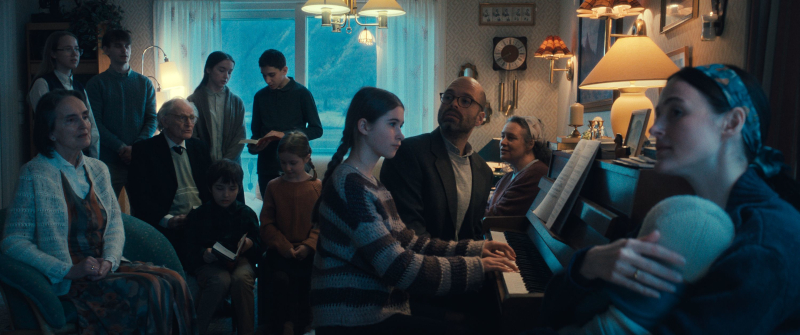
The family, who practice daily Bible-reading and prayer, right down to their kids who completely buy into their parents’ religious values, immediately plug in to the local church community, opening their home for bring and share meals and hymn-singing round the piano. The kids are banned from using social media, so no mobile phones.
The kids attend the local school, where the headmaster Mats Halberg (Markus Tønseth) is their next door neighbour and one of the pupils, the unruly Noora (Henrikke Lund-Olsen), his daughter, a position of which she often tries to take advantage. She’s an outgoing, free-spirited type. Possibly a little too free-spirited.
There is a tension between the worlds of religion and church on the one hand and school and official Norwegian values on the other. When Elia improvises the tune of a hymn on the school’s electric piano, she is ordered by staff to stop because that would be proselytizing and therefore inappropriate.
Nevertheless, the neighbours get to know one another, with the boundary-challenging Noora teaching the two elder Gheorgiou kids how to jump from upstairs windows and turning up late at night to get them out of the house on various unorthodox adventures, such as taking a boat out on the lake. A far cry from the conservative routines of the Gheorgious.
In gym class, following wrestling lessons in which Elia is paired with Noora, the teacher Frida (Lisa Loven Kongsli from Zack Snyder’s Justice League, Zack Snyder, 2021) notices marks on Elia’s neck and back and suspects that the girl is being beaten at home. Against Mats’ advice, Frida alerts Child Services and that organisation’s representative Gunda (Ellen Dorrit Petersen from The Innocents, Eskil Vogt, 2021; Thelma, Joachim Trier, 2017) becomes involved.
As the Gheorgious find their five kids taken away from them while Child Services investigate the matter, temporarily placing the kids with a number of foster families, they enlist the help of a lady lawyer from the Church, an appointment which doesn’t work out, forcing them to find someone else to represent them in the case. It turns out that Mats’ wife Mia (Lisa Carlehed) is also a lawyer, and she agrees to represent them. Mia seems to know her way around the Norwegian legal system, and her presence does a great deal to stop certain aspects of the situation developing in worse directions.
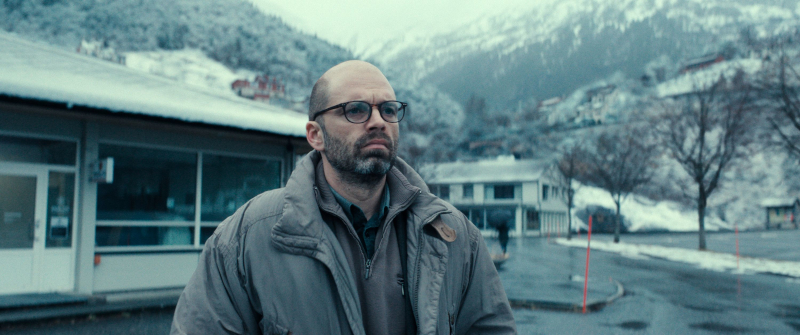
Frustrated by what he sees as their case going nowhere, Mihal enlists the help of conservative Romanian Christian groups who use social media to whip international opinion into a frenzy on their behalf, demanding that the Gheorgious get their kids back. This doesn’t sit well with either Mia or the Norwegian authorities. Lisbet doesn’t really have anything to do with her husband’s initiative.
As to whether the family beat their kids – well, it looked unlikely to me, and I surmised that Elia’s injuries had been sustained from other sources – perhaps an upstairs window jump, where we only ever see her leave the ledge and are not shown how she lands on the ground below. Certainly we are shown an incident where Lisbet, holding the baby and hot milk, pushes her daughter away out of concern that the baby might be scalded (it isn’t), a perfectly reasonably action on the mother’s part, which is blown up out of all proportion in a family court as if to suggest mother assaulted daughter.
Mihal does admit to punishing wrongdoing with regards to his kids, but we only ever see him doing so by grounding his kids which, by chance, means they miss Noora’s birthday party.
Equally, he is asked to sign a statement by the police which includes the word “slap”, which appears to mean something much stronger in Norwegian than it does in his native Romanian. He is assured, if he signs, that this can be sorted out later, but he will only be allowed to leave the police station if he signs. Later, this aspect of the statement causes major problems.
It would be easy to cast the story in terms of religious (conservative Christian) values set against secular (post-Christian, atheist) ones, or Romanian culture discovering its differences with Norwegian culture, but to impose such a framework would do Mungiu and his collaborators a great disservice, as you feel he and they are attempting to tell a story interrogating all this stuff and trying to make sense of it without jumping to preconceived conclusions.
Certainly all this provides fascinating glimpses into cultures and subcultures in conflict over their different world views, but such issues are rarely cut and dried. In today’s world, with its isolated cultures and subcultures, sometimes isolated within their own cultural bubble, bolstering their own opinions and refusing to listen to / enter into dialogue with any differing opinions, that’s an issue all of us face one way or another, an issue that it’s difficult to tackle without taking sides. (I write this as if there were two opposing factions, but often there are myriad shades of differing opinion, and we ignore the complexities of such situations at our peril. Very easy to state that in words, much harder to put it into action in the real world.)
Mungiu, who has made this film employing an internationally diverse cast and crew, is to be congratulated for trying to come to terms with all this without having an axe to grind for one culture or culture or another. As a result, the situations of the various adults and children portrayed consistently engage the viewer and / or audience, making us constantly reassess our values in the light of those held by others. This is remarkable filmmaking, entering an impossibly complex arena where few would be brave enough to tread.
Fjord is out in cinemas in the UK on Friday, November 13th.
Trailer: