Star Wars: The Mandalorian and Grogu
Director – Jon Favreau – 2026 – US – Cert. 12A – 132m
****
The mercenary Mandalorian and his infant charge, the Yoda-like Grogu, must rescue the young Rotta the Hutt who has been kidnapped by gangsters – out in UK IMAX cinemas on Friday, May 22nd
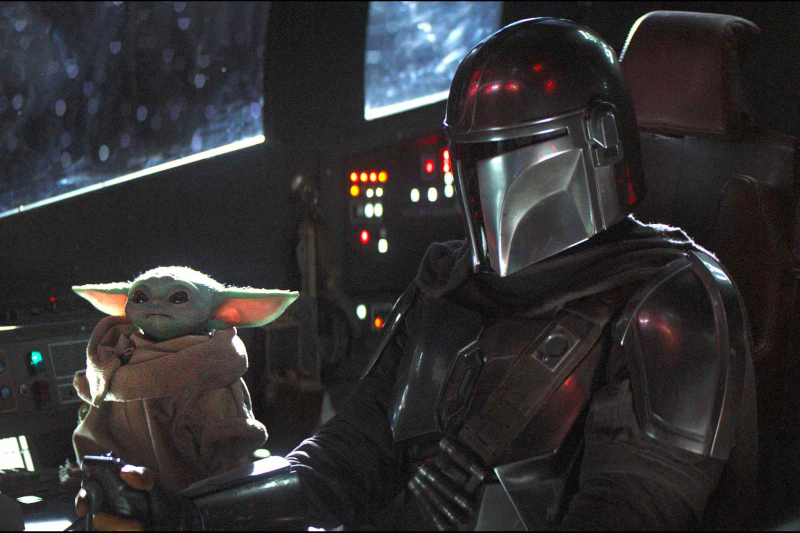
The character of the MandalorIan resembles a bounty hunter from the early Star Wars films but is, in fact, a Mandalorian warrior sworn not to remove his mask. And he has an apprentice Grogu, who is to all intents and purposes a baby version of Yoda, the character who first appeared in The Empire Strikes Back, although Grogu isn’t actually Yoda, but a different character of a later generation. For those completely new to Star Wars, Yoda was both a Jedi Master skilled in harnessing the Force and a diminutive, otherworldly creature performed by a puppeteer. Audiences immediately warmed to him. Unlike Yoda, Grogu is too young to talk (although he does make suspiciously verbal sounding utterances from time to time) and you might think he would be unbearably cute and make the film difficult to watch. But he isn’t, not at all.

When franchise creator George Lucas still owned Lucasfilm, Star Wars: Episode I – The Phantom Menace, George Lucas, 1999 introduced the irritating, kiddie-oriented character of Jar Jar Binks, widely regarded as an error of judgement. The Mandalorian TV series and the current film have both been made under the ownership of Disney, who acquired Lucasfilm in 2012.
Yet Grogu, the brainchild of The Mandalorian series creator Jon Favreau, genuinely engages you. For one thing, Grogu is very much part of a duo, like the universally loved robots R2D2 and C3P0. Grogu tags along behind the Mandalorian like a small child. He has an instantly likeable walk as he bobs along. The Mandalorian is the seasoned adventurer able to handle any situation, the action hero; Grogu is the toddler who must constantly be told to put on his seat belt and never to touch the buttons on the cockpit’s control panel. In the scene where Grogu is required to rescue the Mandalorian by flying his spaceship, he immediately flips the safety catch on the ship’s weaponry and starts firing and blowing things up where he’s supposed to be operating something else. “There’s a reason those buttons have safety catches,” Pedro Pascal’s voice tells him.

Where the character of Grogu as created on the screen is essentially a puppet, that of the Mandalorian is a man in a costume who never takes off his helmet. Or rather, three men: Favreau shrewdly casts the character with three performers. Pedro Pascal (from Materialists, Celine Song, 2025; The Wild Robot, Chris Sanders, 2024; The Last of Us, TV series, 2023- ; The Mandalorian, TV series, 2019-23) speaks the lines and performs the character, while performer Brendan Wayne (from The Mandalorian; Cowboys and Aliens, Jon Favreau, 2011; Red Dead Redemption, video game, Christian Cantamessa, 2010) moves about giving the character a Western-style swagger and Lateef Crowder (from The Mandalorian; Wonder Woman, Patty Jenkins, 2017; Fast and Furious 7, James Wan, 2015; Warrior King, Prachya Pinkaew, 2005) does all the stunt work in the many action and fight sequences. It sounds an odd way of doing things, but you aren’t aware of the trick on the screen and it proves highly effective.
As for the plot, the Mandalorian is an independent contractor who to all intents and purposes is working for the New Republic, the interplanetary society that has taken over the galaxy for the greater good following the fall of the Empire in Return of the Jedi (Richard Marquand, 1983). He is hired by the New Republic’s Colonel Ward (Sigourney Weaver from the Alien and Avatar franchises) to rescue Rotta, a young member of the Hutt dynasty (you may remember the villainous Jabba the Hutt from Return of the Jedi), who has been kidnapped. Although the Hutt twins, who have taken over their late father’s crime syndicate, are an unsavoury pair, they are supplying the New Republic with useful intel so Colonel Ward wants to keep in their good books. So she sends the Mandalorian, Grogu in tow, to fulfil their request to secure Rotta’s return.

The Mandalorian and Grogu touch down on the planet Shakari and head to a metropolis which looks and feels much like New York where the Mandalorian starts asking questions of a food vendor, a four-armed, motormouthed monkey (voice: Martin Scorsese, director of Killers of the Flower Moon, 2023; Silence, 2016; The Wolf of Wall Street, 2013; Goodfellas, 1990; Taxi Driver, 1976; Mean Streets, 1973) who directs his attention to a nearby billboard where Rotta the Hutt (voice; Jeremy Allen White from Springsteen: Deliver Me From Evil, Scott Cooper, 2025; The Iron Claw, Sean Durkin, 2023; The Bear, TV series, 2022-26 ; Shameless, TV series, 2011-21) has become a star of arena fights thanks to promoter Janu. A visit to Janu (Jonny Coyne from The Mandalorian; Ma Rainey’s Black Bottom, George C. Wolfe, 2020; Preacher, TV series, 2018) – and a fight with Janu’s minions in an anteroom – provides evidence that Janu isn’t going to part with his new protégé willingly.
A chat with Rotta in his cell reveals that far from considering himself kidnapped, the young Hutt relishes his new found fame as an fighter celeb and is looking forward to freedom after his upcoming, final match. He is unaware of the situation that the Mandalorian has uncovered: namely, that Rotta’s last match really will be his last since Janu will have him killed by unleashing every fighter he possibly can at the young Hutt, one after another, until one of them kills him in the arena.
Moreover, Janu has a hidden past, while the Hutt twins may not be all that they appear…

I have been gripped by the plots of some of the previous Star Wars films, but if I’m honest, the plot here isn’t one of this film’s strengths, which lie elsewhere. For one thing, the spaceships are fantastic – possibly more fascinating to look at than in any other big screen Star Wars outing. For another, if some of the characters border on cute, none of them do so in an irritating way. There’s yet another ending where someone must drop a bomb into the exact spot on the enemy base to blow it up, but at least this time the enemy base is a huge outcrop in the middle of a jungle rather than the usual sphere in outer space.

Some of the best things here are the numerous giant monsters – lots of them! – including a couple of stop-frame animation efforts that can be chalked up to Phil Tippett (Mad God, 2021 and the stop-frame animation genius behind Jurassic Park, Steven Spielberg, 1993; Starship Troopers, 1997; Robocop, 1987, both for Paul Verhoeven; The Empire Strikes Back. Irvin Kershner, 1980) and a giant water dragon in an underground well pit – which gets a great introduction that reminded me of the waste disposal area sequence in the original Star Wars (1977) where there’s something in the water but you don’t know what it is) – a mountainside opening recalling the snowbound battles of the first half hour of The Empire Strikes Back – although, why would anyone with half a brain deploy Imperial Walkers on a mountainside pass where if they fall they are going to fall off the path and down the mountainside… I mean, seriously…?

– and a whole sequence where the Mandalorian is unconscious, possibly dead, and it’s up to Grogu to wordlessly nurse him back to health, hiding most of his mentor’s body in a hollowed out, horizontal, collapsed tree trunk and covering the rest with leaves and lose vegetation to conceal him from the enemy. This latter is a genuine high point, as the proceedings slow right down into a near-meditative state and we have nothing better to do than watch Grogu go about his business. Which is fine by me.
The other high point, already mentioned, is the use of Scorsese as a voice actor. Genius.
The whole is shot with the IMAX format in mind – it was shown to UK press at the BFI Waterloo IMAX, where it looked great – so try and see it on a decent IMAX screen if you want to see it. If you watch it in a regular cinema – or (in due course) at home, or, worse still (God forbid) on a smartphone, it isn’t going to work anything like as well.
Star Wars: The MandalorIan and Grogu is out in IMAX cinemas in the UK on Friday, May 22nd.
Trailer: