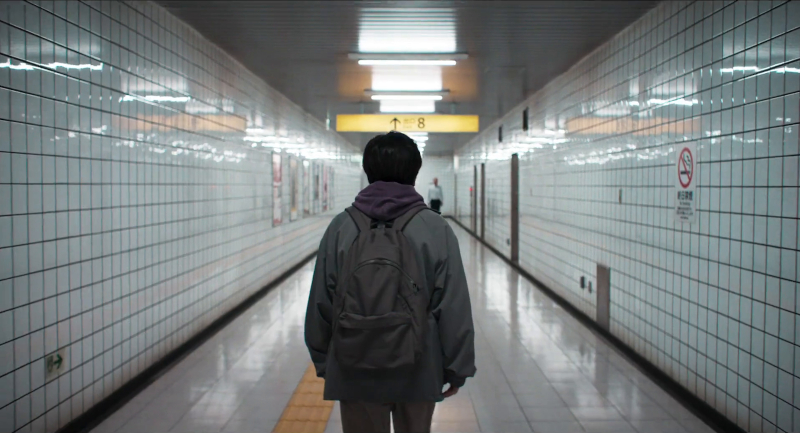
Exit 8 (Hachiban Deguchi, 8番出口)
Director – Genki Kawamura – 2025 – Japan – Cert. 15 – 95m
*****
A commuter tries to leave the Tokyo Underground but finds himself retracing his steps within a repeating system from which there is no exit – out on digital Monday, June 8th and Blu-ray Monday, June 29th in the UK and Ireland
A packed carriage on the Tokyo Underground. A commuter (Kazunari Ninomiya from Letters from Iwo Jima, Clint Eastwood, 2006), heading to his first day at a new job, can’t help but notice a young mother whose baby is crying. This is not a situation anyone likes to find themselves in, least of all the young mother. One male passenger takes it upon himself to berate and belittle the woman for selfishly allowing her child to make a noise in such a crowded, public space, inconveniencing everyone present. On one level, is he simply voicing what everyone else in the carriage is thinking? On another, is he completely out of order? After all, the mother is not the child making the noise, and she is doing her best to calm it. The irate passenger is clearly not helping the situation.
Perhaps someone should intervene and tell the man to leave the woman alone. The longer this carries on, the more obvious this course of action seems the correct one, but, equally, the longer the man carries on his tirade against the mother without anyone standing up to him and telling him to stop, the harder it is for anyone to do so.

And then the commuter gets the phone call from his ex-girlfriend, telling him she’s pregnant and asking his advice. As he gets off the train, his world is reduced from the wider world of the subway carriage with the man arguing with the mother and her baby to his handset as he walks and tries to engage on the device with his ex. As in the carriage, he doesn’t really know what to do. He was thrown by the argument in the carriage, which was arguably nothing to do with him, although he could have intervened and (hopefully) stopped the man’s abusive behaviour, and now he is thrown by the situation with his pregnant ex, which without any shade of doubt has everything to do with him.
While this is going on, he scrolls through social media on his device. Among other things, he sees disturbing videos of white mice or possibly rats onto which have been grafted human organs, such as an ear.
Eventually, he ends the call. He puts his device away and looks up. He doesn’t know this particular stop and is an unknown passageway. However, as he tries to make his way out, the same corridors and people in them start repeatedly appearing, as if on a loop.

On one section, a smartly-dressed man (Yamato Kochi) wearing a pressed white shirt and carrying a briefcase comes round the corner and advances purposefully towards and wordlessly passes him. Our commuter keeps turning a corner and this smart briefcase man keeps turning up. Later, our commuter runs into a small boy (Naru Asanuma) who appears to be lost. He also encounters a high school girl (Kotone Hanase), who taunts him, and a woman (Nana Komatsu from Samurai Marathon, Bernard Rose, 2019; It Comes, Tetsuya Nakashima, 2018; Silence, Martin Scorsese, 2016), both of whom are onscreen less than the briefcase man or the small boy. Much of the proceedings are shown from the perspective of the commuter, although a whole section switches to that of the briefcase man, while the boy might just be the key that helps the commuter escape from his looping, repeating labyrinth.
Meanwhile, there are rules to follow in order to reach Exit 8 and leave, otherwise the commuter is simply sent back to Exit 0 and has to start all over again. A set of instructions on a wall helpfully advises the reader to watch out for anomalies, so as he passes them, the commuter starts checking things like a pile of rubbish or the five posters on one of the walls, or the series of locked doors.

This plays out like a video game, and it’s no surprise that the whole thing is adapted from one. What is surprising is that the narrative sustains over the 90+ minutes running length so that you’re never bored and constantly kept guessing in the manner of a suspense thriller. Also, this review is written after only a single viewing of the movie – but it’s a movie to which you might well go back and watch it again in an attempt to spot any anomalies that the commuter might have missed, and see if you can work out where, when and how many separate times he goes wrong.
What are the anomalies? Some of them are quite subtle (a door handle that turns and allows a door to be opened that previously didn’t), some of them are things he misses (like a sign he passes warning “turn back” when it didn’t before). Others are much more extreme – and indeed silly – blood dripping down walls, the lights going out, the appearance of the mutated lab mice seen earlier on the video, an oncoming deluge of water flooding the corridor tunnel. However these latter tropes don’t occur until the final reel, by which time you’re well and truly engaged in the characters’ dire circumstances, and they build effectively on the situation.

Eventually, the commuter teams up with the boy, perhaps out of a mixture of a desire to help the child and guilt at having himself unintentionally fathered a child. And there’s an ending which suggests that perhaps the commuter is now ready to confront both the man harassing the mother in the carriage and his own responsibilities as a father. Or perhaps he isn’t – it’s all open to interpretation.
One of the posters is for an Escher exhibition, employing the artist’s famous Möbius Strip II (Red Ants) in which ants traverse a Möbius Strip, a one-sided object that folds back on itself causing the ants to continue their journey in perpetuity with no end in sight, the perfect metaphor for what seems to be happening to the commuter, the briefcase man and the boy.

You might think this is a horror film, or a suspense thriller, but I’m not quite sure that’s exactly what it is. Perhaps it would be better described as a mystery thriller. It’s certainly an adaptation of a video game, but perhaps it’s closer to a meditation on relationships, fatherhood, society and technology. Whatever it is, it’ll have you gripped from start to finish. Highly recommended.
Director Kawamura has extensive credits as the producer of, among others, The Colors Within, Naoko Yamada, 2024; Monster, Hirokazu Kore-eda, 2023; The Makanai: Cooking for the Maiko House, TV series, Hirokazu Kore-eda and others, 2023; Suzume, Makoto Shinkai, 2022; Belle, Mamoru Hosoda, 2021; Detective Chinatown 3, Chen Sicheng, 2021; Weathering With You, Makoto Shinkai, 2019; Mirai, Mamoru Hosoda, 2018; Fireworks, Yukihiro Miyamoto, 2017; Your Name, Makoto Shinkai, 2016; The Boy and the Beast, Mamoru Hosoda, 2017; Wolf Children, Mamoru Hosoda, 2012; Villain / Akunin, Lee Sang-il, 2010; and Confessions, Tetsuya Naskashima, 2010.
Exit 8 is out on digital Monday, June 8th and Blu-ray Monday, June 29th following its release in cinemas in the UK and Ireland on Friday, April 24th.
Trailer: