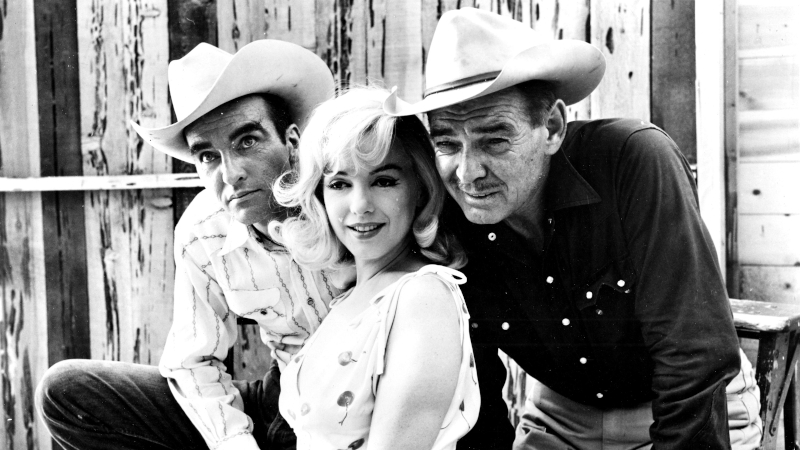
The Misfits
Director – John Huston – 1961 – UK – Cert. – 125m
****
As the Old West fades, a woman tries to navigate the men who appear to be dying with it in the final film of both Marilyn Monroe and Clark Gable – back out in UK cinemas on Friday, June 5th; the season Marilyn Monroe: Self Made Star plays BFI Southbank throughout June and July
Reno, Nevada. Local resident Isabelle (Thelma Ritter from Rear Window, Alfred Hitchcock, 1954; Pickup on South Street, Sam Fuller, 1953; All About Eve, Joseph L. Mankiewicz, 1950) meets garage tow truck driver Guido (Eli Wallach from The Good, The Bad and the Ugly, Sergio Leone, 1966; The Magnificent Seven, John Sturges, 1961; Baby Doll, Elia Kazan, 1956) as he inspects the damage to the car of Roslyn (Marilyn Monroe) who claims, from an upstairs window, that it was caused by men bumping into her vehicle to get her attention.
The worldly Isabelle attempts to coach the hapless Roslyn as to what to say in the divorce court, a service Isabelle would appear to have performed for previous house guests. Following the hearing, and a brief encounter with Roslyn’s ex Raymond (Kevin McCarthy from Invasion of the Body Snatchers, Don Siegel, 1956), the two women head out to a cocktail lounge to celebrate.

Ahead of them at the venue, Guido confides in pal Gaylord (Clark Gable from Gone with the Wind, Victor Fleming, 1939; It Happened One Night, Frank Capra 1934) about Roslyn, who has clearly had something of an impact on him. Gaylord strikes up a conversation with Roslyn unaware she’s the woman Guido has mentioned. They are getting along swimmingly when Guido suggests they join the men at the out of town house he was in the process of building for his late wife before she died.
They go to Guido’s for a tour of the house, where records are danced to and much alcohol is consumed. That night, Gaylord drives Roslyn home.

Having moved in together, Roslyn and Gaylord finish off building, decorating and furnishing Guido’s house in a manner which meets with his approval when he and Isabelle visit. Gaylord suggests they head out to round up the 15 mustangs that have been spotted in the hills.
They visit a rodeo where they pick up Gaylord’s old friend Perce (Montgomery Clift from Judgement at Nuremberg, Stanley Kramer, 1961; From Here to Eternity, Fred Zinnemann, 1953; A Place in the Sun, George Stevens, 1951) who agrees to join them for the mustang hunt. At the rodeo, Perce competes in several bucking bronco rides despite sustaining injuries.

To corral the mustangs, Guido flies ahead with his plane to drive the horses in the direction of Gaylord and Perce, who are waiting in their trucks to lasso the animals, which turn out to number around half a dozen…
Throughout all this, a noticeable rift has been growing between Roslyn and the male culture of Gaylord and his friends. Setting up house and garden, she objects to his suggestion of shooting the rabbits that have been eating the garden’s lettuces.
At the rodeo, she is appalled to learn that the horses are encouraged to buck harder by the attachment of a flank strap. And hunting the mustangs, she is further disillusioned to learn that they are not to be sold for ownership and riding as she had assumed, but rather for horse meat of the kind found in dog food, which she opposes…

In a screenplay adapted by her husband Arthur Miller, Monroe convinces as a fragile and naive woman. Gable is suitably charming and worldly as the cowboy in the dying Old West, while Eli Wallach proves increasingly likeable as a regular, widower Joe and Clift, who only appears part-way though, terrific as the rodeo rider past his prime. Miller’s script, although it meanders somewhat for its first two thirds, delivers a compelling portrait of the Wild West which is dying out in the face of modern America (as it was in 1961).
It’s a Western in which the Wild West has given way to urban sprawl, its social model collapsing like the marriages of Rosalyn and Guido and the rodeo career of Perce. When the characters are in the city, there’s a sense of the excitement of modern life, even though it seems to wreck their lives; when the are outside Reno in the desert, there’s a sense of unreality as if they were trying to reclaim a past that no longer exists as national culture has moved on.

By far the most effective section of the movie is the mustang chase and lassoing sequence, and its aftermath, when the characters, even though they are driving trucks rather than horses, seem to achieve a certain authenticity as they rope their quarry. They should perhaps be on horseback, yet we’ve already seen Perce do this in a scene where, enclosed in the safe space of a rodeo ring, horse-riding is effectively reduced to a museum exhibit from an earlier time, so that’s not really a option. And because of Roslyn’s objections, the whole thing doesn’t work out for the male characters anyway.
Visually, this sequence sees cinematographer Russell Metty (Columbo, TV series, directors include Steven Spielberg, 1972; Spartacus, Stanley Kubrick, 1960; All That Heaven Allows, 1959; Written on the Wind, 1956; both Douglas Sirk; Touch of Evil, 1958; The Stranger, 1946, both Orson Welles) come into his own more than in the earlier parts of the picture, while the whole is beautifully paced by editor George Tomasini, who worked on Hitchcock’s output from Rear Window, 1954 to Marnie, 1964, the year he died, not to mention Cape Fear, J. Lee Thompson, 1962.

Strangely, it was Gable’s final film, marking the end of a long and illustrious career, as he died within 12 days of shooting what is arguably his finest performance as the cowboy who seems to be living about fifty years beyond his sell-by date. Monroe, too, would never appear onscreen again: she lasted another 18 months. By all accounts, she was in a bad way mentally during the shoot thanks to drink and prescription drugs, arriving an hour late on set and at one point taking two weeks off for rehabilitation in hospital. And yet, on the screen, her portrait of a fragile woman completely out of her depth is remarkable.
Clift lasted longer, but he was gone by 1966: like Gable, he is terrific as a cowboy out of time. Further down the cast list, Ritter and Wallach are predictably watchable, and as a bonus there’s a wonderful (if brief) turn from Estelle Winwood (from The Producers, Mel Brooks, 1967; Darby O’Gill and the Little People, Robert Stevenson, 1959) as a lady collecting money for the local church in a bar scene.
The Misfits is out in cinemas in the UK on Friday, June 5th.
A major two-month season this summer celebrating the centenary of the birth of cinema’s most enduring film star, Marilyn Monroe. Marilyn Monroe: Self Made Star, opens at BFI Southbank on Monday, June 1st, coinciding with Monroe’s 100th birthday, and runs throughout June and July 2026.
Trailer:
Season Trailer: