Leonora in the Morning Light (Leonora im Morgenlicht)
Directors – Thor Klein, Lena Vurma – 2025 – Germany, Romania, Mexico, UK – Cert. 15 – 103m
**
In Mexico, France, Spain and the England of her childhood, Surrealist painter Leonora Carrington must confront her personal demons – out in UK and Ireland cinemas on Friday, May 29th
Deserted hillsides, a sliver of a road, eventually a tiny red car moving along it, to the accompaniment of a pulsating electronic score suggesting the present day. Another stretch of road: the car drops off the woman, in stylish trousers and blouse, who smokes observing the landscape. The driver gets out to photograph her, much to her displeasure, but he’s run out of film.
An illustrated title card: Death. Xilitla, Mexico, 1951. The man takes her to the rooming house of Edward (Ryan Gage), leaving her as he promises to look after their son. Outside the window, she can hear the two men discuss all that has happened to her. Her madness.

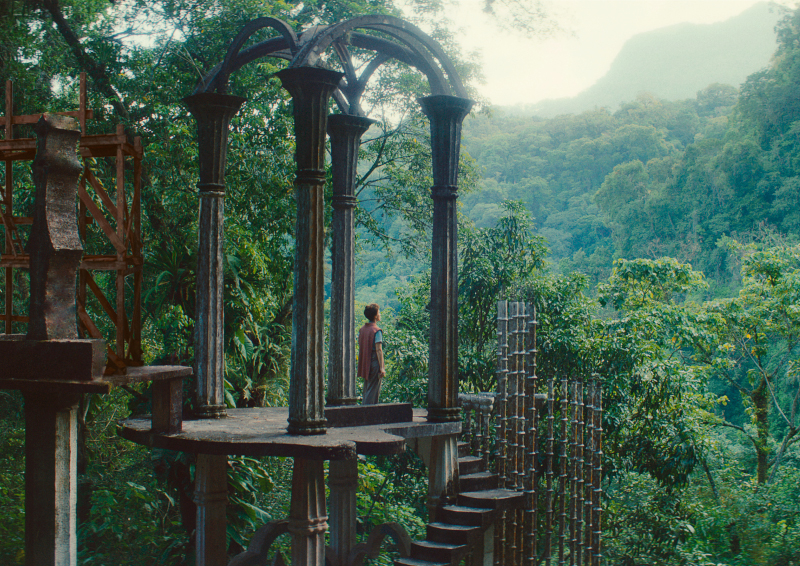
She and Edward are riding with others in the back of a lorry on a road. In Spanish, she asks a woman on the lorry (Yasmira Escárrega) about her amulet – “a sacred stone that illuminated the path through the underworld”. At Las Pozas Gardens, Edward reveals his intention to build the Garden of Eden on Earth, introducing Leonora Carrington (Olivia Vinall), for it is she, to the works foreman. Looking out over the jungle paradise from a viewing platform, she suggests the gates of hell are close to those of heaven. Alone she explores, observing a spider’s web. She climbs a staircase to another viewing platform…
More illustrated title cards break up the narrative whole. The Horse presages scenes in Paris, 1938. The Hyena – a hyena wearing an actor’s mask – scenes in Santander, Spain, 1940 and a flashback to Leonora’s childhood and her troublesome relationship with her father. And, finally, The Alchemical Kitchen, which looks to be the point the budget ran out because unreadable yellow titles against a cream wall background tell us about Leonora’s significance in art history. Or rather, they would if only we could read it. And then, the credits roll.

A couple of detail shots show Leonora’s hand sketching a horse on different occasions, but this gets to be more than a little irritating because the production clearly hasn’t negotiated any of the rights to show the paintings, so we’re constantly wondering what her work looks like. (This also applies to a sequence where she unearths a picture by her old lover Max Ernst, but we don’t get to see it.)
The hyena, on the other hand, puts in an appearance in a couple of highly effective sequences. In one, set in Spain in 1940, Leonora, unconscious, is wheeled into a electric shock therapy session. It’s brutal. The doctor (Luis Gerardo Méndez) later accuses her of authoring her own suffering. He tries to get her to draw her journey there, to talk or draw about her family. The sound of a horse outside the window prompts a memory from childhood; her English father refusing to let her (child actor Wren Stembridge) ride with a hunt and telling her women are educated differently from men – to please. Her Irish nanny (Vivienne Soan) telling her about sprites and animal spirits which live just above the ground. Later, the young Leonora prays to the these spirits, expressing her hatred for her father.

Editing patterns conflate these childhood memories with her current treatment. She writes. She draws. The doctor wants to see. She wants to know what’s behind the locked door in his consulting room. So badly that she sneaks out of her room, goes through his desk to find the keys, and opens it. A hyena entering the drawing room where her father is giving Nanny Mary a dressing down for filling Leonora’s head with tales of animal spirits. Offscreen, he attempts to shoot the hyena, which in the continued, unbroken take returns to the drawing room where, mostly hidden from us by furniture, the hyena savages him. Her delirium continues; a week later the hospital releases her.
The overall narrative starts off promisingly enough with the build up to Leonora ascending the Garden of Eden viewing platform at Xilitla, the image which quite understandably appears to be the one used to promote the film. That, coupled with the opening minutes, suggests acres of sprawling landscape, but the film never really delivers on that scale, giving us instead fairly confined spaces – a small section of a lake and a track through fields in the South of France’s San Martin D’ardeche in 1939, a marketplace in Mexico, bland interiors and exteriors from the gothic-inspired Victorian home Leonora’s childhood.

A Surrealist gathering in Paris, 1938 includes Dali (Cat Jugravu), André Breton (Denis Eyrley) and Peggy Guggenheim (Mercedes Bahleda), but nothing much is made of them. Leonora is taken along by lover Max, rarely referred to by his surname Ernst (Alexander Scheer), and the couple have a lot of scenes talking about big issues like death. Much is made of Leonora’s friendship with Remedios Varo (Cassandra Ciangherotti), who subsequently gets Leonora (but not herself) across the Franco-Spanish border when the Germans enter France in 1940 shortly after Max is arrested by gendarmes as a German alien. Remedios comes back into Leonora’s life in Mexico where she is a mural painter.

The non-linear narrative chops and changes between its several geographical locations in different times, possibly as a result of moving great slabs of the film around relative to others in the editing process. This might have worked, but for this viewer, it didn’t, making for an immensely frustrating viewing experience.
If Vinall makes a terribly po-faced Carrington, there’s also an extremely watchable quality to her. That’s just as well, since the piece comes from the school of writing / directing which assumes you know who (historically factual) characters are, so there’s no need to name them. That might work for anyone with a strong working knowledge of the characters concerned, but for the vast majority of audience members, this really isn’t good enough. Most people with a working knowledge of art history can probably work out that Max is Max Ernst, the surrealist painter with whom Leonora Carrington lived for a number of years in the South of France, but it’s never clear, for example, exactly who her female companion over the years Remedios Varo is, or who Edward (James) is, or that her partner later in Mexico, photographer Chiki Weisz is a Holocaust survivor.
All in all, this muddled effort, which has so much potential, is something of a disappointment. It’s adapted by the co-directors from Elena Poniatowska’s novel Leonora.
Note; Surrealist painter Leonora Carrington is a different artist from Bloomsbury set artist Dora Carrington, the subject of Carrington (Christopher Hampton, 1995).
Leonora in the Morning Light is out in cinemas in the UK and Ireland on Friday, May 29th.
Trailer: