The Czech Year (Špalíček)
Director – Jiří Trnka – 1947 – Czechoslovakia – Cert. PG – 80m
*****
A celebration of Czech peasant life, with a striking Christian element – on the Blu-ray Jiří Trnka: Puppet Master, released in the UK on Monday, August 10th
Originally made as a series of short films which were subsequently edited into a feature, a similar strategy later adopted by fellow countryman Jan Švankmajer making Alice (1988), this opens (after a static title sequence) with a song about musicians wondering how they can afford a dulcimer. There’s a feeling of community among a villagers’ marching band comprising double bass, clarinet, serpent and horn, who are joined for processions and dances by assorted villagers. As the song ends, they are scattered but not dispersed by a death-like scarecrow figure on a cart.
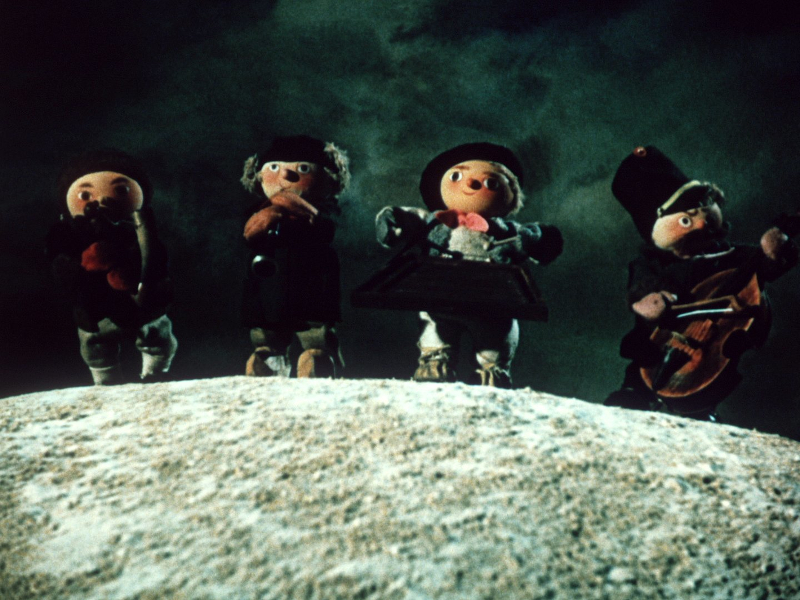
A bear who has joined in their revelry is revealed as an actor whose bear mask has come off and been lost when he has fallen in a freezing stream (it has ice on top), and the season of winter is introduced by a pan along a model backdrop which appears to be painted on layers of glass. There are precedents for this technique, whether you look at Disney’s 2D animation experiments with the many glass levels of the multiplane camera used to achieve the illusion of depth on, for example, Fantasia (1940) or those of special effects animator Willis O’Brien who for such works as The Lost World (Harry O. Hoyt, 1925) and King Kong (Ernest Schoedsack, Merian C. Cooper, 1933) crafted miniature 3D sets in which to film stop-motion puppet dinosaurs.
Trnka’s background was in illustration – he illustrated some 130 or so books – and unlike O’Brien, he’s not striving for naturalism so much as for an illustrative quality – his brushstrokes and painterly detail read as such, rather than pretending to be real hills or trees.
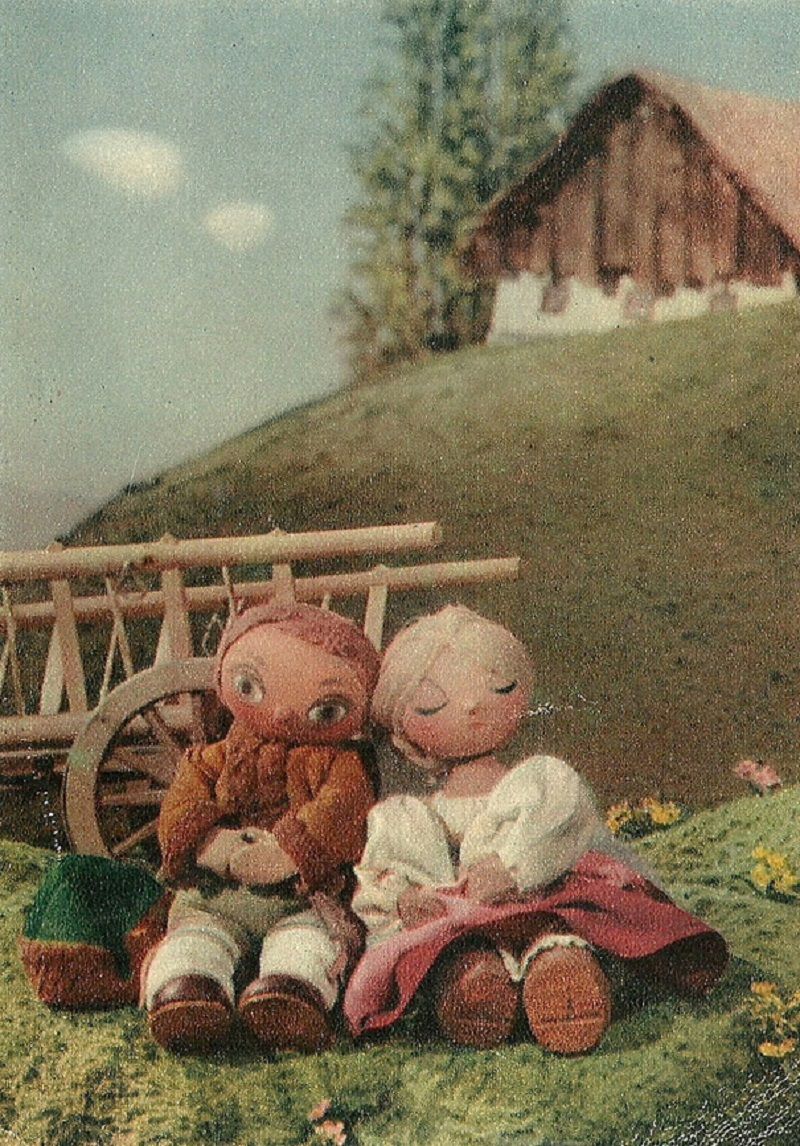
This gives way to a duck flying in the sky (a puppet mounted on either a background or non-reflecting glass to that it appears to fly) as young men and women call out to one another across the rural landscape and a duck and her ducklings come out and make their way to a stream. Inspired by a bird singing in a tree, a young man carves a flute from its wood with which he sings that he hopes to make a pleasing sound. Trnka’s puppets and sets create a strange world all of their own. One can imagine the young David Lynch (a painter turned stop-frame animator turned live action director) seeing this and and being inspired to film the obviously fake Robin singing at the resolution of Blue Velvet (1986).
A sequence of peasants caught in a storm has foliage blown by (a) wind (machine) mixed in with its miniature animated figures to help create its illusion, augmented in places by diagonals painted on foreground glass to conjure torrential rain. The weather turns to calm with a song about Adam being put in the Garden of Eden to look after it, peaceful images marred by the presence of a black serpent scurrying out of sight behind a rock, presumably up to no good.
Adam, accompanied by a deer, lives in a cave made up of strange, diagonal rock formations which resemble quartz and echo the diagonal rain earlier. He dutifully tills the soil, but then (mixing the character up with Jesus in the wilderness) finds himself tempted by the Devil. A mounted huntsman appears to chase the deer, but in the end relents from shooting it with his bow and arrow.
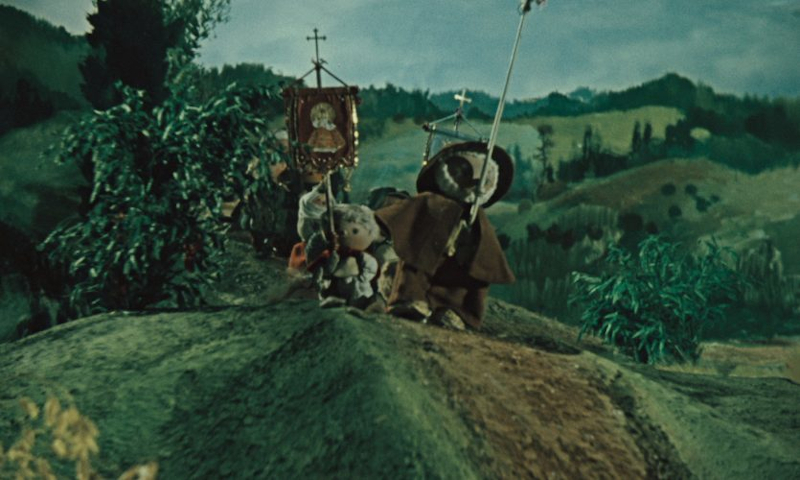
The scene switches again to an obviously Christian church procession, in which a man proclaims the message of Salvation – “you are being granted ample mercy”– as the musicians and dancers follow his lead. We are in the world of ritualised church worship, and I find it difficult to imagine a filmmaker shooting a scene like this unless they themselves had experienced something similar – it feels like an insider’s perspective, someone making art about something the know intimately and of which they have considerable experience and understanding.
“Grant us your mercy, oh God!”, intones the procession leader, “give blessings to our trade.” The appearance of a stranger in his rusty cart produces generous shouts from those in the procession of, “bestow bread on the needy from on high” as they approach a monument on a hill that looks vaguely like a miniature of a church building on a pedestal. A man and a woman picture one another (as tiny double exposed, inserted images) as bride and groom, another pictures a victorious game of skittles.
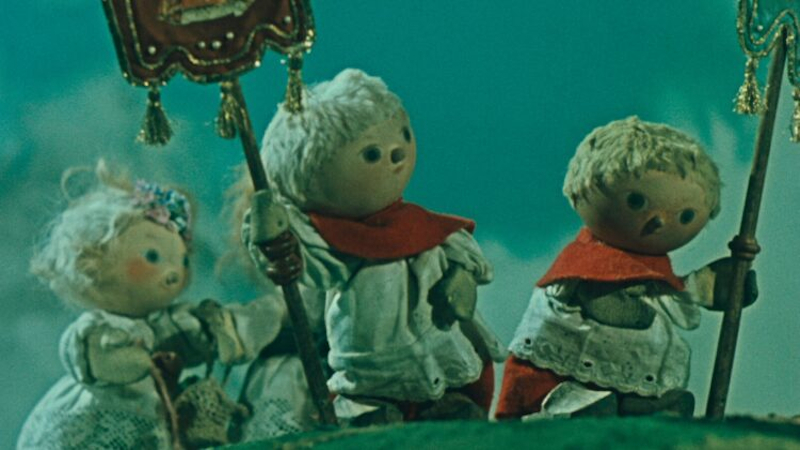
Angels appear in the Heavens playing musical instruments, given an unearthly appearance by a sort of slight double image (possibly achieved by shooting through some sort of glass). Choirboys on the ground and angelic singers echo one another, what liturgical language refers to as “the whole company of Earth and Heaven”.
The villagers watch a travelling show. A cobra (its surface beautifully assembled from small beads) slithers from its basket. An austere man – a magician, perhaps? – turns into a clown and back again. There are dire warnings of a prophecy to Christians by a blind lad. The magician turns into a jack in the box (with no box), tormenting a showman monkey. Acrobats deliver weird and wonderful spectacle; skeletons appear in various guises. There is a skittle alley, stalls selling the wares of craftspeople, fortune tellers, and a marionette show.
The next section, which includes an old lady remembering she used to have teeth and a young man enjoying his beer, focuses on a community meal. A woman remembers her partner who went off to war, the battlefield strewn with the dead; a couple dance, infatuated with one another, a man follows the image on an ethereal woman appearing before him in the sky. There is a closing, wintry sequence, in which an honoured guest is rumoured to have arrived in Bethlehem.
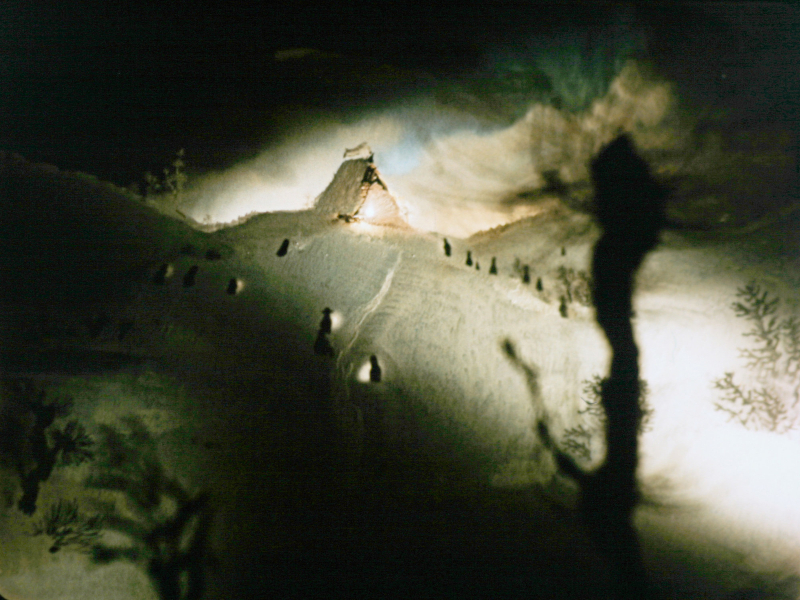
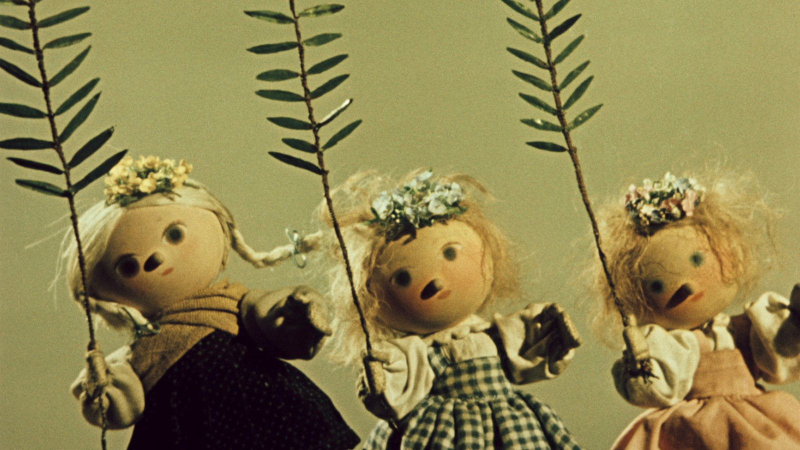
The painted faces of Trnka’s puppets never move; his genius is in the effect he achieves by facial design, staging, blocking and lighting. No-one else has ever made stop-frame cinema quite like this: numerous proponents have found ways to may eyes, nose and mouth move to give voice to their puppets’ expression, but few if any have followed Trnka’s path. You would swear that these puppets were alive!
Also remarkable, in this particular film, is the level of religious (read: Christian) expression. Even though this was made over three quarters of a century ago, anyone who is religious (such as myself) may be surprised just how deeply it affects them. Altogether an extraordinary and essential film, and not just for its innovation in the stop-frame animation medium.
The Czech Year is out on the Blu-ray Jiří Trnka: Puppet Master, released in the UK on Monday, August 10th.
Trailer: