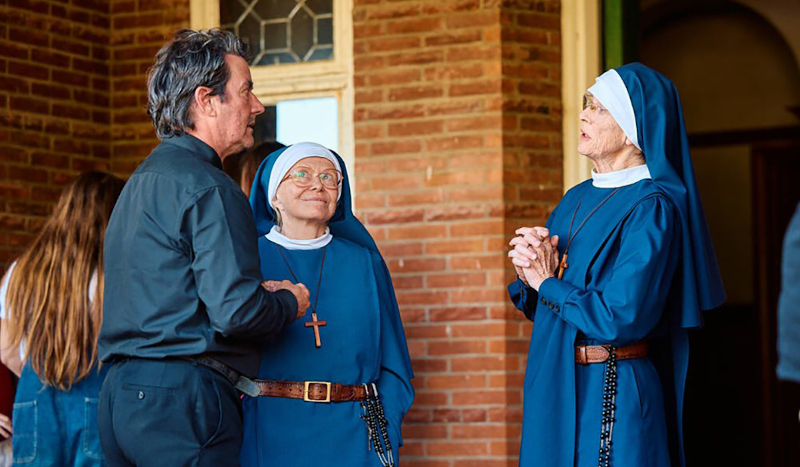
Holy Days
Director – Nat Boltt – 2026 – New Zealand, Canada – Cert. 12a – 101m
***1/2
Three ageing nuns must save their ramshackle convent from property developers and help a local Maori boy come to terms with his mum’s death and his dad’s new partner – out in UK and Ireland cinemas on Friday, Aug 14th
In a wondrously tacky stop-frame parody, giant-sized Brian rides his giant-sized bicycle through the village (cut to live action Brian played by Elijah Tomati) to explain to Sister Agnes (Judy Davis) at the door of his destination building that he’s committed blasphemery. It turns out his exact words were, “Jesus Jumping Christ”. Taking it good humouredly in her stride, she tells him to come in. And, as a penance, assigns him to clean all the upstairs floors.
As a title informs us, it’s New Zealand. 1974.
Upstairs, Sister Mary Clare (Jacki Weaver) explains that the reason for all the baby photos is that the nuns used to take them in. And shows him, thorough the window, Sister Luke’s garden. Which has seen better days. Brian says his mum loved it here. The feeling was reciprocal, apparently. Nun and boy turn floor polishing chores into improvised sports exercise gliding along the floor.
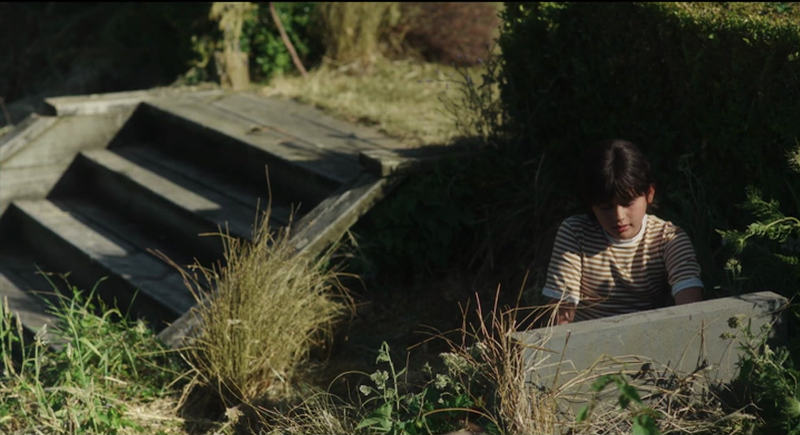
Alone, Brian talks to his mum’s grave.
Over a meal, the head nun is concerned that Brian hasn’t come to terms with his mum’s passing. Sister Luke (Miriam Margolyes), putting aside a bowl of broth into which a small chunk of ceiling plaster fell, tucks into the bigger dish at the centre of the table. Into which promptly fall her dentures.
The screenplay is adapted from the book by Joy Cowley, which apparently takes the form of a flashback, the boy’s memory of his time with the nuns. The figures of the three nuns provide director Boltt – who also appears in a minor but significant role in the cast – with the chance to furnish three veteran actresses with memorable roles.
Davis is the one in charge, trying perhaps a little too hard to be a good role model for the others. It feels like a lightweight role compared to much of her work, and yet there’s an unexpected comedic warmth to it. And she’s not quite the squeaky clean individual that she at first appears, smoking cigarettes under stress like a Hitchcock mother, and later bribing a traffic cop with a wad of notes when the nuns find themselves on a tight schedule to return home by car.
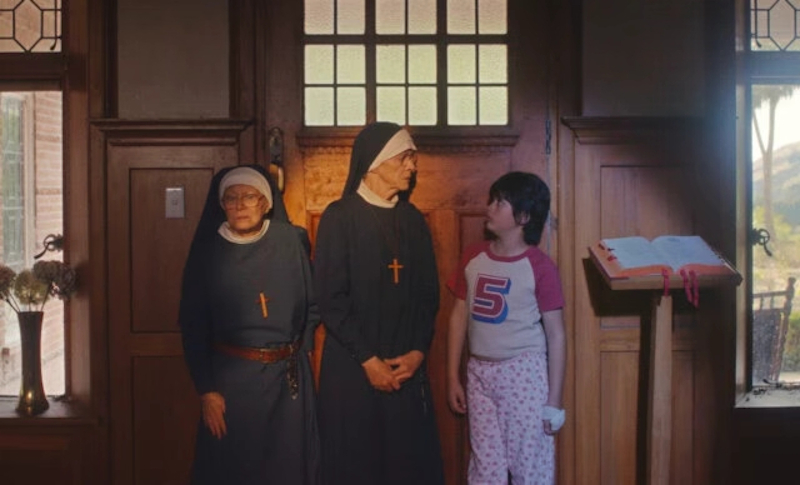
Weaver has a constant twinkle in her eye and is full of the joys of life. Again, this writer can’t recall seeing her in such a light and upbeat role.
Margolyes, playing a nun in the early stages of dementia, constantly makes inappropriate yet strangely pertinent comments. Most of them seem to be about sex. When Davis quotes an appropriate Bible verse meant as an encouragement, Margolyes responds with: “Genitals like donkeys.” Ezekiel 23: 20. (In case anyone is wondering, the quote is genuine.)
These three function as surrogate mothers to the young boy, a role that ought to be taken by his stepmother Liz (director Nat Boltt) if only Brian would give her a chance, but he’s so fixated on his late mum that she can’t get close to him. Whereas the nuns aren’t tarred with the brush of being brought in as replacements for his mum.
Surprisingly, perhaps, given the obvious Christian setup of nuns, the tale is equally happy to explore Maori ideas of the afterlife as it is Christian ones. Brian is of Maori descent, as was his mum. He purloins – but his dad lets him keep – his mum’s old snow globe which contains a little model of the mountain where she grew up. The place is apparently a stepping off point into the next life. Heaven? His dad describes it as “a better place”.

In the plot not unlike a classic Ealing comedy (although it might not feel the case for the first twenty or so minutes), Findlay is pressurised by the new bishop to approve of a plan to get the nuns off the property so a developer can realise his plans and the church make a pile of money. Their plot includes transferring Sister Luke into the Nazareth care home.
The nuns, however, have security of tenure as long as they are still living on the premises. So they decide to drive South (stealing Findlay’s car to do so) to visit former sister Patricia, who has the deeds of the place for safe keeping. She is in South Island, where Brian’s mum is from. Prompted by Brian, they resolve to go and get the deeds. Naturally, Brian wants to come.
The local priest Father Findlay (Jonny Brugh) is concerned how often Brian hangs around the nun’s house, but the head nun gets him working on things, or they would do were it not for the surprise arrival of the new bishop (John Bach). Then he escapes from his dad by bike, and the three nuns end up searching the property for him, in the course of which a second plot kicks in to send the narrative off on an altogether different direction.
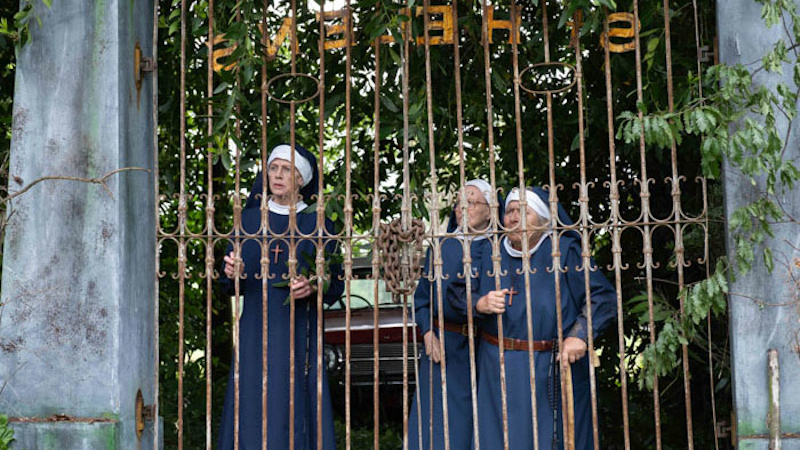
The ferry is full, but Agnes bribes the ticket man with spirit-based fruit cake. When they reach Sister Hildegarde’s place, where they were planning to stay over, it too has been sold for development. On a beach, Sister Mary Clare tells Brian about how she was taken from her mum and never even had an address to write to her.
A row when Sister Luke refuses to leave the car for a piddle results in Brian’s mum’s snow globe being dropped and broken. Nevertheless, holding it in his hand, he sees beyond it to the actual mountain modelled in the globe, now on the horizon.
They finally arrive at the home of Sister Patricia (Tanea Heke), the boy’s aunt who he remembers as Patricia of the Plum Duff Pudding.
Unaware that developer Harry Greaves is preparing to tearing down the nuns’ home, Sister Agnes explains the situation to Patricia. Brian, meanwhile, finally makes peace with Liz in his head when he sees her kind note in the luggage that she packed for him. Desperate to see his mum, he sets out on his own to the mountain as snow starts to fall. When the nuns come looking for him, he’s found by Luke when she wanders off, and it is she who protects him from the worst of the wintry weather until the others locate the pair of them.

Brian, meanwhile, has had an encounter with the spirit of his mum, wearing a big Maori cape and speaking their language, which although speaking English, he understands. In a moment of revelation, he tells her he owes someone an apology. And, she chimes in, when you owe someone an apology, you shouldn’t make them wait. The dead should stay with the dead, and the living should stay with the living, she tells him.
On the journey back, the landscape is glorious. With the others concerned that they won’t make it in time, Sister Agnes is persuaded to exceed 30 mph. Then sister Mary Clare takes over the driving. She is used to the tractor. But she turns out to be a mean driver, capable of overtaking the hippie Dormobile that almost won’t let them pass. Sister Agnes shows a new side as she bribes a traffic cop that stops them for speeding, who in turn phones the ferry to hold it so they don’t miss it.
After an animated sequence of driving on to the ferry. Brian returns home and makes up with Liz in a genuinely touching reconciliation. Meanwhile, under Sister Mary Clare’s driving, the Jesus on the dashboard wobbles violently and Sister Luke’s false teeth fly out. They reach the property where Brian’s dad prevents the developer from doing a runner and the new Bishop, still determined to demolish the deal, listens to the nuns saying they still live there, they just took a holiday. Nuns don’t take Holy Days, is his ripost.
Just when you think it’s wrapped everything up, the film is still capable of surprises, delivering a deeply touching scene which would be a spoiler to reveal. Then comes a scene of the grand opening of the done up convent with the main cast (minus the bad guys, the bishop and the developer) dancing, followed by a bonus: a minute or two of the stop frame animation (by Ty Jepsen, with miniatures by Chris Reddington) that has delightfully punctured the whole and, indeed, suggests a way that animation could be integrated into just about any live action film you can imagine to make a most welcome enhancement.
Holy Days is out in cinemas in the UK and Ireland on Friday, Aug 14th.
Trailer: