Categories
Animation Art Immersive Movies Shorts

Water Body

Water Body

Artists / Directors – Barney Steel, Ersin Han Ersin, Robin McNicholas – 2026 – UK – 25m

*****

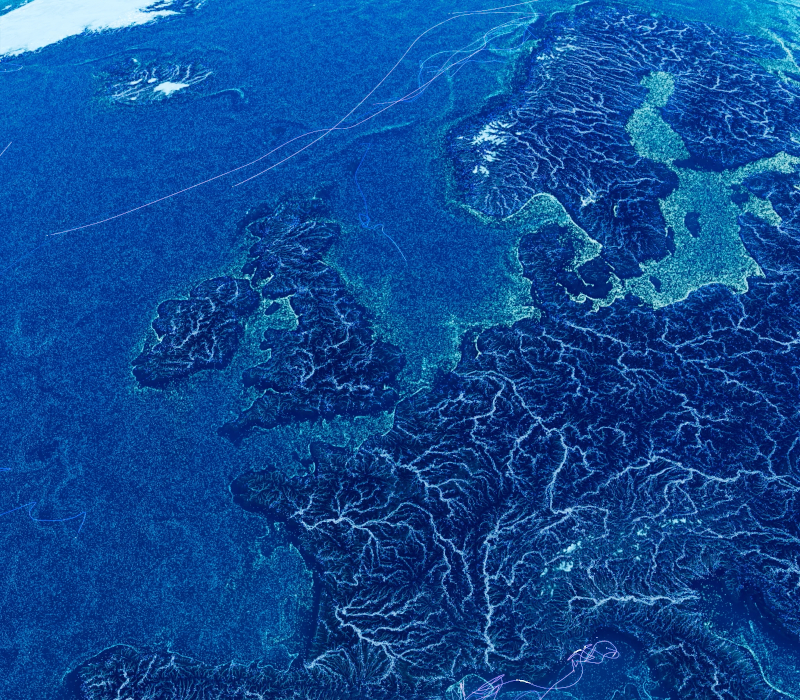
A sensory experience centred around a moving image of the Thames as part of the global water network based on data sets – installation at St. Martin-in-the-Fields crypt 12:30-21:00 hours from Saturday, October 3rd to Sunday, October 18th as part of the London Film Festival’s LFF Expanded strand

A little waiting area shows a series of hand-crafted hangings by artist Elena Landinez showing various river tributaries before you enter the experience space proper. Before entering that space, you are alerted to the fact that the experience includes a total blackout section, also that there are pottery vessels handmade by ceramicist Ludmilla Balkis inside the space for you to take containing water that was cloud some two weeks ago, from which you can drink. Seating is mostly bean bags on the floor, and a single row of conventional seating at the back.

So I’m sitting on a seat at the back – or is it the back? – not really knowing what to expect. The lights go down: total blackout. All around me, sounds. (These started, I think, before the blackout, as if little rivulets of water were running somewhere.)… Read the rest
Categories
Documentary Features Live Action Movies

London’s Last Wilderness

London’s Last Wilderness

Director – Pablo Behrens – 2026 – UK – Cert. 12a – 61m

*****

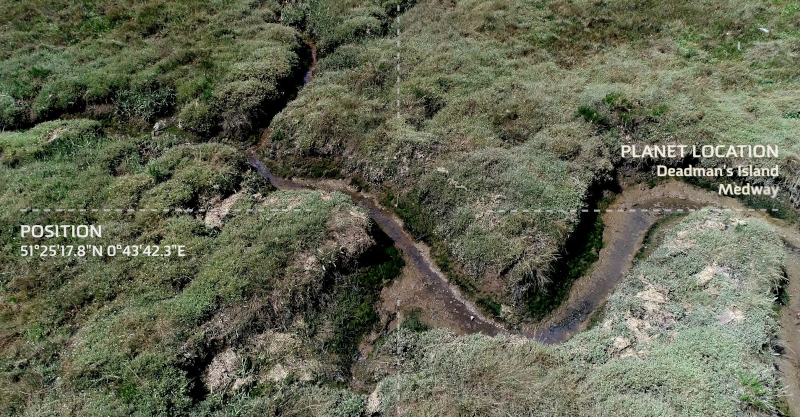
London’s Thames Estuary filmed and edited from the point of view of an alien – out in UK cinemas on Friday, April 24th

A genre bender of a documentary, this owes a great deal to Petropolis (Peter Mettler, 2009) which comprises aerial cinematography of the environmental wreck of Canada’s Alberta Tar sands. The subject of London’s Last Wilderness, however, is not an ecological catastrophe, however much its narration by intertitle might (mis)interpret it as the aftermath of a war zone. It is rather the estuary of the Thames, the river that further inland flows through London, which city puts in a brief appearance towards the end. Indeed, insofar as this has a narrative spine, it is of a journey from the largely uninhabited estuary inland to the metropolis itself.

Where Petropolis was shot largely from a helicopter by a cameraman, the results recalling nothing so much as the aerial footage that opens The Shining (Stanley Kubrick, 1980) and closes (because they bought the rights to it) Blade Runner (Ridley Scott, 1982), aerial photography has moved on considerably in the last fifteen of so years with the evolution of drones, today a major part of the filmmaker / cinematographer’s arsenal.… Read the rest

Categories
Features Live Action Movies Music

Slade in Flame

Director – Richard Loncraine – 1975 – UK – Cert. – 91m

****

Slade play Flame, a small-time rock band who cut their musical teeth managed by lowlife crooks before going on to a meteoric rise and fall managed by corporate suits – 2K Remaster for the film’s 50th Anniversary Re-release is out on UHD / Blu-ray on Monday, May 19th

In the early 1970s, four-piece pop act Slade (singer-guitarist Noddy Holder, bass player Jim Lea, guitarist Dave Hill and drummer Don Powell) were a British pop phenomenon. They clocked up six number one singles, with three going straight to the number one position. To capitalise on that success, the band’s manager Chas Chandler, previously Jim Hendrix’s manager and, before that, the bass player with The Animals, decided Slade should make a movie; the band, however, didn’t want to make light, upbeat, whimsical fantasies like The Beatles vehicles (A Hard Day’s Night, 1964; Help!, 1965, both Richard Lester; Yellow Submarine, George Dunning, 1968); they wanted instead to make something darker, reflecting the experience of trying to make it in a band in England in the late 1960s.

First-time feature director Richard Loncraine proved to be an inspired choice, confirmed both by the gritty, urban nature of his many subsequent films (The Missionary, 1982; Bellman and True, 1987; Richard III, 1995) and for his signature compositional style (letterbox frame, sepia-dominated palette), developed with cinematographer Peter Hannan (The Missionary, not to mention Monty Python’s The Meaning of Life, Terrys Gilliam and Jones, 1983).… Read the rest