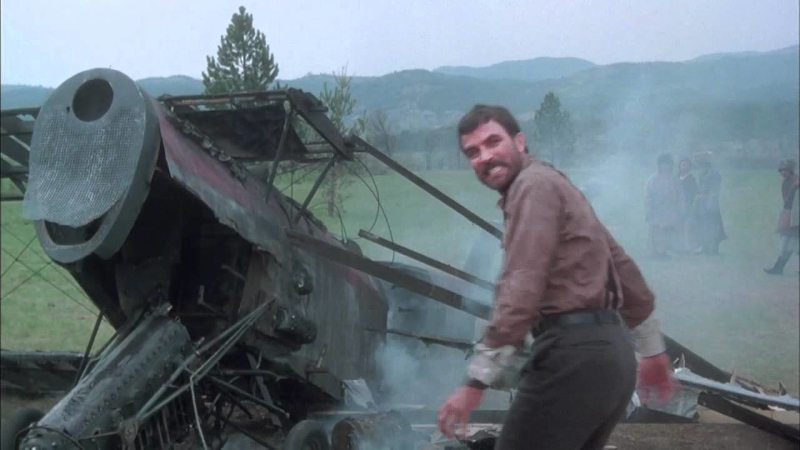
High Road to China
Director – Brian G. Hutton – 1983 – US, Yugoslavia, Hong Kong – Cert. PG – 105m
Film ***
John Barry score *****
An heiress urgently needing to find her missing father enlists the help of a biplane pilot– 1920s continent-crossing adventure is out now on Blu-ray
Set in the roaring 1920s and based on a 1977 novel by Jon Cleary (The Sundowners,The Green Helmet) which would turn out to be his last to reach the screen, this also marked the final director’s job for Hutton (Where Eagles Dare, 1968; Kelly’s Heroes, 1970; X Y and Zee, 1972). It appeared in the wake of Raiders of the Lost Ark (Steven Spielberg, 1981) but before such obvious attempts to capture the same audience as Romancing the Stone (Robert Zemeckis, 1984) or King Solomon’s Mines (J. Lee Thompson, 1985). Given it was an adaptation, perhaps it would have been made regardless. Cleary was reportedly less than happy with the final film.
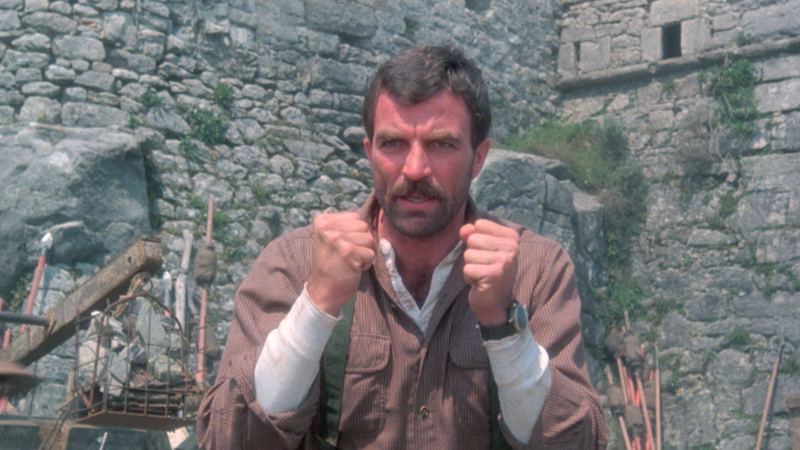
The production went through several changes of director and cast before actually being filmed. Leading man Tom Selleck had lost out to Harrison Ford for the Raiders role because the producers of Magnum P.I. (TV series, 1980-88), which made Selleck a household name, refused him permission. He plays biplane pilot O’Malley, who shot down twelve Germans in a legendary World War One dogfight. The memory still haunts him, because they were inexperienced young men called up by the Germans who never stood a chance against more skilled fighter pilots such as himself.
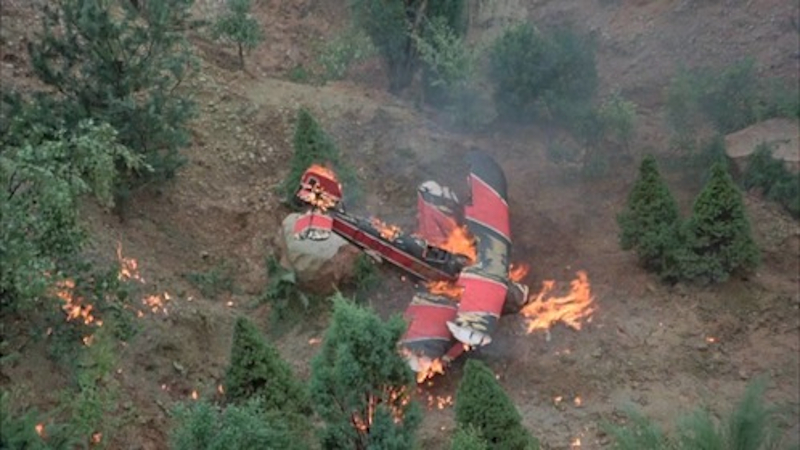
A decade later, he is drinking heavily and pursuing a number of married women. If this suggests a gritty drama, the screenplay, credited to Sandra Weintraub (story, China O’Brien, 1990) and S. Lee Pogostin, never really allows for that, preferring to deliver male-female banter and rivalry against a backdrop of spectacular, continent-spanning adventure with a good smattering of biplane aerial action thrown in for good measure.
O’Malley, although central and in need of getting out of town owing to various cuckolded husbands seeking revenge, is not the character who drives the narrative. That honour goes to Eve “Evie” Tozer (Bess Armstong from Serial Mom, John Waters, 1994; My So-Called Life, TV series, 1984-5; Jaws 3-D, Joe Alves, 1983, The Four Seasons, Alan Alda, 1981), a flapper heiress with more money than sense who suddenly learns from her father’s posh, top-hatted assistant Charlie (Michael Sheard from Grange Hill, TV series, 1985-89; The Empire Strikes Back, Irvin Kirschner, 1980) that if she can’t find her father Bradley Tozer and get him to London in the next 12 days, his company (and hence his fortune) will pass to her father’s dastardly business rival Bentik. The urgency is underscored by Charlie’s meeting a sticky end at the hand of one of Bentik’s assassins.
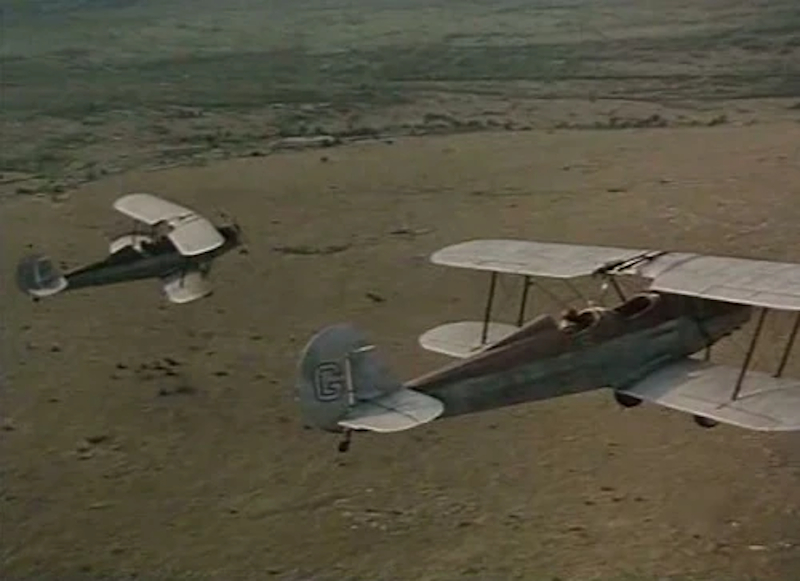
Bradley has disappeared across continents, Evie knows she’ll need a plane to find him, and her search for available pilots and aircraft leaves O’Malley as her only option. With accomplished pilot Evie flying one plane and O’Malley the other, accompanied by the latter’s trusted mechanic and partner Struts (Jack Weston from Dirty Dancing, Emile Ardolino, 1987; The Four Seasons; Cuba, Richard Lester, 1979), they stop at a British airbase in Afghanistan, the fiefdom of a despotic Khan (Brian Blessed from Henry V, Kenneth Branagh, 1989; The Black Adder, TV series, 1983; Flash Gordon, Mike Hodges, 1980; Z-Cars, TV series, 1962-78), the village of a woman who knows her father that they help escape from the Khan.
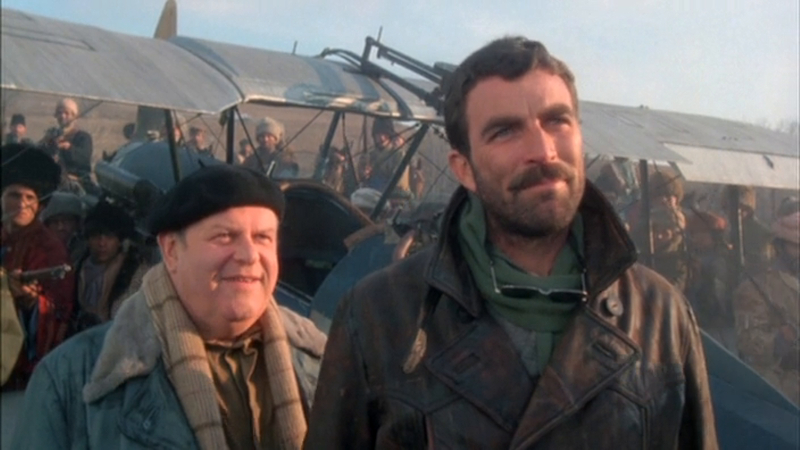
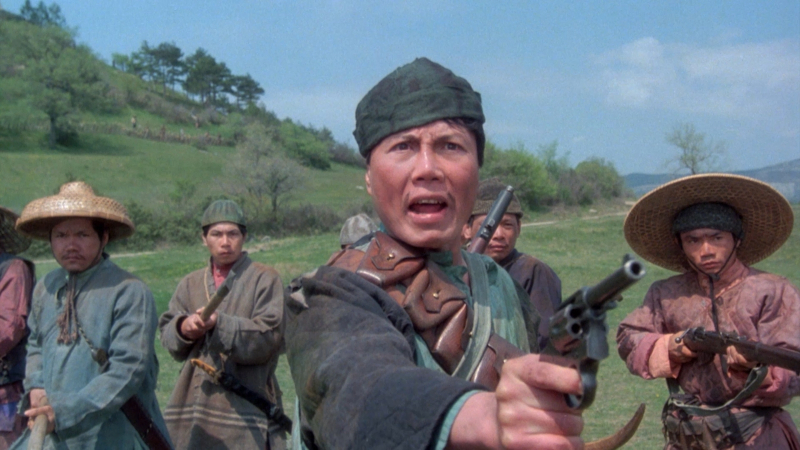
At her village, they hear news of her father from a wise old man Zura (Robert Lee from Britannia Hospital, Lindsay Anderson, 1982), do battle with the biplane of a vengeful German pilot, possibly the remnant of an earlier script draft, before finally arriving at the Chinese village where her father Bradley (Wilfred Brimley from Hard Target, John Woo, 1993; Cocoon, 1985; The Thing, John Carpenter, 1982) has assumed the mantle of much-admired local leader to defend the villagers against the local warlord.
The film works as a reasonably satisfying Sunday afternoon matinee, the sort of film that would play on British TV when this writer was a child, but you can’t help feeling it could have been so much more. Both Armstrong and Selleck are pleasant enough as leads, but imagine what this might have been with something like the screwball comedy of Cary Grant paired with Katherine Hepburn (Bringing Up Baby, Howard Hawks, 1938) or Rosalind Russell (His Girl Friday, Howard Hawks, 1940). Indeed, the first director to be associated with the project was John Huston, who directed Humphrey Bogart and Katherine Hepburn in jungle adventure The African Queen (1951), and one can only imagine what he might have done with it. Spielberg’s Raiders did a lot more with male-female banter, an element which contributed significantly to its charm.
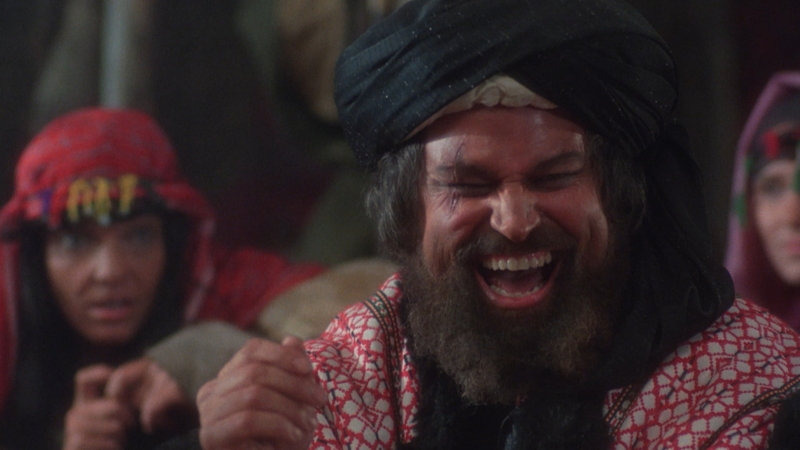
Further down the cast list, Jack Weston is given little to do as Selleck’s sidekick, and Brian Blessed seems for too enthusiastic (and white, ethnic British!) as the Khan, but some of the other bit-part performers fare better. The film periodically cuts to Robert Morley (from Who is Killing the Great Chefs of Europe, Ted Kotcheff, 1978; Those Magnificent Men in Their Flying Machines, Ken Annakin, 1965; The African Queen; The Small Back Room, Michael Powell, Emeric Pressburger, 1949) as Bentik, a thoroughly nasty type too rich and privileged to ever do his own dirty work and a superb comic portrayal of a villain by Morley. Michael Sheard’s role as Evie’s minder is intriguing if short-lived. Chinese-born British character actor Robert Lee holds up well as an Oriental village elder, as does Wilfred Brimley as Evie’s father when the narrative eventually delivers him.
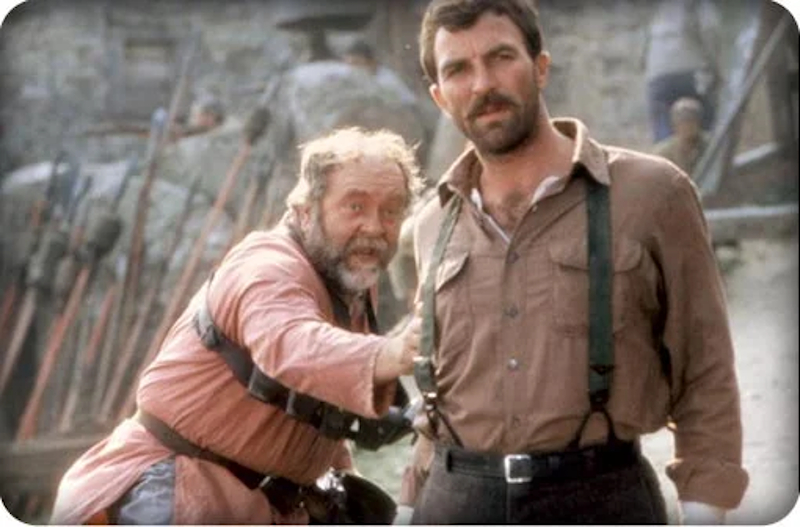
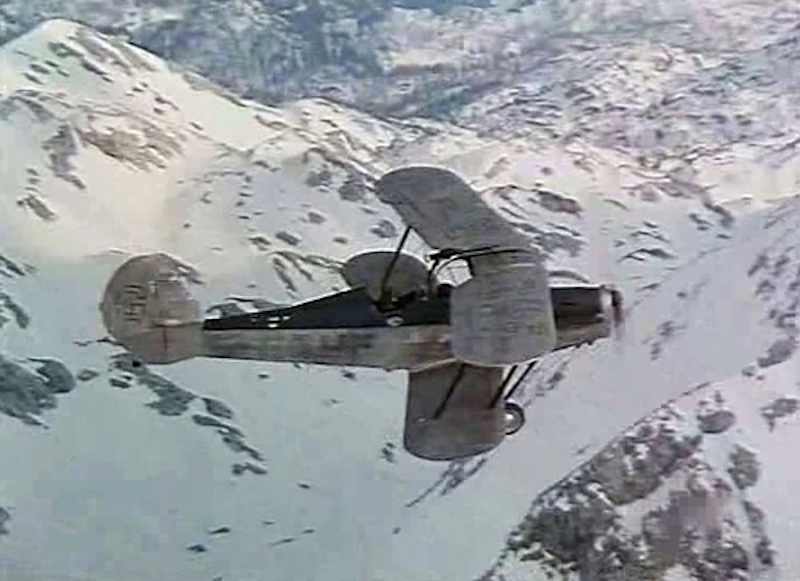
The film has some additional, major assets. It makes great use of spectacular locations, shot with a valley in Yugoslavia doubling for India, Afghanistan and China.
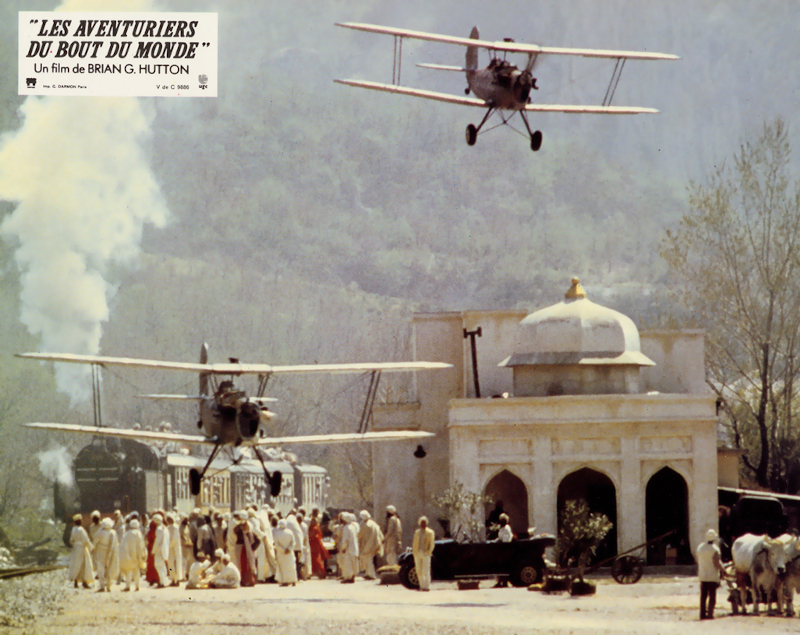
Also, using seemingly only two biplanes, and 1983 effects technology, it achieves great flying sequences, including some impressive stunt work, so that you really believe Selleck, Armstrong and Weston are actually flying the planes.
The icing on the cake is a terrific score by John Barry (Chaplin, 1992; Dances with Wolves, 1990; Mary, Queen of Scots, 1971; Bond Movies 2-7 and more, 1963-71 +). His orchestral flights of fancy here brilliantly capture the joy and soaring freedom of flying, and the whole thing gains a lush, epic feel from his contribution which it would not otherwise have possessed. A case of the music being by far the best thing here, pulling the production up to an altogether much higher level.
The disc’s extras include a fascinating interview with associate producer Frederick Muller on how the logistics of the production were put together (17 mins); an interview with co-star Bess Armstrong (28 mins); and, last but not least, an appreciation by archivist and film historian Vic Pratt (21 mins).
New, low price video label Toy Robot are an imprint of Arrow Video, and the same care has gone into this release as on regular Arrow Video releases.
High Road to China is out now on Blu-ray in the UK.
Trailer: