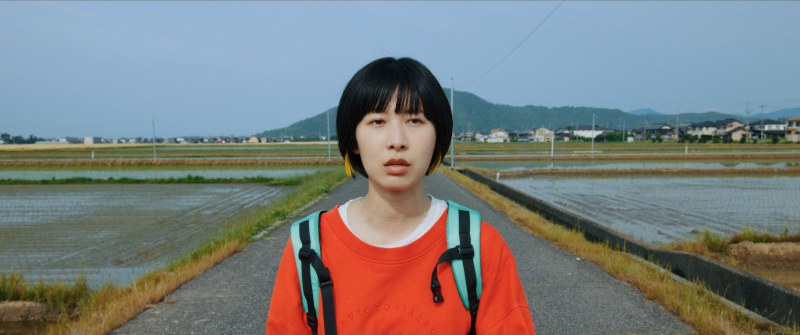
imoto Loop (ジモトループ)
Director – Masaya Tsutsumi – 2026 – Japan – 113m
*****
A 29-year old woman’s day starts replaying on the very day she plans to leave her provincial hometown for Tokyo – premieres in the Critics’ Picks Competition of the 30th Tallinn Black Nights Film Festival
This is a film by an Eastern nerd (that is meant in the best possible way) who clearly loves their Western fantasy, science fiction and time travel movies and TV. You can see in it echoes of Groundhog Day (Harold Ramis, 1993) and, in its final half hour, of 1960s Gerry and Sylvia Anderson TV shows and Back to the Future (Robert Zemeckis, 1985).
Yet, like Groundhog Day, it also wants to tackle big, philosophical issues head on. It’s very much its own film.
The night before she leaves her home town of Nagahama in Shiga prefecture at age 29 to start a new life in Tokyo, Satomi (Hitomi Uneda) gets drunk at home as usual and contemplates the black void outside her window. Her scattered beer cans mysteriously roll towards the window. She reaches out towards the void. The morning after, she wakes up on the floor, her T-shirt ironically proclaiming, Every Day is a New Day. The beer cans and her suitcase are by the window.
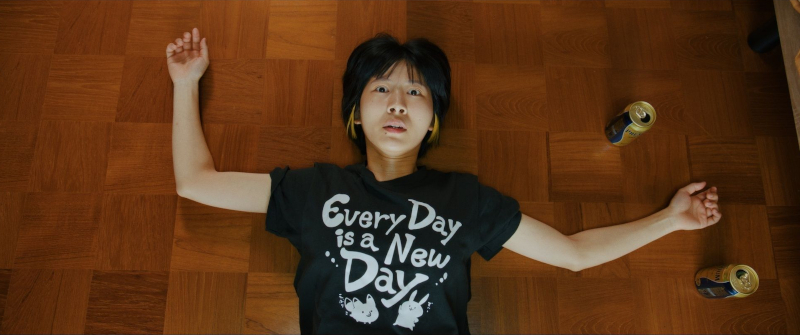
The T-shirt proclamation is ironic because, like Bill Murray in Groundhog Day, Satomi is destined to keep reliving this day over and over. Every day, she buys supplies from the store from the same guy (Nobuhiko Kunimi) serving at the checkout, sees a weather report about migratory birds playing on a TV, watches a monk cycle past the shop doorway singing a song. She gets to the local station, starts the train journey, but never gets as far as her connection at Maibara station (also in Shiga prefecture). Instead, she wakes up to relive the day.
The third day this happens, she tries getting a lift from her mum instead of taking the train. The fourth, she gets a girlfriend to drive her in the opposite direction. The fifth day, she takes her parents’ car to drive herself.
Every time, the journey just stops and she wakes up again.
She makes a map: the points at which she returns to wake up yesterday morning form a circle about 13 Km in diameter.
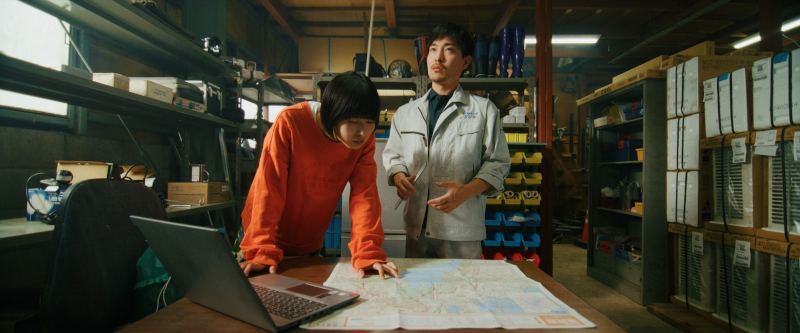
Former Tokyo University student Keisuke (Shinma Okazaki) from her school year has written theories about loops. He suggests she try something different – like, not leaving the town. She takes him out to a bar. The subject of ‘the butterfly effect’ comes up, and they talk into the night… She asks him to stay with her until midnight and drags him to a venue where old tabletop multi-player games such as Carom can be played. He admits that he doesn’t really miss Tokyo academia. He pushes her as to why she thinks Tokyo will be for her an improvement on Nagahama.
They make it past midnight, and she suggests he drive her to Maibara in the morning. On the journey, she wakes a day and half earlier.
Reliving that first day, after Satomi gets him up to speed, Keisuke shows her a paper on Gravitational Anomaly-Motivated Time Loop Theory (G-Mot. Loop Theory). At her home, the beer cans are no longer rolling towards the window. Yesterday’s gravitational anomaly has disappeared. He says he’ll consult with former research colleagues, but that she might have to wait a year before anything comes back. He advises her not to make any memories with anyone she cares about.
She drinks with her dad in the kitchen. Goes back to her old, dead end job. Wakes up on different mornings in different coloured T-shirts or sweatshirts. Hangs out with Keisuke. Tokyo has become an irrelevant, unattainable world, she accepts her geographically restricted life, settling into a routine over four years. Just when you think you’re not building anything, she says, life builds itself anyway. She meets Tomoki (Yoji Minagawa from Melancholic, Seiji Tanaka, 2018) and feels a connection.
Instead of a Groundhog Day rerun, this has become a fable about accepting what you can’t change and making the best of it.
Then Keisuke rings, upsetting everything. He’s worked out what’s happening, and to sort it out brings equipment to recreate the gravitational anomaly – “basically a time machine, although it doesn’t look like it” – and in order for everything to work, a specific escape velocity must be reached. He’s adapted a van which echoes Back to the Future’s Delorean.
As bizarre machines spring into life to a military drumbeat soundtrack, the whole thing also starts to resemble the launch sequence of the craft in the Thunderbirds (TV series, Gerry and Sylvia Anderson, 1965-6). A beer can rolls, the gravitational anomaly is detected.
Why would you touch anything like that?, she is asked. I was drunk, okay, comes the reply.
With the computer assessing the escape velocity as higher than expected, can Satomi, driving the van, make it?
Jimoto Loop premieres in the Critics’ Picks Competition of the 30th Tallinn Black Nights Film Festival which runs in cinemas from Friday, November 6th to Sunday, November 22nd 2026.
This review originally appeared on DMovies.org: you can find it here.
Trailer:
Critics’ Picks mashup trailer:
Festival teaser trailer: