Categories
Features Live Action Movies

Bright Star

Director – Jane Campion – 2009 – UK – Cert. PG – 119m

*****

The early nineteenth century romance between prospectless young poet John Keats and the younger Fanny Brawne – in cinemas from Friday, November 6th 2009

Bright Star‘s title comes from an 1819 love poem written by 23-year-old John Keats for 18-year-old Fanny Brawne, his next door neighbour. The poet (historical spoiler coming) contracted tuberculosis and died at the tender age of 25, before the couple could be married. Brawne subsequently mourned him for several years.

As you might expect from a filmography including both The Piano and In The Cut, Jane Campion is never one to match standard expectations and often overturns them to advantage.
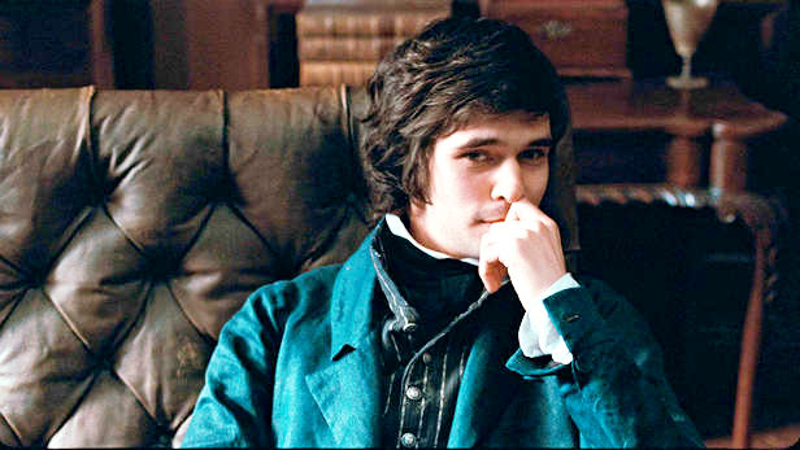
There is scarce little (verbal) poetry here either spoken by the actors onscreen or in voice-over. The source materials are Andrew Motion’s biography Keats and the poems themselves. Reading Motion’s book, Campion was very taken with his material on the love relationship between the poet and Brawne and thought there could be a film there. Without any real idea as to how such a film would work at the time. She eventually opted for telling the couple’s story through the eyes of the girl.… Read the rest

Categories
Art Documentary Features Live Action Movies Series Shorts Television

Greenaway
By Numbers

How Peter Greenaway’s obsession with various numeric and other cataloguing systems has led to the creation of highly complex, multi-layered film pieces that joyfully play with audiences

If ever anyone were to make a film about the Dewey Decimal System, it would be Peter Greenaway. He is obsessed with ways and means to classify the world in which he finds himself, systems to organise and make sense of that peculiar world, people’s relationship networks with one another and their movement and actions within that world and those networks.

I first came across him on the theatrical release in Hammersmith of his three hours plus epic The Falls (1980), made in between his early, self-financed short films of the 1960s and 1970s and his first, more conventional in length feature The Draughtsman’s Contract (1982). The Falls takes its name from entries in the section of a directory beginning with the letters F A L L e.g. Orchard Falla, Constance Ortuist Fallaburr, Melorder Fallaburr. The directory chronicles survivors of a Violent Unknown Event, VUE for short… [read more]

Full article at DMovies.org in association with Doesn’t Exist Magazine – purchase your copy now.