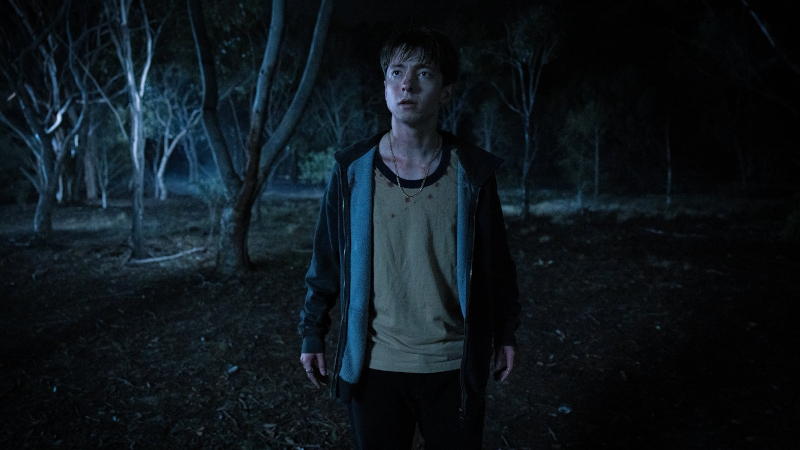
Leviticus
Director – Adrian Chiarella – 2025 – Australia – Cert. 15 – 88m
*****
Following treatment by a faith healer, two gay teen lovers are stalked by a being that for each of them resembles the other – out in UK cinemas on Wednesday, September 2nd
This is at once a drama and a supernatural horror movie made from a gay perspective. At no point (unless I missed it) does the film refer to anyone or anything called Leviticus. Perhaps that’s the name of the monster (who is not named in the film). Perhaps it’s a reference to the Book of Leviticus in the Bible – possibly not such a stretch since key plot elements involve a local, fundamentalist Christian church community – and such gathered groups tend to believe the Bible to be true word for word (rather than, say, using it as a text to be read and engaged with, taking into account its historical context and trying to make sense of it in today’s world).
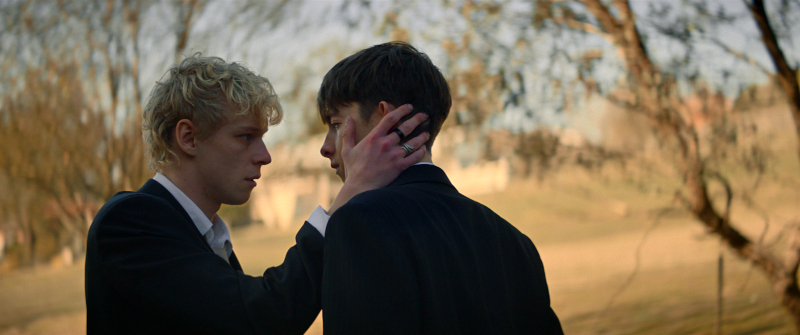
Naim (Joe Bird from Talk to Me, Danny & Michael Philippou, 2022) and Ryan (Stacy Clausen) hang out together in the area around their small outback town. Naim is unnerved by the sight of a snake digesting a toad. Ryan takes him to a nearby abandoned warehouse, where they suddenly kiss and are all over each other. Later, when Naim attends the local church with his mother (Mia Wasikowska from Bergman Island, Mia Hansen-Løve, 2023; Judy & Punch, 2019; The Double, Richard Ayoade, 2013; Alice in Wonderland, Tim Burton, 2010), he and Ryan can’t help making eyes at one another.
Later still, when Naim sees Ryan kissing another boy, he’s jealous. So much so that he tells the church elders about them, resulting in the pair undergoing treatment at the hands of a faith healer (Nicholas Hope from The Drover’s Wife, Leah Purcell, 2021; The Invisible Man, Leigh Whannel, 2020; Scooby-doo, Raja Gosnell, 2002) trusted by the church.
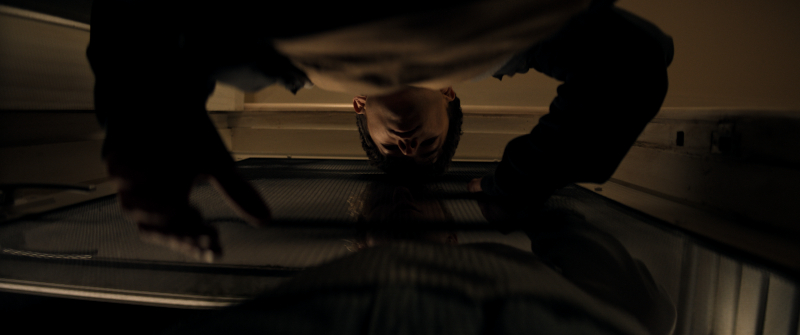
Thereafter, Ryan starts talking about someone visiting them and tormenting them, and pelting them with stones. Naim follows and sees Ryan lifted up as if being strangled by and having objects thrown at him by, an unseen assailant.
Naim has had enough, and comes clean. Then he himself is subjected to the faith healer’s practices, after which he experiences the assailant first hand. It appears as the person you fancy, or for whom you have romantic feelings. However, unlike your object of desire this being is malevolent. And it only attacks when you’re alone.

This extremely clever set up allows for some truly unnerving exercises in a game of cat and mouse, where sometimes your desired is your desired, and sometimes they are out to get you. The narrative milks this for all it’s worth, and the scenes that follow prove highly effective. If you get into a car with the person, are they the desired or a monster? If they appear at your door, are they the desired or a monster?
All this functions most effectively as a metaphor for conversion therapy and its effect upon its subjects. The weakest link in the script chain is the faith healer: the film would be just as effective if, instead of substituting the faith healer figure for conversion therapy, it had shown conversion therapy as producing the same set up.

That said, as a religious (Christian) person myself, I’ve been enough churches of various persuasions to find the set up here believable, faith healer notwithstanding. Conversion therapy, in this writer’s view, springs from a deficient model of Christianity which regards gay identity as sinful, a perversion of being straight. However, it seems to me that God creates people with different sexual preferences, and that such preferences (provided they are not abusive or predatory) are simply the,way people re made. The gay teenagers portrayed in this film are neither abusive nor predatory. Although, tellingly, the monster possesses exactly those qualities.
While there are certain elements here which could have been worked better at the screenplay level – for a really well thought through portrayal of deficient Christian religion look no further than Apostasy (Daniel Kotokaljo, 2017), a British drama which understands Jehovah’s Witnesses really well.
The current innovative horror nevertheless hits its target of conversion therapy bang on, and works well enough whether you watch it as a gay character study, an indictment of dodgy practices carried out on the name of (Christian) religion, or a genuinely unnerving horror outing regardless of your religious or sexual preferences.
Leviticus is out in cinemas in the UK on Wednesday, September 2nd.
Trailer: