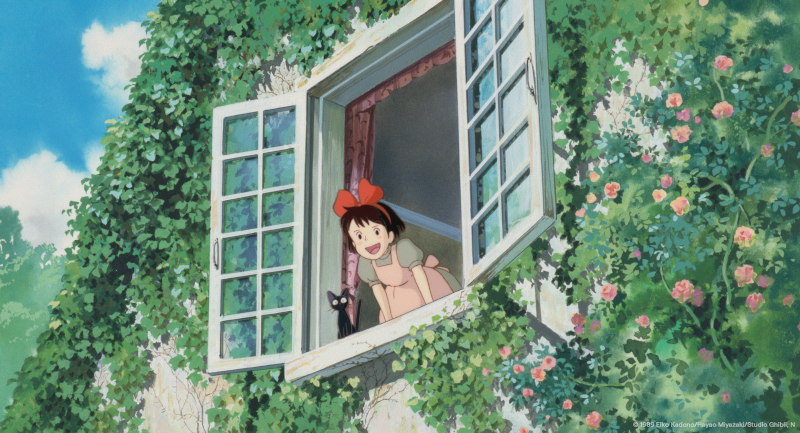
Kiki’s Delivery Service (Majo no Takkyubin, 魔女の宅急便)
Director – Hayao Miyazaki – 1989 – Japan – Cert. U – 103m
*****
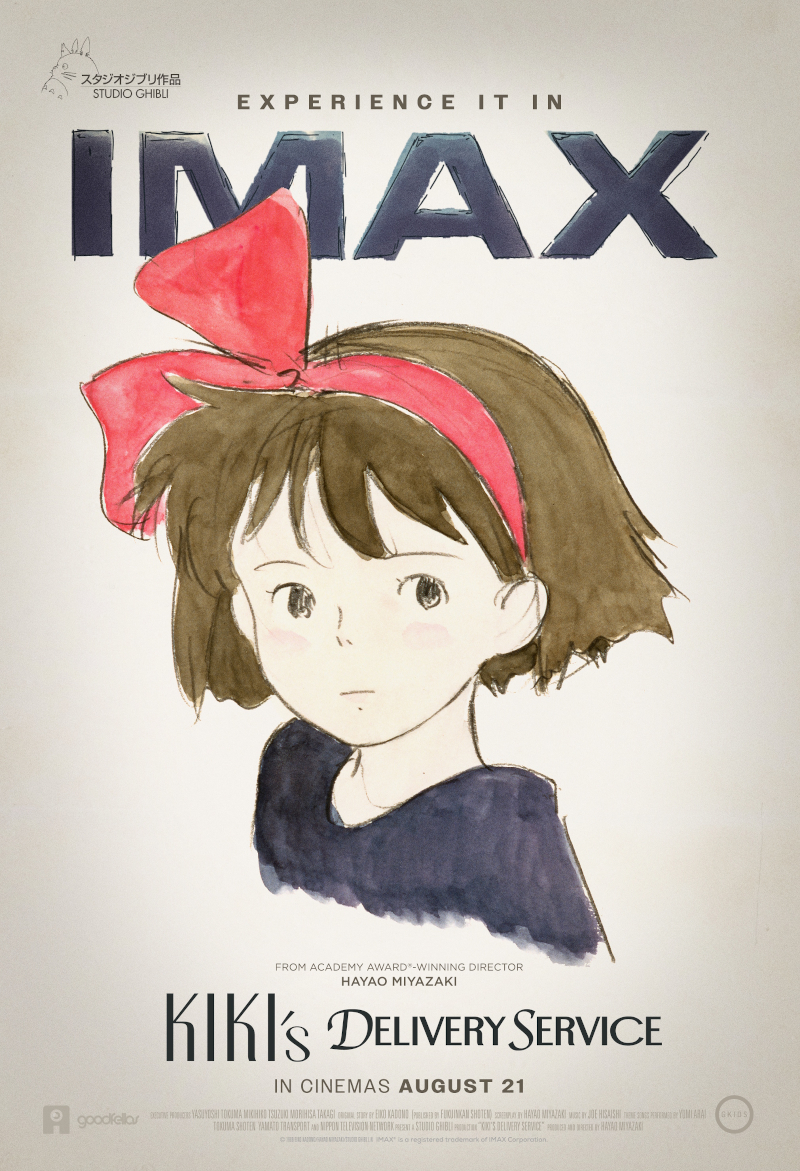
A young witch sets up her own small business and must learn to make her way in the world – out in a 4K remaster in regular UK and Ireland cinemas from Friday, August 28th following last week’s exclusive presentation in IMAX cinemas
Having reached the age of 13, young Kiki (voice/1989 Japanese dub: Minami Takiyama; 1998 Disney dub: Kirsten Dunst) must leave home to do a year’s apprenticeship as a witch in a location where there isn’t one already. Loaned at the insistence of her mother (voice/1989 Japanese dub: Mieko Nobusawa; 1998 Disney dub: Cath Soucie) the latter’s tried and tested broomstick, and accompanied by her talking black cat Jiji (voice/1989 Japanese dub: Rei Sakuma; 1998 Disney dub: Phil Hartman), she flies out on a night of the full moon. An encounter with a somewhat snooty witch who has just completed her year out reminds Kiki that she needs to develop her own special skill: at this stage, she has no idea as to exactly what this skill might be.
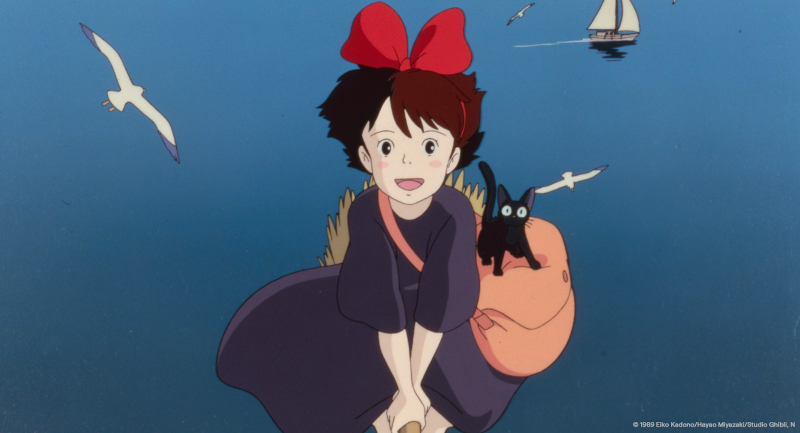
Resting overnight in an in transit railway cattle truck, she takes off again and arrives in Koriko, a bustling city much bigger than the tiny, provincial town where she grew up. She immediately runs into problems with the traffic, causing a near-accident, and is helped to escape an unsympathetic traffic cop by a lad her own ago Tonbo / Tombo (voice/1989 Japanese dub: Kappei Yamaguchi; 1998 Disney dub: Matthew Lawrence).
She is unable to find a place to stay until she runs into kindly baker’s wife Osono (voice/1989 Japanese dub: Keiko Toda; 1998 Disney dub: Tress MacNeille), who offers her an attic room in exchange for helping out with the shop. Events lead to Kiki’s delivering orders by broomstick, and turning her into a small businessperson as she sets up her own delivery service. She must deliver a stuffed cat in a cage to nephew Ket (voice/1989 Japanese dub: Yuriko Fuchizaki; 1998 Disney dub: Pamela Adlon) of her neighbour (voice/1989 Japanese dub: Kikuo Inoue; 1998 Disney dub: Julia Fletcher) , which she loses after an encounter with an angry mother crow defending her nest, causing her loyal cat Jiji to stand in for the toy while Kiki recovers it from cabin-dwelling artist Ursula (voice/1989 Japanese dub: Minami Takayama; 1998 Disney dub: Janeane Garofalo), with whom the young Kiki bonds.

Meanwhile, a romance is developing between the reluctant Kiki and the more forward Tonbo who, it turns out, is something of an amateur aviation nerd. (So too is a romance between Jiji and the white cat who lives nearby.) Tonbo is building a flying machine around a bicycle, and takes her out riding on it when it’s basically a bike with a large propeller on the front. He is also interested in the large airship which is being build and flight-trialled locally.

Kiki runs into difficulties flying when her abilities start to fade. Ursula visits the city, and suggests Kiki needs to take some time out to recover her motivation. Suddenly, she can now longer understand what Jiji is saying to her – all she hears now are miaows and other such cat noises familiar to us. The young witch is still struggling with this when, on the TV news, she sees Tonbo dangling from the near-vertical dirigible which has run into trouble. She takes to the air on her broomstick to save him, unsure whether her powers of flight will hold up long enough for her to rescue him…
It’s hard to think of another film, animated or otherwise, that so well represents the challenge of turning from girlhood into adulthood. 13 years of age is a very specific time in a person’s life, yet I would challenge any child or adult, female or male, not to relate to Kiki. Growing up and facing adult responsibility is something we’ve all been through or, for the very young, will go through in due course. There is nothing in the film that parents wouldn’t want children to see, nor is there anything here that insults the intelligence of adult viewers.

This is one of those films which, like the best children’s literature, is conceived for ‘children of all ages’. (Studio Ghibli’s subsequent filmography includes adaptations of a number of children’s books – Howl’s Moving Castle (Miyazaki, 2004), Tales From Earthsea (Goro Miyazaki, 2006), Arietty (Hiromasa Yonebayashi, 2010), When Marnie Was There (Hiromasa Yonebayashi, 2014) – this one is from Eiko Kodono’s eponymous novel and is in this writer’s opinion the best of the lot.) It’s a marvellous film to first discover as a young child, and an equally thrilling discovery for the mature adult viewer.
Kiki is a likeable character who, like all of us, makes mistakes, yet somehow manages to move forward in her dealings with the world. Before initially setting out from home, she has to be persuaded to take her mother’s tried and trusted broom rather than the one she has just built and of which she is extremely proud. Not used to flying, she crashes into and bounces off a couples of tree after take off, but soon settles into the rhythms of flying.

Like Tonbo, Miyazaki is, among other things, an aviation nerd, with a number of his films featuring flying (My Neighbour Totoro, 1988) and / or flying machines (Nausicaä of the Valley of the Wind, 1984; Porco Rosso, 1992; The Wind Rises, 2013) of one type or another. The flying sequences in Kiki, even though they mostly feature the fictional form of travelling on a broom by a witch, are both convincing and absorbing, capturing as they do the pleasures of soaring through the sky and watching the landscape pass below, along with such attendant perils as stormy weather or being attacked by a murder of crows. There is much emphasis on what, for want of a better term, we might call lone pilot aerodynamics, with Kiki taking off and landing with the vertical versatility of a Harrier Jump Jet or flying alongside geese in formation catching a wind current. Breathtaking moments have her suddenly change direction in mid-air.
There’s a feeling of feminine intuition about all this, contrasted with the more technologically minded Tonbo who is building an aircraft based on industrial components and can imagine nothing more exciting than a trip on the locally developed airship. When the pair go riding together on his aircraft-propeller-fitted bicycle, you sense that they are soul mates, yet very different because they are male and female. Although his heroine is the main focus, you feel that Miyazaki has equal respect for both genders.

Perhaps the most fascinating element here is Kiki losing her powers and being told to spend time doing other things to let her mind recharge while she’s not worrying about the issue. Ursula compares this loss and resultant need to recharge to the way an artist works. In the Japanese language version, Jiji never speaks human language again, but in Disney’s 1998 English dub, he does. Disney re-edited their soundtrack in 2010, taking out much of voice actor Phil Hartman’s improvisation over Rei Sakuma’s voicing of Jiji, bringing the English more in line with the original Japanese track.

The 2010 re-edit also restores the two Japanese songs which bookend the film, which also contains a typically memorable Joe Hisaishi score. The current English language version of the 4K remaster is of the 2010 dub re-edit. It’s an excellent dub, so it becomes a personal choice as to whether you see the film in Japanese with English subtitles or dubbed into English.
Either way, the film remains among Miyazaki and Studio Ghibli’s finest achievements, and the chance to see it restored in 4K IMAX is most welcome.
Kiki’s Delivery Service is out in a 4K remaster in regular UK and Ireland cinemas from Friday, August 28th following last week’s exclusive presentation in IMAX cinemas.
Trailer: