Middlesex Hospital Blues
Curators – Iain Forsyth, Jane Pollard – 2026 – UK
****
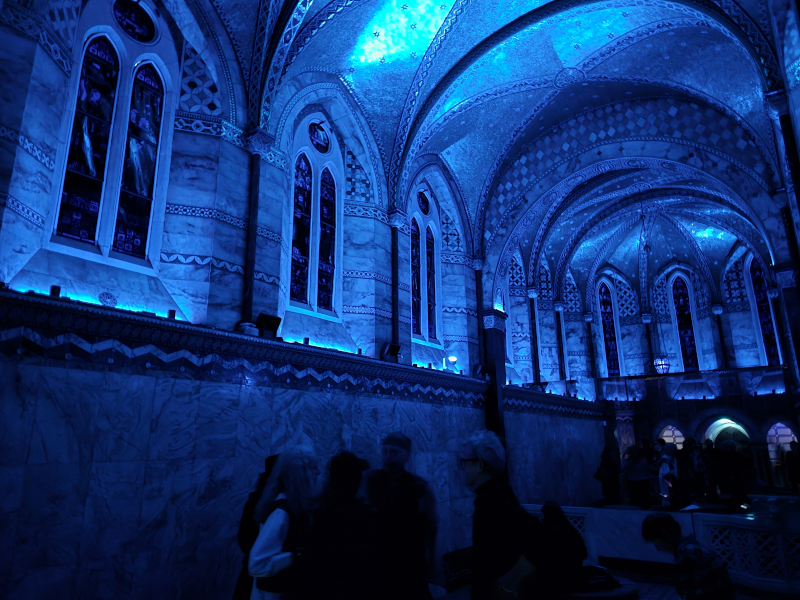
A chapel interior is repurposed as a reinvention of Derek Jarman’s final film Blue – exhibition / installation at Fitzrovia Chapel from Friday, October 16th to Wednesday, November 18th
Pollard and Forsythe’s third and final installation / exhibition at the Fitzrovia Chapel is a deceptively simple setup.
With the space opening from mid-morning to midday to five or six pm depending on day of the week, most visitors will be entering the building from daylight – although, as the evenings creep in, towards the end of the day, and losing an extra hour of daylight in the evening after the clocks go back an hour on Sunday, October 25th, some visitors may be entering from fading light or even darkness.
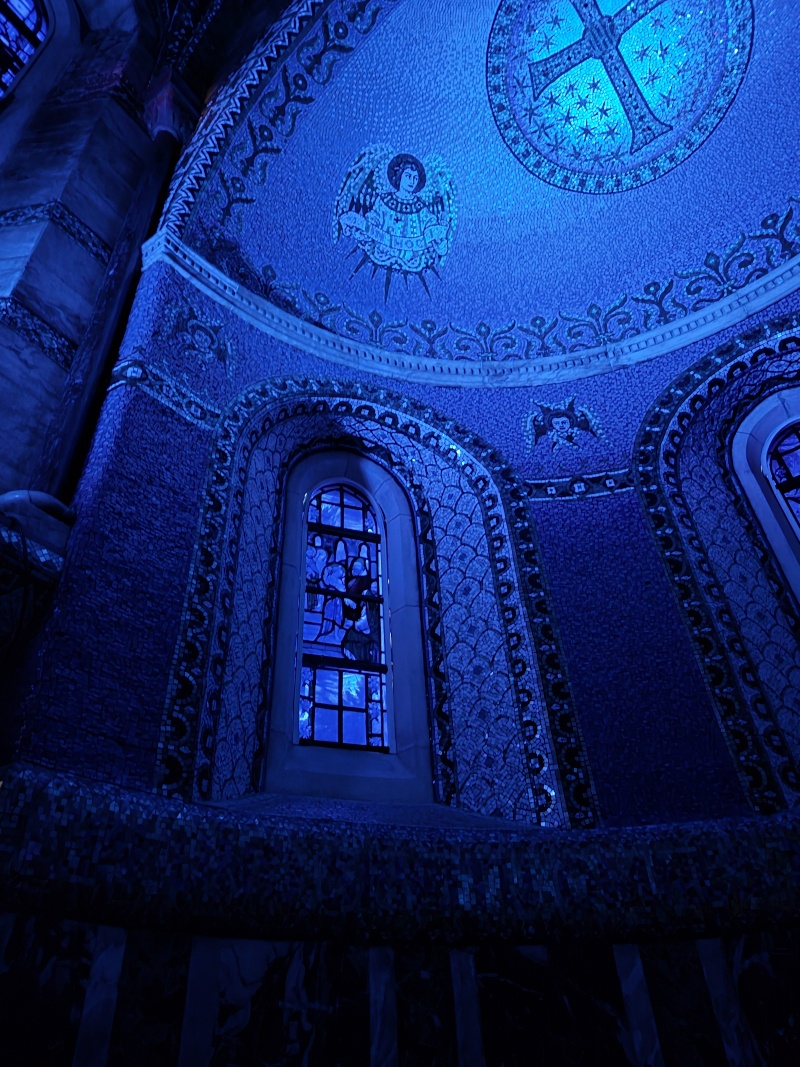
Entering from daylight as this visitor did, one is immediately struck by the lighting.
In a reimagining of the late director Derek Jarman’s final film Blue (1993), the interior is lit in that colour, which has the effect of locking the architectural interior into a sort of perpetual twilight, and not one in which the light goes slowly from light to dark but which seems more or less fixed. Blue’s image was fixed as an optically created, constant shade of blue and its soundtrack consisted of two intertwined stories, one about the colour blue as a character who comes into conflict with other colours, the other dealing with Jarman’s day-to-day existence as a gay man living with / dying from AIDS.
The shade of blue and the word denoting the colour have several associations – Yves Klein’s paint hue International Klein Blue, the colour of Princess Diana’s dress when she visited the Middlesex’s AIDS unit in 1987, and the nickname for that hospital’s uniforms.
An installation within this space is based around a pre-recorded sound / voice / music piece which runs for a specific duration of time like a film, but in sound only. It’s not particularly narrative in form, consisting rather of people reading verbal texts.
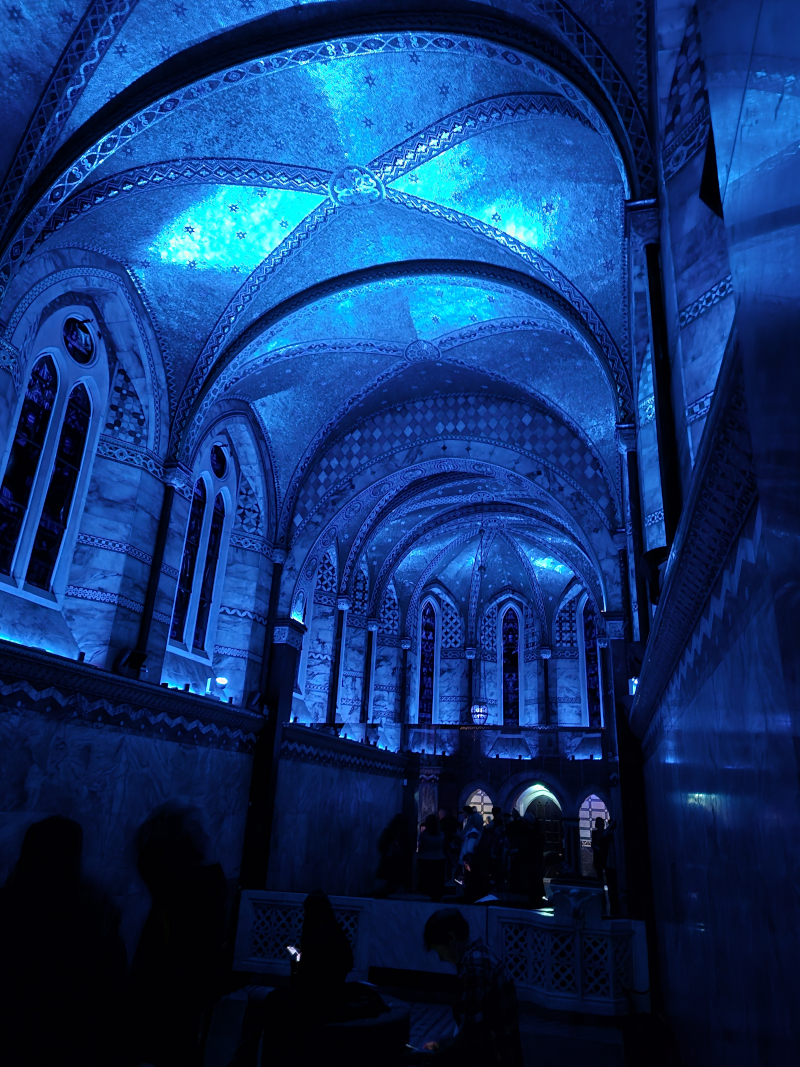
Somewhat disconcertingly, a mirror has been installed in the middle of the chapel so that’s instead of being able to look down to the far end of the building’s interior where the altar is situated, one appears to see the back of the church reflected in the mirror. The mirror stops somewhere above head height by maybe three or four feet, so that if one looks above that one can see the back of the church but not not the lower altar area.
Describing this bisection of the interior by a mirror does not, however, give the whole story, because there are a couple of sculptures out of sight beyond the glass, which are revealed by intermittent dramatic changes of of lighting, the mirror actually being not so one-way mirror, but a two-way mirror the two-way properties of which only become visible to the viewer as certain elements behind the mirror are illuminated via lighting cues. The two sculptural forms, represent upright couples embracing.
Something about the form of these figures suggests knight’s armour, and perhaps, because of the context of a traditional European or Western church interior, the visitor associates this with all those tombs bearing statues of medieval dignitaries lying at rest in knight’s armour. Yet all of the figures here are instead standing upright and embracing.
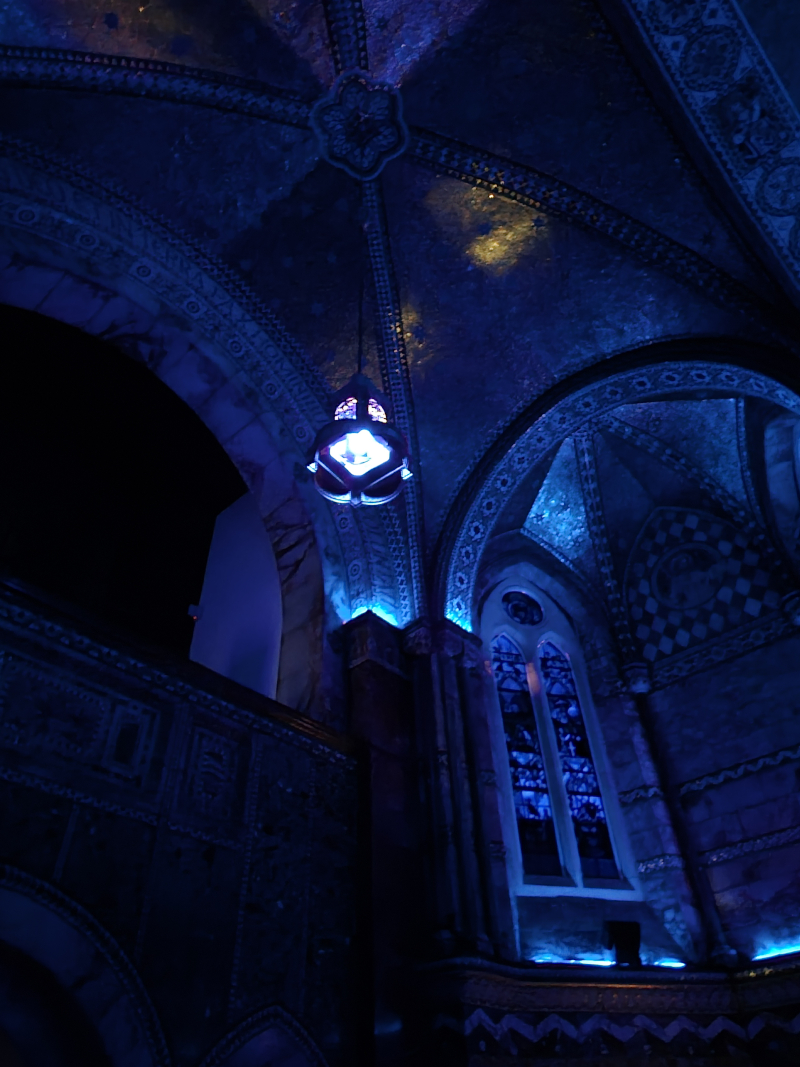
The sound installation put together by composer and Jarman collaborator Simon Fisher Turner is strange, unearthly and ethereal. Fellow Jarman collaborator Tilda Swinton contributes her voice to readings alongside tapes and private recordings of Jarman himself. These aural elements are enhanced within the overall sound field thanks to Raj Patel of Arup’s custom designed loudspeaker system.
The spoken vocal content is evocative not only of the colour blue – at one point, there’s a list of two word phrases from common English parlance, all of which use the word blue as one of the two words – but also of hospitalisation and the final human journey of dying In such an institution, with the spoken text augmented with extracts of descriptions of exactly that.
I found the experience at once profoundly moving and at the same time elusive, in the sense that It seemed very much about transcendence and a sense of the of the numinous, not an easy thing to put in into words when the experience is so essentially sensory in nature.
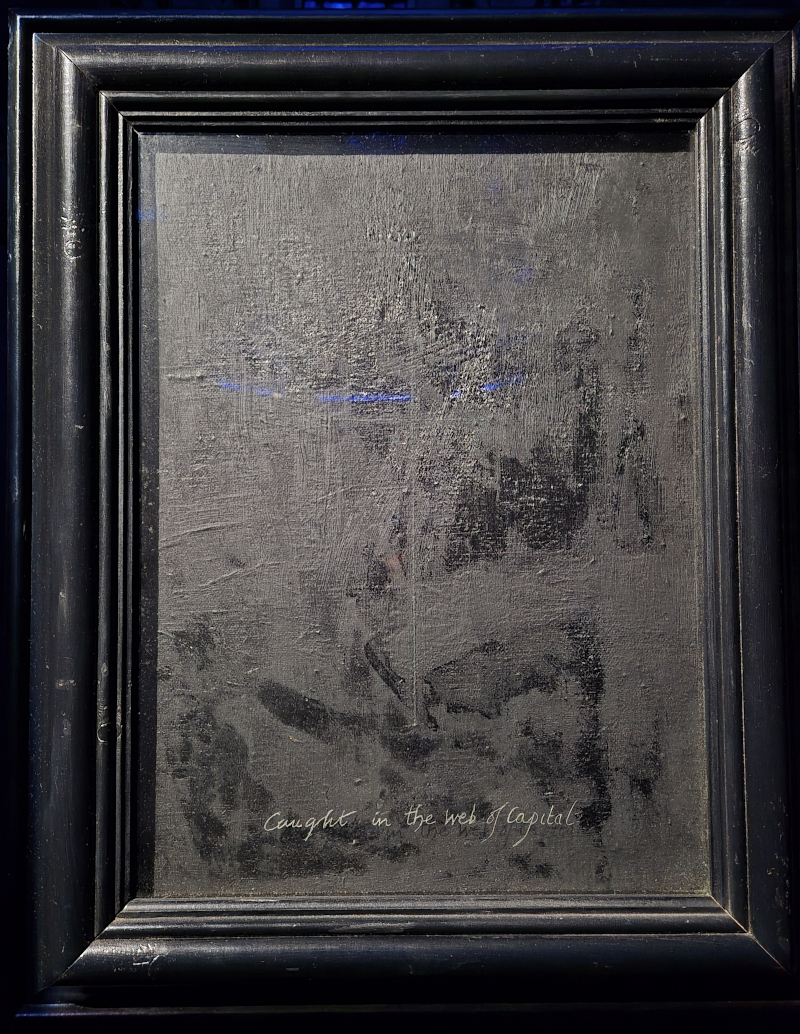
As well as the sound / voice / music installation, there is also a small Jarman artwork in the font area, The Spirit of the World, a quasi abstract, layered texture of whites with the inscription, ‘caught in the web of capital’, which resonates with everything else going on here.
It provides a fitting closure to Pollard and Forsythe’s profoundly moving series of three installations at this remarkable venue.
This is the third of three pieces following Souvenir and Miseris Succurrere Disco curated for the space by Iain Forsyth and Jane Pollard, whose most recent documentary Broken English, about the singer Marianne Faithfull, is available to rent on BFI Player, Apple TV and Amazon Prime.
Middlesex Hospital Blues is an exhibition / installation at Fitzrovia Chapel from from Friday, October 16th to Wednesday, November 18th.
The Fitzrovia Chapel, 2 Pearson Square, London W1T 3BF
Opening times:
11am to 6pm Monday – Saturday
Late night Thursday until 8pm
12pm to 5pm Sunday
Admission free
@fitzroviachapel