The Wizard of the Kremlin (Le Mage du Kremlin)
Director – Olivier Assayas – 2025 – France – Cert. 15 – 137m
*****
Starting in 1990s Russia, an avant-garde theatre director morphs into first a TV producer then the mastermind behind the rise and rule of Vladimir Putin – out in UK cinemas on Friday, April 17th
2019. Roland (Jeffrey Wright) writing a book on a prominent Russian novelist and on a research trip to Moscow when he receives a message from someone who has materials that will interest him. So he accepts the invitation and is driven to a private house on the woodlands outskirts of that city where he is shown first editions and documentation pertaining to the writer.

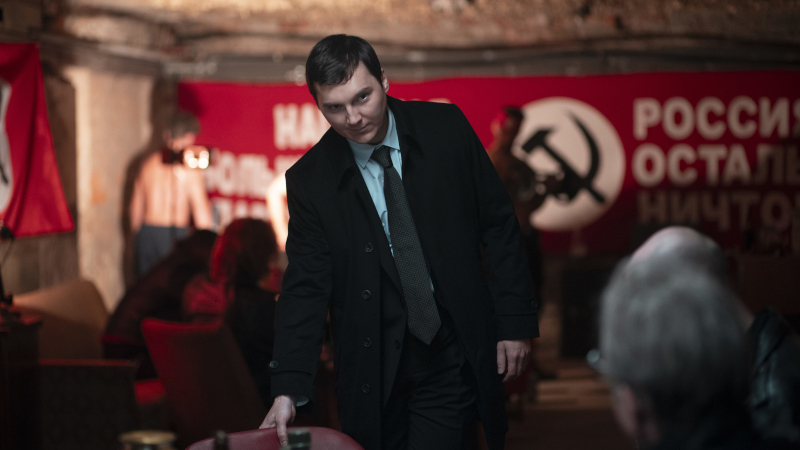
All this, however, is a pretext to the main event. His host, Vadim Baranov (Paul Dano), starts to tell Roland his life story from his student days onwards. Which sets the scene for what is to follow: a portrait of a close-up portrait of a shadowy figure who was to become Vladimir Putin’s arch-manipulator and right-hand man.
Dismissive of Gorbachov, he takes us back to the early 1990s when the Soviet Union was collapsing and Boris Yeltsin was in the presidential ascendant. A time of gunfire and violence, when men of increasing wealth and power could be killed at any time, a fact illustrated by an SUV exploding mid-convoy along a Muscovite spaghetti junction. Baranov was a student of the creative arts who used to stage avant-garde theatre plays, and would often find himself at parties or social gatherings of other artists. At one such, he meets singer Ksenia (Alicia Vikander) as she performs with a man on a lead acting the part of a brutish but faithful dog. Knowing he’ll never find another woman like her, he embarks on a relationship with her.

He makes acquaintances of the likes of Dmitri Sidorov (Tom Sturridge) and Boris Berezovsky (Will Keen). The first is a dubious, rising star of an entrepreneur with fingers in numerous pieces representative of what will come to be known, as a class, as the Russian oligarchs. The second is a TV producer who takes Baranov under his wing. In the world of TV production, Baranov will find a place to allow his visionary and manipulative talents full rein.
Baranov and Berezovsky become inseparable, the latter a frequent visitor to the apartment where the former is now living with Ksenia. He can tell she is drifting away from him toward his friend, and it’s only a matter of time before she moves out. Her departure doesn’t worry him too much, focused as he is on finding an outlet for his manipulative talents, which he satisfies via his discovery of and professional partnership with secret police official Vladimir Putin (Jude Law), a man at the top of his game and increasingly referred to as ‘the Tsar’ as the narrative proceeds.

As Yeltsin starts to lose his grip on the presidency through his declining health, Baranov and Berezovsky prop him up quite literally to get him through the 1996 election by tying him to a chair so that he remains upright at his desk for the TV cameras during an election broadcast. He wins, but slips into being little more than a puppet figurehead. In the ensuing chaos, Putin takes on the presidential mantle as caretaker, then wins an election himself.
While very much his own man, a hardliner who believes the Russian people want a tough leadership that tells them what to do, and possessing no scruples whatsoever about getting rid of loyal allies who have outlived their usefulness – a fate for which Berezovsky is ultimately destined – Putin nevertheless finds an ally in Baranov, a man whose ability to read the zeitgeist and manipulate institutions, individuals and the masses accordingly will prove invaluable to him.

After fifteen years in which Putin and Baranov will have discussions about their current concerns into the long hours of the night, the latter slowly withdraws into private life. By the time Roland meets him, Baranov is a devoted father to his young daughter.
This has a very different feel to previous outings by highly idiosyncratic French director Assayas (Clouds of Sils Maria, 2014; demonlover, 2002; Irma Vep, 1996), no doubt not entirely unconnected with his initial feeling, on reading the source novel by Giuliano da Empoli, that there was no way to adapt it into a film. Nevertheless, various people kept suggesting it to him as a film, and clearly the property marinated in his head.

What we get is a film not in his native French but in the English language. And although it’s presumably not his first language, I assume Assayas is reasonably proficient at speaking English, since this doesn’t feel like one of those embarrassing movies where a director clearly speaks a different language from the one in which he’s making the film.
Wizard is essentially a character study, with leading man Paul Dano (from The Fabelmans,Steven Spielberg, here Will Be Blood, Paul Thomas Anderson) on screen most of the time once we get through the opening introductory frame story with the ever-watchable Jeffrey Wright. Dano is extraordinary here: he exudes a calmness, a centredness, in the midst of his formative years in the cultural storm that was Russia in the 1990s. Perhaps it’s clearer when you read the book, which Assayas initially thought too dialogue heavy to turn into a film, but it can be difficult to follow all Baranov’s machinations. Not that it matters one whit – you feel him to be in control amidst the maelstrom, and you absolutely buy his site of mind and consequent influence.

As other rise and fall (or, more accurately, are taken down by Putin), Baranov rides the storm and only disappears from view when he himself decides the time is right. He is the eponymous Wizard of the Kremlin, the Rasputin to Putin’s Tsar, his dark arts having everything to do with vision, planning, politics and outmaneuvering others and nothing to do with any occult activity or similar (in case anyone was thinking from the title that this was an occult horror film, which it absolutely isn’t – it’s a political thriller cum biopic). In a sense, the storm around him changes from the social collapse and anarchy of 1990s Russia to the immutable strength of Vladimir Putin once the latter has consolidated (with Baranov’s help) his power base.

As in Firebrand (Karim Anouz, 202), where he played Henry VIII, Law once again portrays a despotic ruler at the centre of (but not the protagonist of) the drama. Here, as his power increases, Law employs a jutting lower lip. The big difference between Henry VIII and Putin is that the latter is someone we’ve all seen on TV news footage, whereas the former was not. This presents the actor with a challenge, to which he rises admirably. You can’t help thinking his Putin is as effective as his (in some ways very different) Henry VIII. He’s a thug, yet a careful one completely in control of his surroundings.

Fascinating power struggles occur towards the end between TV producer Berezovsky, who wants to impress on the president that he, Berezovsky, not Putin, is in charge, but this, along with the rise and fall of entrepreneur Sidorov and the adventures over the years of Ksenia, who at one point is sailing (presumably) the Mediterranean on a luxury yacht, are very much sideshows to the main event of Baranov, and the sub-event of Putin.
As the whole thing moves along at a good pace, the element that really fascinating, even if their finer points are incomprehensible, are Baranov’s machinations and manipulations. If Law delivers a memorable performance as the familiar Putin, Dano as Baranov outdoes him with his extraordinary take on the man’s shadowy operator. All this, plus the compelling backdrop of Russia emerging from the turmoil of its 1990s into the hardline power that it is today.
Highly recommended.
The Wizard of the Kremlin is out in cinemas in the UK on Friday, April 17th.
Trailer: