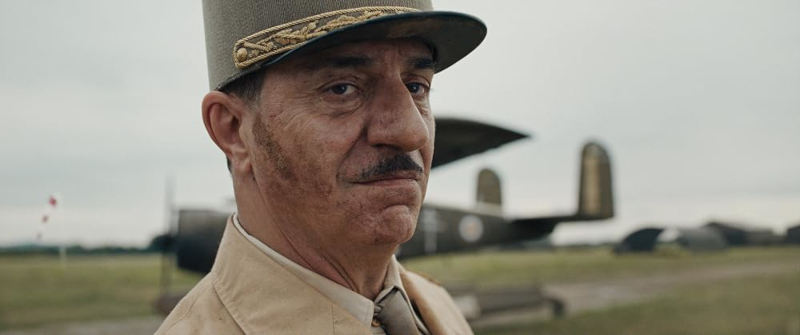
Director – Antonin Baudry – 2025 – France – Cert. 15 – 160m
*****
Feeling betrayed by France signing an armistice with the Germans in 1940, General De Gaulle leaves for London to set up and command alternative Free French forces – first part of a two-part movie is out in UK cinemas on Friday, August 28th
1940. In the brief but decisive Fall of France, De Gaulle (Simon Abkariam) – later described by a detractor as a “petty general” – overtakes a French tank column to see for himself what the Germans are doing (after an aide bringing news admits he’s not actually seen it for himself). With his military car under tank fire, De Gaulle uses his arm to signal his driver when and how to change direction so that he can accurately assess the situation before the French tanks turn up and destroy the German tank.
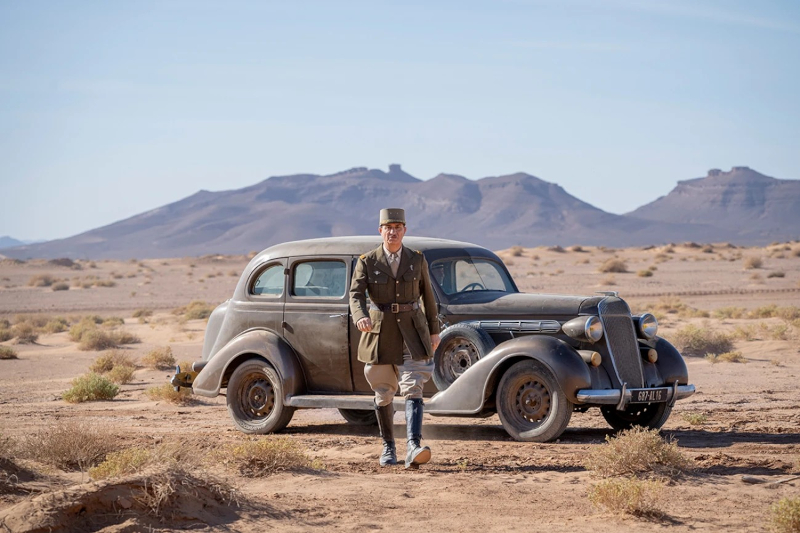
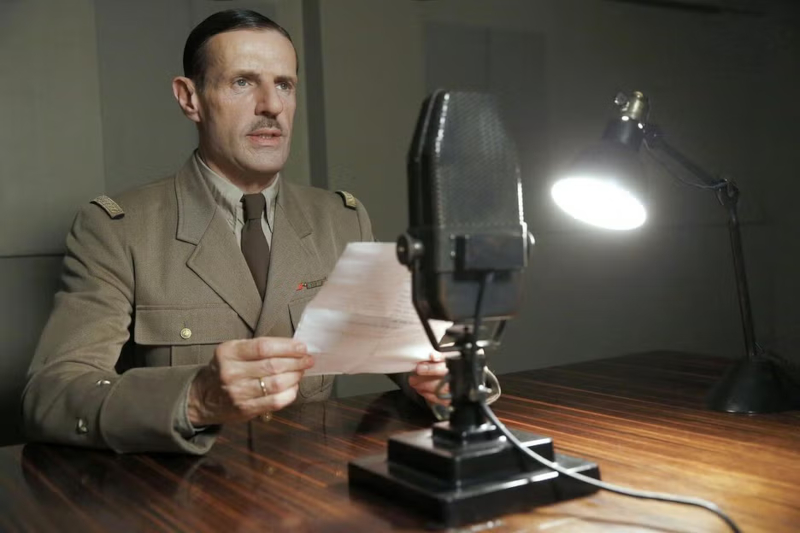
Days later, he is horrified to see Marshall Pétain (Alain Libolt) sign an armistice with Germany. As far as De Gaulle is concerned, Pétain and Admiral Darlan (Matthieu Kassovitz), who supports Pétain, do not speak for France. De Gaulle with the one aide prepared to accompany him leaves for London hoping to enlist the support of British Prime Minister Winston Churchill (Simon Russell-Beale) who gives him a nightly broadcasting slot on BBC radio and a house in Hampstead. At the latter, he recruits to answer the phone Blazej (Karim Leklou), the Polish plumber sent to fix the taps. Visits to the French embassy and French sailors stationed in the UK result in paltry support, but the few men he actually manages to recruit are solidly behind him, one officer suggesting that he needs a logo, swiftly resulting in the Free French emblem.
As De Gaulle moves into an office in Central London, Churchill is torn in his negotiations with US President Roosevelt (Campbell Scott) between siding with the newly formed Vichy France government, who have France’s navy, or with the wild card De Gaulle, who has a madcap plan to wrest control of the French African colonies from Vichy France. De Gaulle manages to take Congo and Cameroon, but his refusal to fire on fellow Frenchmen as a matter of principle scuppers potential victory in a conflict with the French fleet. Churchill subsequently bombs the fleet without De Gaulle’s approval as Vichy France edges closer to Germany.
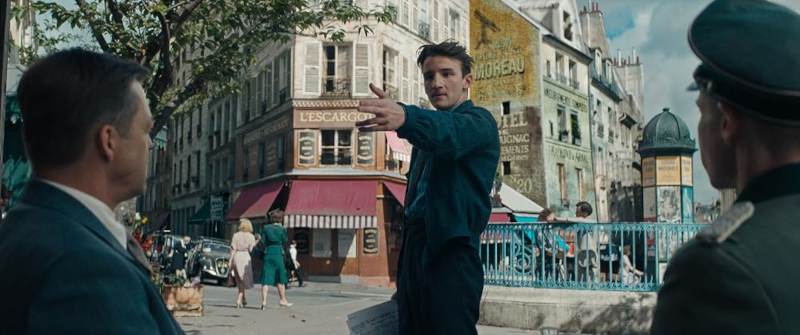
In parallel to all this, Fernand (Florian Lesieur), a young man in Paris gets involved in the Paris protests against the Pétain government and the Nazis, and finds the very motivation he needs in De Gaulle’s broadcasts. His guardian uncle and aunt don’t see it that way, and fearing for his safety, send Fernand off to stay with his father in Algiers. He persuades his Jewish girlfriend Livia (Anamaria Vartolomei) to come with him, but knowing it’s forbidden for Jews to leave Vichy France, she gets off the Southbound train at the last French station. This has its impact upon the young man, as too will the appointment of Admiral Darlan to command the French forces in Algiers when the young man was expecting De Gaulle.
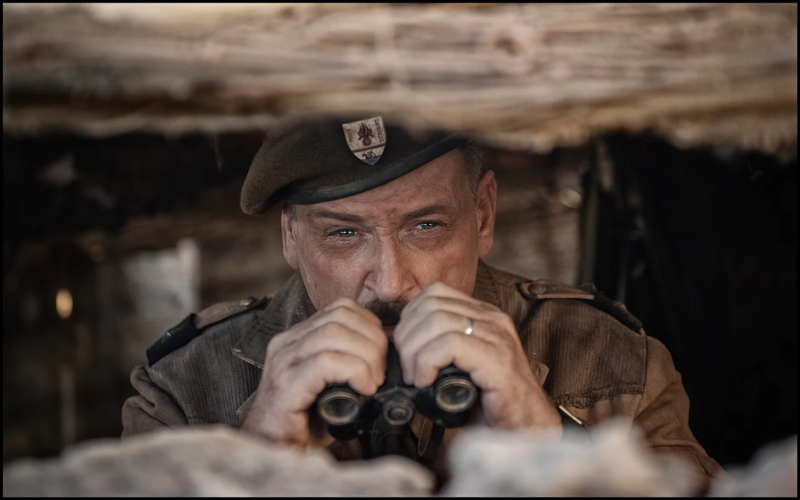
Also featured is the North African siege of Bir Hakeim in which a tiny unit of Free French under Kœnig (Benoît Magimel), one of De Gaulle’s generals, holds out against the Germans under impossible odds in what everyone concerned, themselves included, believes to be a suicide mission. This conflict proves a heavy draw on the German forces and allows the beleaguered, non-French, Allied forces to retreat with minimal losses, putting De Gaulle and his seemingly madcap schemes in a good position for negotiating with the supportive Churchill and the less sympathetic Roosevelt.
Amidst a clutch of impressive performances – Libolt is suitably single-minded as De Gaulle, Russell-Beale statesmanlike, diplomatic and wily as Churchill, while Lesieur and Vartolomei prove believably idealistic as the youthful, activist Frenchman and his girl – Leklou’s Polish plumber turned De Gaullist minion proves, unexpectedly, by far the most striking character here, which makes it something of a pity that he becomes less and less significant as the film goes on.
Still, the battle scenes, which range from a handful of men in a jungle skirmish to full scale desert battles and naval routs, feel like the production didn’t lack for budget.
The first of a two-part movie (with the second part due for release on September 18th) this is a well put together and engrossing exercise in National myth-making. The historical material is sacrosanct to the French, and while much of it is true, including the extraordinary Bir Hakeim siege story, you can’t help but wonder what liberties have been taken with the real life facts. The young Parisian and his friends appear to be fictional inventions who nevertheless serve most effectively to give some idea as to what was happening among the ordinary French populace at the time.
Whether the film(s) will have the same appeal to the British as they did to the French is anybody’s guess. Obviously there is a lot here about Churchill and the tightrope he walked in negotiating with the US, Vichy-France and the Free French, with those different parties’ conflicting aims, which has clear appeal to UK audiences. Moreover, several, impressive naval or land battle sequences ensure that, unlike Churchill biopic Darkest Hour (Joe Wright, 2017), the piece never turns in on itself as a drama in which the producers can’t afford to stage any of the major conflicts in the war. At the same time, it never rises to the level of the in your face, hands on spectacular of Dunkirk (Christopher Nolan, 2017), although, to be fair, it’s probably not trying to do so.
In the end, this first of the two De Gaulle movie parts is a study of its eponymous statesman who had a major impact on World War Two and France’s role within that conflict. As such, this very much does what it says on the tin.
De Gaulle: Resistance is out in cinemas in the UK on Friday, August 28th.
Trailer: