Bitter Christmas (Amarga Navidad)
Director – Pedro Almodóvar – 2025 – Spain – Cert. 15 – 111m
***1/2
A woman learning to deal with panic attacks is actually a character playing out a screenplay as it is being written by a writer director coming out of an arid creative period – out in UK and Ireland cinemas on Friday, August 28th
This loosely falls into the category of the story of the film being written by a person outside that story, with a parallel narrative dealing with the person outside the story writing that story.
Almodovar uses this schema to talk about the writer-director whose creativity has dried up. And the medical phenomenon of panic attacks.
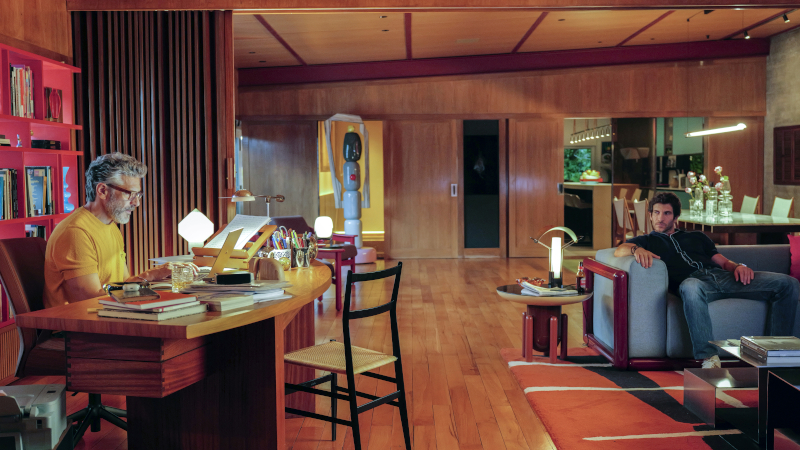
Elsa (Bárbara Lennie) has a migraine she can’t shift. Painkillers and rest – in the words which appear at the bottom of the screen of Elsa’s narrative as Raúl (Leonardo Sbaraglia) types them on his laptop – only make it worse. Her partner Beau (Patrick Criado) stays at home that evening to be there for her instead of going to the club as he normally would on a Friday. But then she feels worse, so he drives her to hospital, where she’s given an injection and a sedative, stays in overnight, and the next day feels well enough to go home.
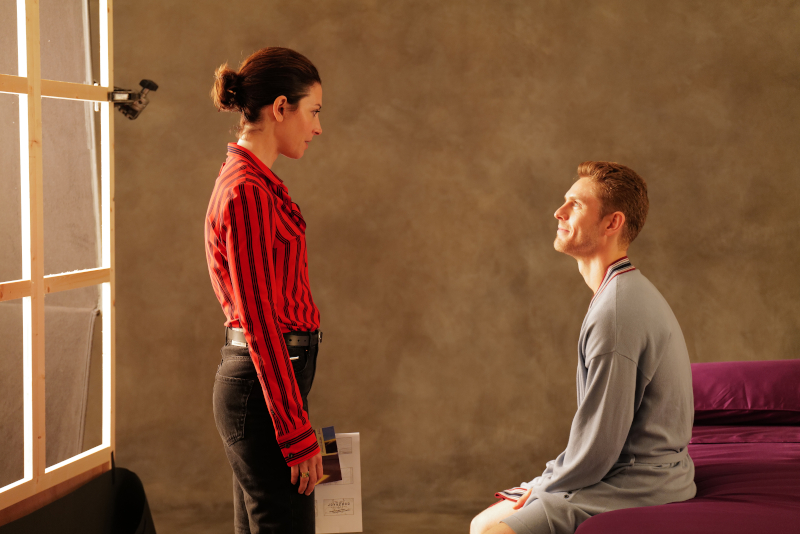
Elsa’s story unfolds like a catalogue of partner and friends: how she met Beau – a fireman who works weekends as a stripper; her married friend Patricia (Victoria Luengo) who Elsa thinks should leave her husband for good; her suicidal friend Natalia (Milena Smit) who lives with her mother in a small village with an elderly population. Patricia tells Elsa that what she is experiencing is a panic attack, and what type of tranquilisers will sort it out.
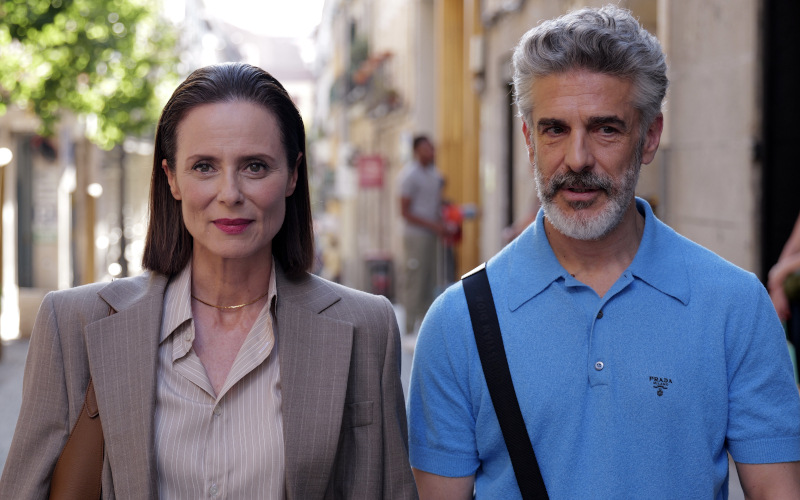
At the same time, Raúl’s P.A. of twenty years’ standing Mónica (Aitana Sánchez-Gijón from A Walk in the Clouds, Alfonso Arau, 1995) tells him she’s quitting, setting him up with Santi (Quim Gutiérrez from The Hidden Face, Andrés Baiz, 2011) as her replacement. She’s quitting because a long lost friend has come back into her life and has a son about to undergo life-threatening surgery. So Monica wants to be there for her.
Almodovar loves juggling multiple characters, and there are moments here where he has a lot of fun doing so, which fun translates onto the screen. Nowhere is this more evident than when Elsa needs to immediately get hold of tranquilisers to calm her panic attack, and the only way to do so is to get them from her friend Gabriella (Almodovar regular Rossy de Palma) who is currently hosting a party with everyone who is anyone present. Elsa can’t face attending the party. She tries to engineer Beau going in alone to pick up the tablets, which turns into the pair of them going in together and her immediately crashing crashing out in a private room while Gaby gets them the required tablets.
Then, singer-songwriter Amaia (playing herself) drops by the room and sings her a quiet song, which is supposed to have a calming effect on Elsa. Maybe it makes more sense if you’re already in tune with Spanish culture, which I can’t say I am. It just feels like the film stops dead in its tracks while the song is sung.

There’s a similar problem later when Elsa and Patricia listen to a couple of songs on the stereo in their rented room in Lanzarote, which are supposed to be the catalyst to finally make Patricia decide that it’s time to leave her husband. The songs are Spanish, probably classics, but unfamiliar in wider international culture, and to a non-Spanish audience they don’t really achieve what Almodovar intends.
Indeed, the press handouts talk about the film being something like a musical because of its five songs. The other two are the songs to which Beau performs a striptease in a club, which is how Elsa first meets him, and they work well enough as backing tracks for that purpose. But a musical? No, just a film which includes five songs.
Almodovar might be capable of a musical, possibly a great and truly lively one given his love of colour and ensemble casting, but this current film isn’t it.
Raúl may be an acclaimed director, but ultimately he is a recluse who lacks imagination and, after a particularly arid creative period, is writing a screenplay by plagiarising the lives of those around him, which isn’t very many people. (Why he isn’t looking at scripts by writers other than himself, which might be just the thing to get his creativity going again, is anyone’s guess – perhaps because he’s putting himself on a pedestal as an ‘auteur’?)

There is a genre of stories where the storyteller starts interfering, and it has given us some great films over the years. The current film places itself in this tradition and from the get-go builds up a wealth of social capital, but then squanders it by failing to explore each character and simply moving on to the next character in line. As it does so, this viewer’s attention waned. I wanted to know more about Elsa’s relationship with Beau, but he just drops out of the film, and I also wanted to know more about the (professional?) relationship of Raúl and Mónica, and while the film attempts to deliver that, I found what it served up to be less than satisfying.
The whole feels like a first draft where the writer hasn’t yet worked out what he was writing about. And then finds out at the end that that is the case, and tells us. Perhaps that’s the point (because Raúl is writing a first draft). If so, it isn’t really enough. I’d rather Almodovar had either abandoned the screenplay, or persevered with a few more drafts to get closer to the nub of the matter.
Bitter Christmas is out in cinemas in the UK and Ireland on Friday, August 28th.
Trailer: