Blow the Night (Yoru o Buttobas, 夜をぶっとばせ)
Director Chusei Sone – 1983 – Japan – Cert. 18 tbc – 108m
****
Two teenage girls: a high school dropout who falls in with gangs, and 24 hours in the life of a girl who knows a band – part of the Chusei Sone Double Feature on Blu-ray from Monday, July 27th.
NSFW
This starts out with a rock drummer playing a fill, freeze-framed almost immediately to the title of the film, then his band The Street Sliders – whose record company Epic / Sony put ¥10m into the film’s budget – launching into a blistering Japanese Punk / R&B number with the cheerful chorus “Masturbation! Masturbation!” The film travels quite some distance with a cut to disaffected schoolgirl Takada (Namie Takada playing a younger version of herself) being told by the principal that she just needs to turn up for school while the exams are on. “Well-behaved student, my ass!” says a suited teacher after the girl’s been dismissed. “What kind of student dyes her hair and her nails red?”
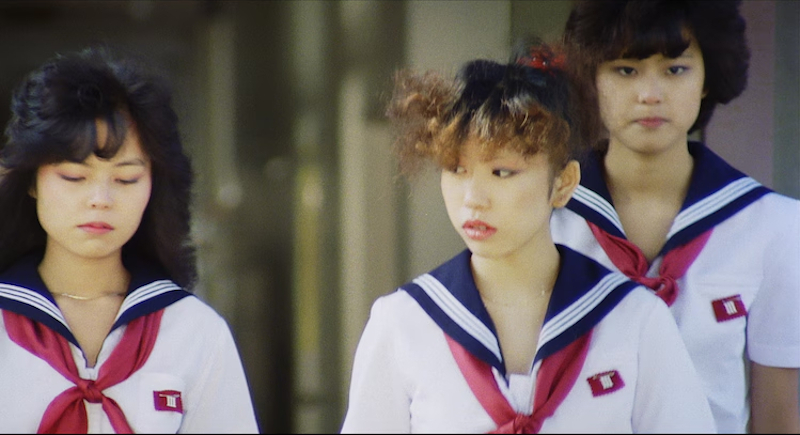
Well, Namie is the kind that gets in at home without keys in the afternoon by negotiating an open window, changes schools every couple of years, and lives with her sister, grandma. It seems a happy enough family at first glance, although her parents are often absent. However, her school have pretty much given up on her, and she often bunks off, taking the train two prefectures south from Maebashi to the much more exciting Tokyo.
The real life Namie, a high school dropout hired as a secretary by new production company Film Workers’ co-founder (with director Chusei Sone, maker of Angel Guts: Red Classroom, 1979) and producer Kunihiko Ukai, turned out to be highly proficient at the job. For her own reasons, she wrote down her experiences in notebooks.
Seen by Ukai, these turned into the starting point for this film, which she co-directed (uncredited) with Sone. Her father is a journalist so busy chasing deadlines that he has never had time for his daughter, so she’s consequently never instilled the necessary social boundaries into her. This means she thinks it’s okay to bully fellow classmates who copy her perm hairstyle.
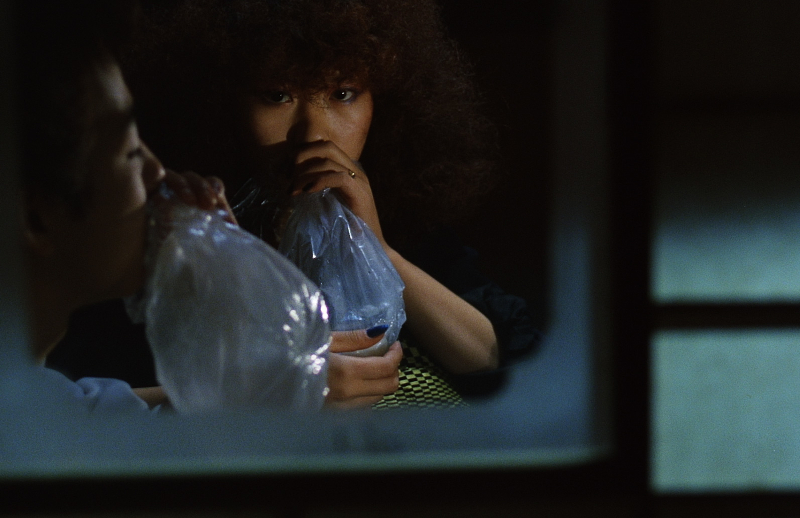
She spend some of her time with similarly delinquent schoolmates sniffing paint thinner from plastic bags.
That’s the opening of one story, which takes place over weeks or months (it’s never clearly specified), but another, out-of-synch story runs in parallel with it which takes place within 24 hours in Tokyo on November 18, 1982. At 7.30am, Rikako (Kazumi Kawai) lets herself into a flat where members of the band (you can tell because there’s a drum kit) and female friends are sleeping together on the floor.
She wants to know where her clothes are, then changes from her smart but austere school uniform into a garish, horizontal striped jumper and white skirt, switching her black pantyhose for light grey tights, then leaves, noticing a passing train as she descends the stairwell. At 10am she buys a MacDonalds. then smokes a cig near a railway bridge.
The constant telegraphing of the date and time in Rikako’s story, which element of the film is fictional according to Mes, contrasts with the much longer time frame of Namie’s remembered from memory story, even though the two are parallel edited. After a while, you twig what’s going on in terms of narrative structure. It’s a peculiar sensibility, yet, on some level, it seems to work. And, towards the end of the narrative, the two stories collide and you understand why the second one is there.
Rikako’s story soon diverges from the band. It covers a lot of ground, though. Many of the female characters are fifteen year old schoolgirls, and whenever we see them walking the streets of Tokyo, there are older men trying to pick them up. All the time. Which is pretty disconcerting, and given that this is apparently what used to happen to young girls in Tokyo on their own, quite an indictment of Japanese male attitudes and culture.
Both Namie and her schoolmate and boyfriend Naoki Taguchi seem to think nothing of berating their teachers: they have no concept of authority. Tom Mes in his audio commentary describes the school environment as a lack of discipline coupled with a sense of repression, and when, late on, a riot breaks out, you imagine you’re watching not a school but a prison where the inmates are taking over.
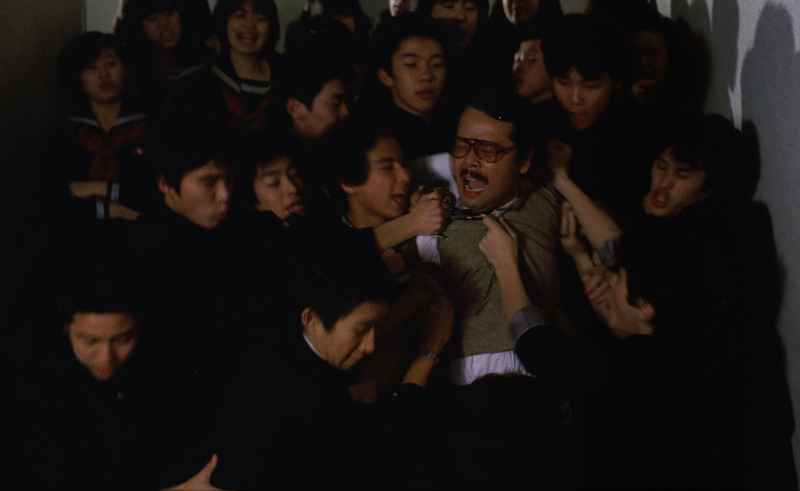
These scenes, in which hordes of teenagers overpower teaching staff male and female, are terrifying – although the pulsating crowds in corridors comprise nothing more than unruly teenagers, they could almost have come out of the spirited South Korean zombie movie Train to Busan (Yeon Sang-ho, 2016) and its sequels – and (while there’s little that could be described as explicit), the female teacher in these scenes is the target of sexual assault.
In an unrelated scene, Namie later hooks up with and sleeps with a gang leader, indulging in another session of thinner sniffing, where Namie beds her companion while the other two addicts look on, passively. Until, to her horror, it’s Takeshi’s turn. She hadn’t counted on this. The sequence mercifully cuts off. It could have been a lot more unpleasant, and if it’s not particularly explicit, it makes its point. (Although, just when you think you’ve been spared, the editing cuts back to it later.
By 10.30pm on November 18, 1982, Rikako is at a disco, trying to evade a gang of boys who want her to go for a ride. Namie’s little sister Natsuko (Yuka Komatsu) who has bunked off to Tokyo, phones Taguchi, now her boyfriend after her elder sister dumped him, and is waiting for him to show up; she falls in with Rikako, her friends and the boys who have come to the same restaurant. She tells them she’s from Maebashi. The boys offer to drive her home. Three cars. Reckless driving, weaving in and out of lanes, with the band’s song Blow the Night! Playing at full throttle. By the time Taguchi arrives at the station to collect Natsuko, they’ve long since gone. And tragedy awaits…
Namie, oblivious to all this, is given a lift to the station by her dad so she can get the train to Tokyo. Wandering the crowded streets, she is hassled by a man she eventually tells to fuck off.
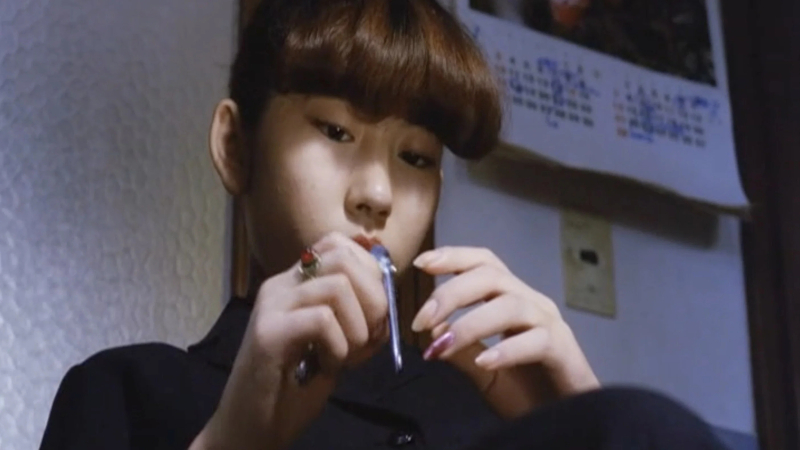
You might think that Namie’s character would elicit no sympathy whatsoever, yet curiously that’s not the case at all. She may be a bully, yet she desperately wants to belong, while her mouthy attitude may well alienate her from others. We feel sorry for the character, due at least in part to the real life Namie’s engaging performance. A revelatory moment occurs when, bunking off in the school sanatorium and busy under a bed sheet, Namie and her boyfriend are interrupted by the arrival of a boy experiencing pain in his leg. Namie takes this in hand and, as if she were the nurse, administers appropriate medication, sending the boy on his way.
The shooting style is one of no cuts within scenes, which as Tom Mes points out in his well-informed commentary track was pioneered in Japanese cinema by Mizoguchi. It’s a similar style to the later Typhoon Club (Shinji Somai, 1985) and for Mes it evokes the German film Christiane F (Uli Edel, 1981) which made good use of musician David Bowie.
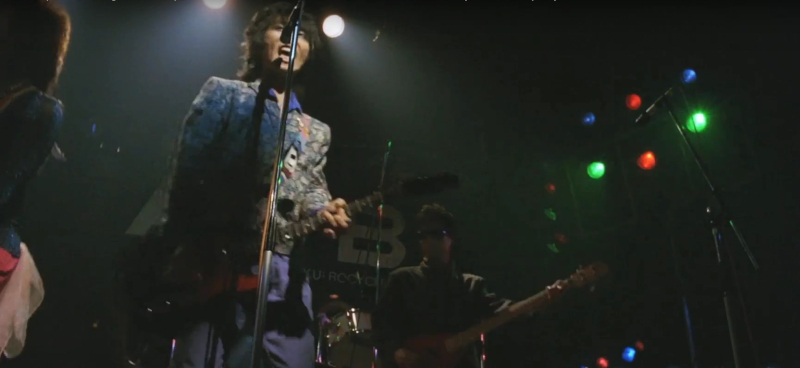
The record company Epic / Sony thought Blow the Night would give the band exposure, and you feel as though the production could have done a lot more with them: The soundtrack makes good use of the band’s music. However, this is a long way from either the British, warts-and-all approach of the much earlier Slade in Flame (Richard Loncraine, 1975), or the same year’s Japanese portrayal of home-grown punk bands in Burst City (Sogo Ishii, 1982). The Street Sliders probably deserved better.
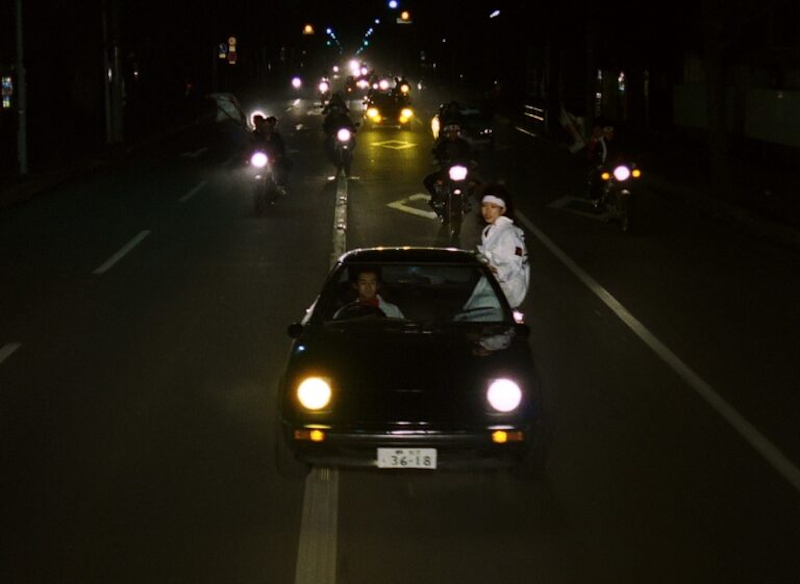
The film seems to walk a tightrope between celebrating life and plumbing its more depraved elements. For the former, Namie sits on the car door of a gang member as it and other cars and bikes speed jubilantly through the streets, wheels swerving, tyres screeching, with the police at the back in hot pursuit…
which beats the sheer exuberance elsewhere of teenagers in school dancing to music or pushing together in rioting crowds. For the latter, those crowds mask rapists assaulting female teachers, while the film also includes a boy’s stepmother falling or being pushed down the stairs and a fatal accident caused by reckless driving. The distance here between joyously embracing life and the occurrence of tragedy is paper thin.
As well as Tom Mes’ commentary, the disc includes a fascinating interview with producer Kunihiko Ukai. An informative video essay on Juvenile Delinquency in 80s Japan by journalist James Balmont, and the film’s trailer.
Blow the Night is out as part of the Chusei Sone Double Feature on Blu-ray in the UK on Monday, July 27th.
Trailer: