A Better Tomorrow (Yingxiong Bense, 英雄本色)
Director – John Woo – 1986 – Hong Kong – Cert. 18 – 94m
*****
The seminal gangster movie that crystallised John Woo’s now-trademark style of brotherhood, bullets and blood and catapulted Chow Yun Fat to Oriental, big screen stardom – 4K Restoration is out on 4K UHD and Blu-ray from Monday, 28th September
After a decade directing comedies and kung fu movies (many for Golden Harvest), Woo’s last two films had been box office flops when producer Tsui Hark gave him the opportunity to make A Better Tomorrow, loosely based at least in plot and character terms on the gritty The Story of a Discharged Prisoner / Yingxiong Bense (Kong Lung, 1967).

Hong Kong’s cinema owners had no problems with two of the three proposed leading men – Ti Lung (from Drunken Master II, Liu Chia-Liang, 1994; Shaolin Temple, Chang Cheh, Wu Ma, 1976) had achieved great success in director Chang Cheh’s martial arts epics at Shaw Brothers (Woo had worked as assistant to Chang early in his career) and Leslie Cheung (from Happy Together, Wong Kar-wai, 1997; Once a Thief, John Woo, 1991; A Chinese Ghost Story, Tsui Hark, 1987) was a successful singer – but Tsui and Woo had to fight hard for third lead Chow Yun Fat, a big TV star lacking any box office clout.

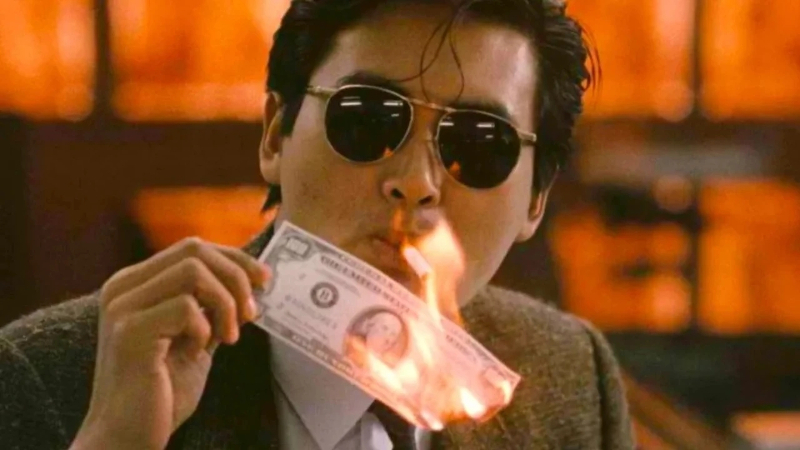
Producer and director both believed Chow, often since compared to both Robert De Niro and Cary Grant, to be something special – and what he was to put on the screen here proved them right. Whether toting guns, eating food or simply grinning, Chow outshines every other actor in the picture. His character Mark Gor’s long black coat, Ray Bans, matchstick in grinning mouth and twin pistol-toting gunplay became Chow’s subsequent trademark.

A cinematic icon is born as the cheerful Mark / Chow, a pretty girl on his arm, enters a restaurant planting pistols in corridor plant pots before going inside a room with guns blazing from both hands to shoot up the guests at a private party. Throwing down the empty guns, he retreats backwards, grabbing the previously planted pistols and shooting as he goes. To top it all, one of the gangster film’s most powerful portrayals of human mortality occurs as an all but dead assailant shoots out one of Mark / Chow’s kneecaps and Mark / Chow walks painfully over to the shootist, one dragging foot trailing blood, to empty a pistol point blank into the wounded man’s head.

The convoluted plot centres around the misfortunes of established triad pals Ho (Ti Lung) and Mark / Chow, their betrayal by rising triad new boy Shing (Waise Lee, similarly cast in Woo’s Bullet In The Head, 1990) and further complications ensuing from the profession as a cop of Ho’s younger brother Kit (Leslie Cheung). If on paper the two blood brothers’ relationship appears central with Mark peripheral, Chow’s onscreen charisma changed all that to turn him into not only a major oriental star overnight but also Woo’s onscreen alter-ego.

Woo would rework and refine the theme of the gangster and the cop who bond with one another in both The Killer (1989) and Hard Boiled (1992), but never again (sequels to A Better Tomorrow notwithstanding) would he make the two men actual brothers nor fail to cast Chow as one or other half of the equation.

A huge Hong Kong box office hit, A Better Tomorrow single-handedly revitalised the Hong Kong gangster picture just as Tsui’s earlier directorial outing Zu Warriors From The Magic Mountain (1983) had previously reinvented the Hong Kong supernatural epic with state-of-the-art special effects. Suddenly Woo’s flagging career was once again up and running, his trademark style of balletic bullets and blood a highly visible and irrefutable commercial proposition on the jade screen.
A Better Tomorrow 4K Restoration is out on 4K UHD and Blu-ray as part of the A Better Tomorrow trilogy from Monday, 28th September 2026.
It recently played as part of Bullets and Brotherhood: The Films of John Woo at BFI Southbank from Friday, 3rd July to Friday, 31st July 2026.
This followed its release in cinemas in the UK on Friday, June 26th.
Trailer: