Tristes Tropiques
(Seulpeun Yeoldae, 슬픈 열대, lit. Sad Tropics)
Director – Park Hoon-jung – 2025 – South Korea – Cert. 18 – 107m
*****
After Master’s death, various members of his group of assassins he has trained from their childhoods vie for control of his former territory – from LKFF, the London Korean Film Festival 2026 which runs in cinemas from Monday, November 2nd to Tuesday, November 16th
In a jungle, The narrator begins his tale. It is strange that he should be speaking to us because he is, in fact, a deaf mute, who consequently never speaks. Apart, it would seem from within his own head. To which musings we as the audience are privy.
Anyway, the narrator talks in clearly reverential terms about Master (Kim Myung-min). Master was possessed of great wisdom. People would bring to him problems they did not know how to to resolve. And he would be able to resolve the answer just like that. Every time.
Just when the audience is starting to imagine Master as some sort of benevolent, socially benevolent guru or spiritual leader, the narrator takes us back to how Master established himself in an unassailable position of power. And our perception of Master Is completely flipped.
Master talked a great deal about not succumbing to fear, and we see him establishing himself following an uprising of a national Liberation Front where he suddenly ruthlessly and efficiently turns against all his co-fighters in the Liberation Front and one by one shoots or otherwise kills each and every one of them.
Apart from one of his victims who somehow survives a slicing of the neck which should have killed him. This character later returns to attack Master’s organisation, and bring both it and him down.
Master tells Roo (Lee Sin-young), the narrator that he, Roo, needs to take a year off. Master gives him all the money he could possibly need and tells him, he can go anywhere he likes for the year off. After that, he’s welcome to disappear and do whatever he wants or return to Master. Master is happy either way.
Roo, has not been particularly anxious to travel anywhere. He is quite content for his year off to consist of hanging out at the local fruit juice bar, perhaps learning the trade of how to make such beverages with the friendly, girl at the counter.
Then one day, Roo learns from Jojo (Park Yu-rim from Drive My Car, Ryusuke Hamaguchi, 2021), his adoptive sister In Master’s family, that master is dead. Master It transpires, would take in kids when their parents didn’t want them. At a price. The parents would sell their kids to him.
Master is now responsible for this group of maybe 20 or so kids. He has raised them in the jungle, a place which like Master himself shows no mercy. Roo never goes into details, but Master somehow raises the kids to be assassins under the name Tristes Tropiques, a moniker gratuitously swiped by the director from Claude Lévi-Strauss’ eponymous memoir. Or perhaps not entirely gratuitously, given scenes at various points of the jungle in the rainy season as if the very sky itself was were crying, depositing its water onto leaves and vegetation.
Thus we come to the present. Roo who is on holiday, and ostensibly out of the situation, finds himself in the middle of a power vacuum. With Master out of the way, various members of his trained child assassin family vie for power. Among them are Master’s business partner Peng (Chen Yi-Wen), the eldest surviving member of Tristes Tropiques Jang (Park Hae-soo from Squid Game, TV series, Season One, 2021), and Jang’s trusted companion Rain (Austin Lin). Also in the picture is the local gangland boss (Wang Po-Chieh from Yi-Yi, 2000; A Confucian Confusion, 1994; A Brighter Summer Day, 1991; all Edward Yang).
This allows director Park to build a narrative involving urban power struggles for the control of the gangland space that was formally run by Master, which delivers serial, bravura, non-stop action set pieces in which various members of the Tristes Tropiques, now grown like Jojo or Roo himself to teenage or young adulthood, attempt to wipe out various other members or gangland factions.
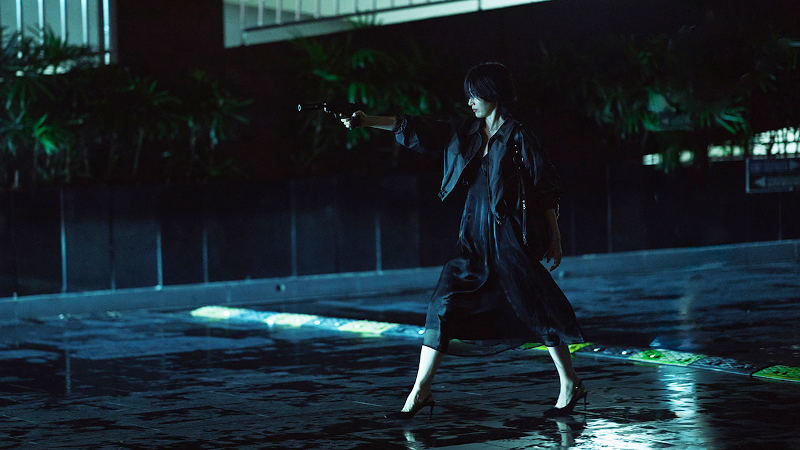
These set pieces, and there are a lot of them, are breathlessly exciting and staged with considerable panache. In what may be the the film’s most impressive such sequence, Jojo enters a building and ascends one of its fire exits removing a high heels. She then waits by the door of the fire exit until a security man comes in to check it. At which point she kills him, then his colleague, then then numerous other security goons and present gangsters.
Having successfully single-handedly massacred high volumes of people, she then retreats back into the fire exit to make her way down to the main entrance on the ground floor, going through a complete change of clothing on the move as she does so so that she exits the building through the lobby passing suited security men just as they are receiving a phone call and start going into the building to find out what has happened.
Roo, meanwhile, recalls Master telling him he is not that smart and sometimes takes a long time to understand things. Yet this is also a strength, because it gives him power in that he sees things that other people do not see. There’s no greater proof of this than the scene where he’s allegedly being arrested. In handcuffs and taken to the police station, but having previously, as his voiceover tells us, studied maps of the entire city in great detail so that he knows where every street is, he realises from a tiny slit In the van in which he’s being transported that he’s not being taken towards the police station but rather in another direction. Consequently, he seizes control of the situation and shoots the half a dozen or so armed suits sitting around him in the back of the van, then shooting shooting still more when the doors of the stationary van are opened before walking to safety.
There are numerous such sequences, thrilling in terms of their choreography and execution yet, at the same time, distant and cold. Its central conceit of a deaf person fighting his way through a hostile world recalls Boy Kills World (Moritz Mohr, 2023).
If the film exists primarily to deliver these set-pieces to an action hungry, mainstream audience, outside of the action, in its quieter moments, it delivers something entirely different. Almost as if we were watching a relationship movie shot by Chris Doyle for Wong Kar-wai (Happy Together, 1997; In the Mood for Love, 2000; 2046, 2004).
Jojo slumps her upper body a table in the fruit juice bar where Roo hangs out and sits contentedly, smiling at him. Later in the same bar, Roo sits at a table with a glass of fruit juice sitting in front of him with a straw sticking out, while across the table, while across the street, another glass of fruit juice its on the table, indicating his unseen observer. It’s in these quieter moments outside the mayhem that the film seems to find its core.
The film was shot in Thailand using several Oriental languages.
Content Warning: extreme violence, graphic imagery, disturbing themes.
Tristes Tropiques plays in LKFF, the London Korean Film Festival 2026 which runs in cinemas from Monday, November 2nd to Tuesday, November 16th.
FURTHER PROGRAMME INFORMATION:
Facebook: @theLKFF
Twitter: @koreanfilmfest
Instagram: @london_korean_film_festival
Homepage: https://www.koreanfilm.co.uk/
Trailer:
Trailer (LKFF 2026):