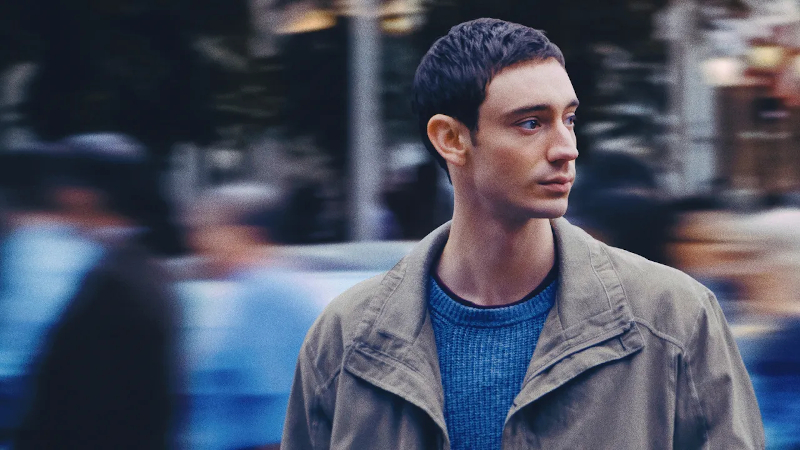
Nino (Nino)
Director – Pauline Loquès – 2025 – France – Cert. 15 – 96m
****1/2
A young man attempts to cope with the news that he has throat cancer in his first weekend following diagnosis – out in UK cinemas on Friday, June 19th
There are some films you watch which are so close to parts of your own life that it’s impossible to be objective about them. This doesn’t happen very often to this writer, but it happened on this film. Over a year ago, completely out of the blue, I was diagnosed with breast cancer. As a UK citizen I’m entitled to free healthcare, and as a cancer patient my treatment is fast-tracked. My initial experience was of being tested for cancer, waiting a week or so for the results to come back, and having the presence of the cancer confirmed. That gave me around ten days to adjust, but it was a terrible shock. Not least because my (mis)understanding was that men didn’t get breast cancer, only women did, so that couldn’t possibly be what I had. And, obviously, it was life-changing.
Cut to the film Nino. A name film, named after its central character. What follows is my own highly personalised reaction as a cancer patient / survivor.

Nino (Théodore Pellerin from Lurker, Alex Russell, 2025; Never Really Sometimes Always, Eliza Hittman, 2020) is a young man about to celebrate his 29th birthday. (I am middle-aged, so that’s a striking difference right there. It’s worth pointing out that, increasingly, in the Western world, more and more young people are being diagnosed with cancer. In their 20s, 30s and 40s.) He goes to the clinic to pick up results of what he had assumed to be routine medical tests, for human papillomavirus (HPV) and learns from the results that he has throat cancer, which is often linked to that virus. In a second, his life is turned around. (Another difference with me – yes, there was a moment when I felt a lump in my chest and wondered, “cancer?”, but there was another week or two before that suspicion was confirmed by tests. A pretty devastating experience.)
In addition to everything else, his fertility will be affected, so he needs to take a sperm sample at some point over the weekend and get it frozen by the sperm clinic before he starts chemotherapy and radiotherapy. One more thing to worry about which he really doesn’t need.
What I completely related to – and I would guess it can apply to a lot more than a cancer diagnosis, any life-changing news for the worse, in fact – is the feeling of your life suddenly and irrevocably being turned upside down. There’s an emotional truth here, and director Loquès’ matter-of-fact observation of Théodore Pellerin’s extraordinary, down-at-heel performance, captures it brilliantly.

Cancer notwithstanding, Nino is a fairly ordinary young man. He has a job and a liveable-in Paris apartment, and he gets around by bicycle. He also has an unfortunate habit of locking his keys in his apartment, which doesn’t really matter because the building’s concierge can sort him out. This particular Friday, however, there’s a note on the concierge’s door saying he’ll be back soon. Only he doesn’t appear. That seems to function as a metaphor for everything else that is going on in this very short slice of Nino’s life we are observing.
So as well as his longtime term bad news about cancer, Nino must contend with the short term problem of where to go while he can’t access his flat. At least he has his bicycle, so he can get around. When he turns up at the apartment of his mother (Jeanne Balibar), her immediate response is, have you locked yourself out of your flat again? But as he tries to talk to her about that morning’s medical diagnosis, he just can’t seem to get the words out, and she is pretty useless at helping him. Whatever he meant to try to say goes left unsaid.
Another thing he really doesn’t need at this point is for his friends to hold him a birthday party. But they do, and he’s there, partying hard but, once again, in a situation where he’s unable to talk to anyone about his diagnosis. Not even his bast mate Sofian (William Lebghil from Arco, Ugo Bienvenu, Gilles Cazaux, 2025). Eventually he loses it and slams the door on some unsuspecting guests with a terse, “I have cancer!”
Nino’s returns back to his flat prove fruitless; finally, he forces his way in to the office and finds the concierge lying, prone, having had a heart attack. He does the right thing and calls the emergency services, but as Nino is hunting through the office for his keys, before he can find them the officious ambulance man has ushered him out of the room and locked the door, sending Nino back to square one. It would be comic if it weren’t so tragic: laughter in the face of death, and all that.

His bizarre head space is further explored in an equally bizarre encounter in a building with a stranger (Matthieu Amalric from A Private Life, Rebecca Zlotowski, 2025; The Grand Budapest Hotel, Wes Anderson, 2014; Munich, Steven Spielberg, 2005) who is never seen again. Indeed, people Nino barely knows play a key role. Early on, unable to talk about his situation, he runs into an old school friend Zoé (Salomé Dewaels) he scarcely knew who is now a single parent mum about to sell some old baby accessories. He improvises a story about being a parent to be and offers to buy one or two items. But when he drops round later, this barely known woman is the one person he confides everything in, including his need to get a sperm sample together, something he struggles with throughout but just can’t bring himself to do, probably because of the stress of his main health worries. When he gets nowhere, she helps him out by reading him through the bathroom wall passages from Anaïs Nin’s erotic writings, which does the trick.
And then he has to overcome the obstacle of turning up, small container in hand, at the hospital with ten minutes to freeze his sperm sample only to find he’s too early in the morning and they’re not yet open, a desperate situation.
More than his immediate plight, the film effectively explores Nino’s state of mind as his personal sense of existence is blown apart. My personal experience is that it’s not so much, as people on the outside expect, the physical stuff that gets you (the diagnoses, the surgical interventions, the treatments, the meds, the side effects) as the psychological impact. As a cancer patient / survivor, that element is what I related to here; I take my hat off to all those involved in this extraordinary movie.
Nino is out in cinemas in the UK on Friday, June 19th.
Trailer: