
Director – Takashi Ishii – 1994 – Japan – Cert. 18 – 108m
****1/2
After her undercover cop husband is killed by a gang, Nami infiltrates the gang and suffers much abuse as she attempts to identify and take her revenge on his killer – out on Blu-ray as part of the Takashi Ishii: 4 Tales of Nami limited edition digipack set (2000 copies)
A compelling yet initially indecipherable image is slowly revealed, as we pull out, to be a pink marker pen colouring the handle of a black pistol in the hands of a girl wearing the pyjama top of the man against the side of whose bed she is sitting. He, it turns out, is Mitsuru (Toshiyuki Nagashima from Godzilla Against Mechagodzilla, Miyagawa, 2002; Godzilla vs. Biollante, Seiichi Yamamoto, 1989; Mishima: A Life in Four Chapters, Paul Schrader, 1985), an undercover cop; she is Nami (Yui Natsukawa from I Wish, Hirokazu Kore-eda, 2011; Still Walking, Hirokazu Kore-eda, 2008; Zatoichi: The Blind Swordsman, Takeshi Kitano, 2003), and she’s fed up with his lack of contact while he’s on the job. As they embrace, she pleads with him, “Don’t do it! Tell them it’s too dangerous!” As a sex scene proceeds, the camera moves to observe a shielded, portable gas ring heater over which the first part of the main titles play.
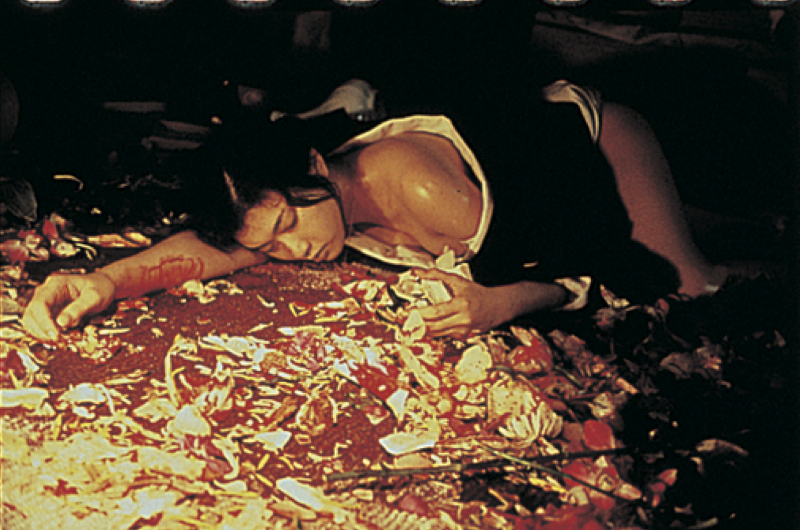
A man in a colourful shirt is shot by another collecting a package at the waterfront at night. In the rainy daylight aftermath, in a highly atmospheric scene, the police find the floating body. Mrs. Tsuchiya, i.e. Nami, must identify her husband’s body, and is subject to an audible barrage of questions from the (unseen) attending press. Later, Mitsuru’s father visits Nami’s mother (Junko Miyashita) and Nami herself to offer his condolences. The police have axed Mitsuru’s pension. Nami has the urn of her husband’s remains (the contents of which which appear to comprise broken china, one piece of which she puts into a necklace locket as a keepsake), but her time alone with this is interrupted by the arrival of four thugs in search of the drugs her husband “stole”. They empty to the funeral urn before, in a deeply unpleasant if mercifully brief scene, starting to gang rape her.
On waking, Nami eats one fragment of pottery and slits her wrist with another. She wakes in hospital, her mother at her side. tormented by the idea that everyone knows; hanging bed curtains blow in the wind amidst a barrage of flashes from unseen cameras and questions from unseen journalists, against which she protests her husband’s innocence.
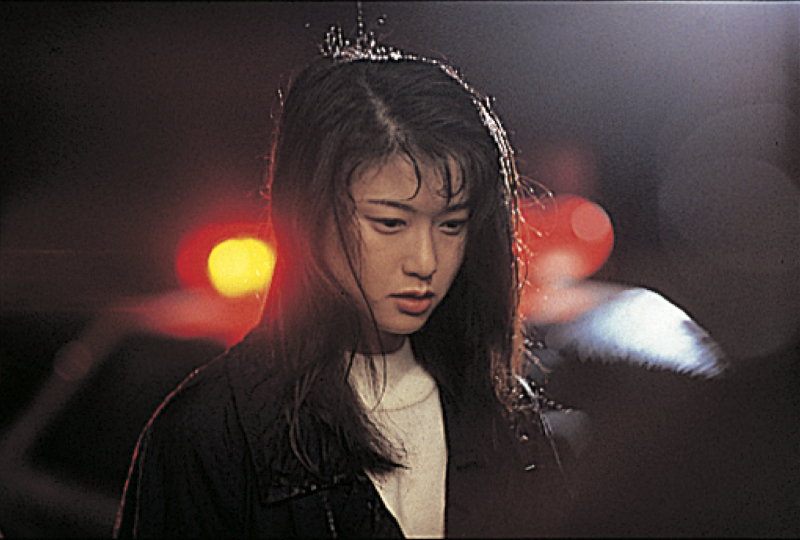
In an underground car park, she observes members of the gang and, armed with a small knife, is prevented from attacking one of them by Muraki (Jinpachi Nezu from Ran, Akira Kurosawa, 1985; Kagemusha, Akira Kurosawa, 1980; Angel’s Egg, Mamoru Oshii, 1985) – the leader – who conceals her presence as a feud erupts and another gang member is stabbed. After taking an overdose by the sea, she wades into the water and floats, like a figure caught in limbo between this world and the next, only to be rescued by a swimming man – the guy who rescued her earlier. He tells her he knows what she’s up to; only after he’s left, does she realise the necklace has gone.
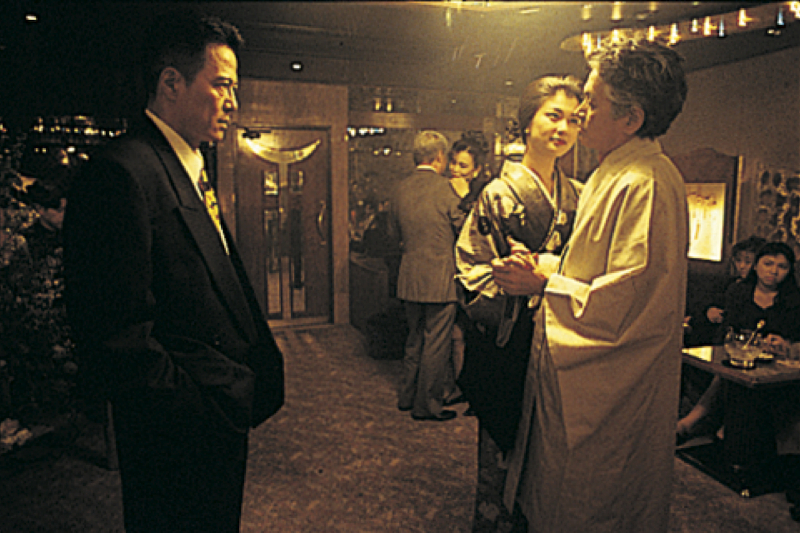
In a hostess club, she is selected by the Madam (Noriko Hayami from Dreams, Akira Kurosawa, 1990; Love Hotel, Shinji Somai, 1985) for Muraki’s clan leader Mr. Ikejima (Minori Terada from Laputa: Castle in the Sky, Hayao Miyazaki, 1986; Love Hotel; Typhoon Club, both Shinji Somai, 1985) on the pretext of being “the new girl from Hokkaido”, watched suspiciously from the next table by Muraki, who the boss instructs to dance with her. As they waltz in the ballroom next door, he tells her he can’t save her next time. She retaliates by threatening to expose him as looking out for her like a traitor. After the boss takes her to eat sushi, Muraki gets into a fight by the lift with two thugs from a rival clan.
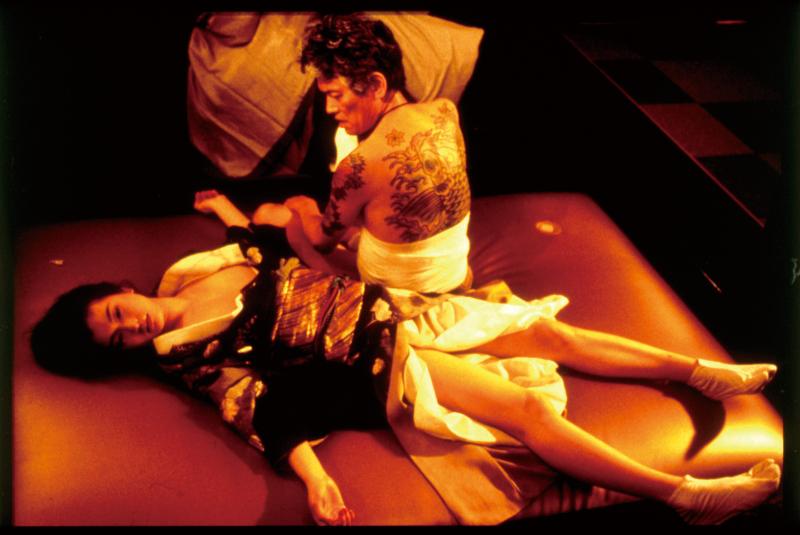
In his hotel room, Ikejima dumps the drunken Nami unceremoniously on the water bed before forcing himself on the unwilling girl. Outside injecting his hand with a syringe, his guard Shibata (Kippei Shina from Outrage, Takeshi Kitano, 2010; A Night in Nude, Takashi Ishii, 1993, Shinjuku Triad Society, Takashi Miike, 1985) is summoned to find the barely conscious Nami floating in a huge bath and initially refuses Ikejima ‘s request to have sex with her. When she later wakes in bed beside the sleeping Ikejima and quietly attempts to leave, it feels like a bad dream. As, infinitely slowly, she pulls from her handbag a knife with a bottle of poison as its handle, Shibata sneaks up on her and tells her not to leave before the boss wakes up.
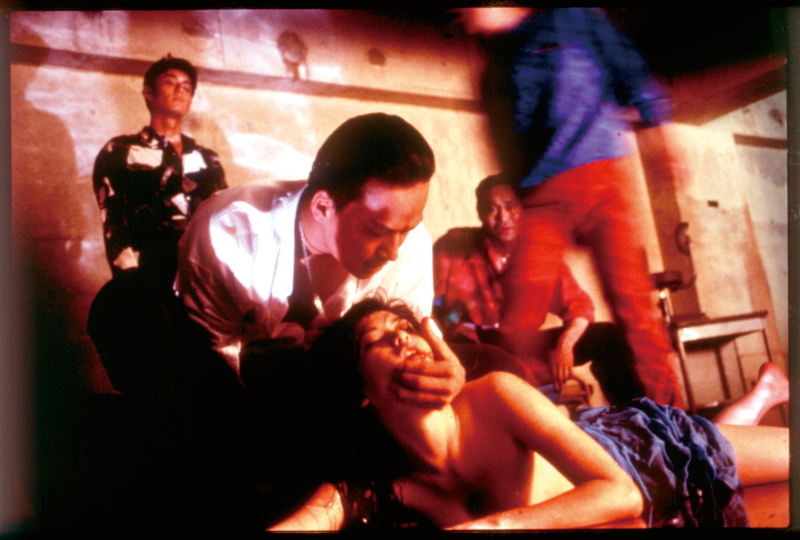
Later, she joins the gang and the boss in their room to play Mah Jong. Later still, she stabs the boss in his sleep, waking him into a frenzied if ineffectual attack, which leads to her being tortured. In the aftermath of a row over a snitch with fellow gang members, Muraki cuts off the tip of one finger. Instructed by their departing boss to “Sell her off in Chiba – but at a good price, though”, the gang play ‘rock, paper, scissors’ over the unconscious woman.
We move through a rundown part of town to the sleazy Yoko’s Tea Room, where Nami is disinterestedly servicing a man in a back room until Muraki turns up to take her away, despite a heavy being assigned to accompany them by the house Madam. However, all the speed-addled Nami can think about is getting her next fix. Holed up with Muraki in an abandoned building, she goes through cold turkey, eventually feeling well enough to tidy the place up a bit, clean her torso (with his help) and get him to show her how to hold and shoot a pistol (which at one point, she points at him loaded).
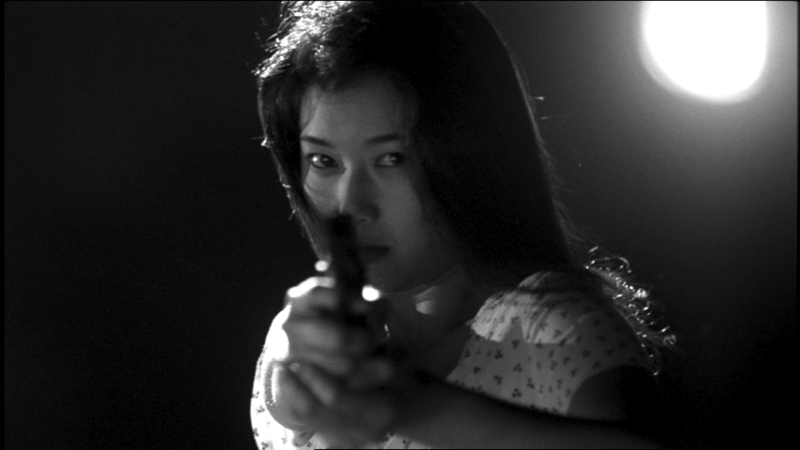
All off which moves towards Muraki’s helping Ikejima escape from a police raid on a gambling joint, sending the boss up to the roof in a lift where Nami is waiting for him with a pistol…But her plan doesn’t play out quite as intended…
The cinematographers – two are credited: Norimichi Kasamatsu from Villain, Lee Sang-il, 2010; Blue Spring, Toshiaki Toyoda, 2001; August in the Water, Sogo Ishii, 1995; Burst City, Sogo Ishii, 1982; Crazy Thunder Road, Sogo Ishii, 1980; and Yasushi Sasakibara from A Night in Nude, Takashi Ishii, 1993; Original Sin, Takashi Ishii, 1992; Violent Cop, Takeshi Kitano, 1990 – are fond of using lengthy, locked off, carefully composed camera shots within which Ishii can get his actors to weave their magic: although there’s a lot of nudity, Ishii seems far more interested in the psychological interplay of his characters than titillation, and his cast – particularly the three leads – serve him well.
The finale has you wondering where it could possibly go in the last ten minutes, then pulls an extraordinary, bravura scene seemingly out of nowhere. Although, as you watch, you realise the whole film has been building towards this.
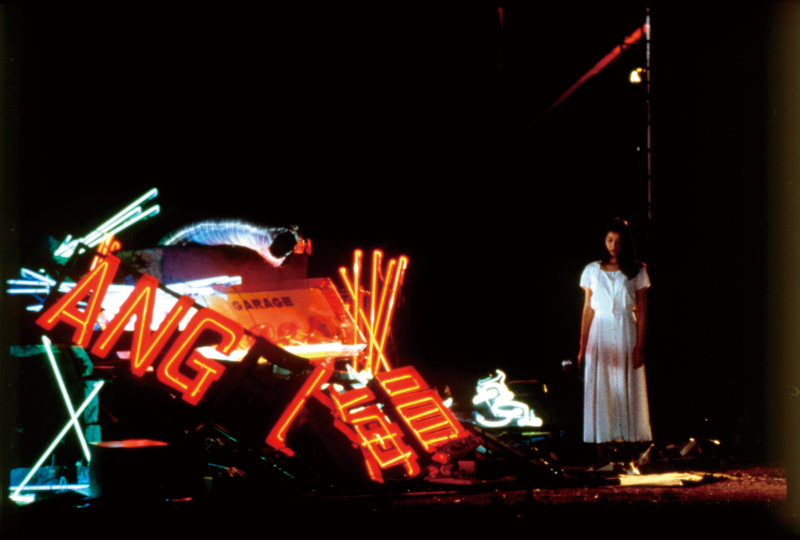
Overall, much of the action takes place at night (as you might expect from the title). The aftermath of the finale plays out over a misty early morning. This look, coupled with the often slow pace of the more dramatic scenes, and the onslaught of unseen paparazzi and reporters from a hostile media circus, helps lend the whole the drifting feel of a dream in which nothing feels quite grounded. This is augmented at various points by scenes of rain falling on water surfaces and snow falling. Altogether, this makes for a remarkable viewing experience.
Kimiko Yo (from Shin Godzilla, Hideaki Anno, Shinji Higuchi, 2016; Villain, Lee Sang-il, 2010; Air Doll, Hirokazu Kore-eda, 2009; Departures, Yojiro Takita, 2008; A Night in Nude, Takashi Ishii, 1993; Yumeji, Seijin Suzuki, 1991; Hiruko the Goblin, Shinya Tsukamoto, 1991) has a bit part as a prostitute.
Alone in the Night is out on Blu-ray in the UK as part of Takashi Ishii: 4 Tales of Nami limited edition digipack set (2000 copies) from Monday, August 25th.
Trailer: