Director – Bi Gan – 2025 – China – Cert. 15 – 160m
****
An authority figure pursues a Deliriant – a man who escapes the authorities and his own social responsibilities by dreaming – through a period of a hundred years – out in UK cinemas on Friday, March 13th
This opens with a long series of intertitles about people discovering that the secret to eternal life is to stop dreaming. Rebels who refuse to do this are known as Deliriants, and they cause all manner of disruption to wider society. Then, the celluloid image catches fire…

revealing people watching stupified from the cinema stalls only to be rushed out by a truncheon-wielding policeman as music plays in the manner of a silent film. A lady photographer (Shu Qi from The Assassin, Hou Hsaio-hsien, 2015; The Transporter, Louis LeTerrier, Corey Yuen, 2002; Millennium Mambo, Hou Hsaio-Hsien, 2001) appears to take a picture of the unseen projector (where we, the audience, are sitting).
The intertitles continue. One Deliriant (Jackson Yee from The Battle at Lake Changjin II: Water Gate Bridge, Tsui Hark, 2022; The Battle at Lake Changjin, Chen Kaige, Dante Lam, Tsui Hark, 2021) has been forgotten because he’s hiding in an ancient, distant past – that is film. Those who can see through these illusions are the ‘Big Others’, who can transmute into those forms the Deliriants love the most.

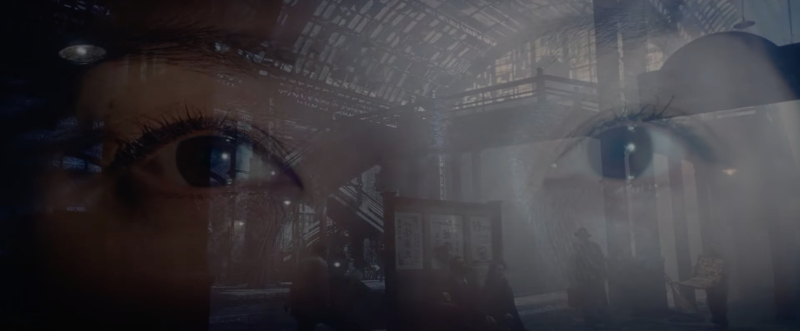
The lady photographer mounts her still camera like a rostrum camera to descend into the eye of a photograph of a male face, to see opium poppies. Could the Deliriant be hiding in an opium den?
Cue an opium den sequence. As the lady photographer enters, there are noises off as hands appear to remove various bits of walls and surfaces. She follows a serving girl (Chloe Maayan from Only the River Flows, Wei Shujun, 2023; The Wild Goose Lake, Diao Yinan, 2019; Long Day’s Journey into Night, Bi Gan, 2018) who asks a young boy to give the monster more food. The boy drops nutrient items into a hole, the lid of which resembles an early, pre-cinema device for creating the illusion of movement. The lady photographer peers into the whole; the disc starts to spin, the images upon it spring into life, a hand reaches into the nutrients and grabs some.
The lady photographer passes through serial rooms in various colour tints on the film print – a brown series of walls on which are projected the hand and arm of a monster, a red opium den where the clients have wasted into skeletons, a blue room where objects are covered in drapes, another brown room where a beam of refracted light traps her against a wall’s surface as the camera move on, abandoning her. By accident or design, this recalls The Cook, The Thief, His Wife and Her Lover (Peter Greenaway, 1989) in which characters move from one set in one colour palette through a door into a set in another colour palette, which in that film also include seamless costume changes.
The Deliriant pursues her, holding a cake where in place of a ring of candles are (stop-frame animated) poppies that bloom, vanish and wither in a movement going round the cake’s circular edge. To escape these dreams, runs the intertitle, she uses her eye as a mirror, to show him his ugliness. He drops the cake, and feasts on the fallen, now static poppies. He becomes dust, she takes that dust away. She opens his back, clears out the opium poppies, and loads a roll of raw 35mm film stock onto the camera reel inside. (this is a directorial blunder – in real life, this would expose the film to light, rendering it useless.)
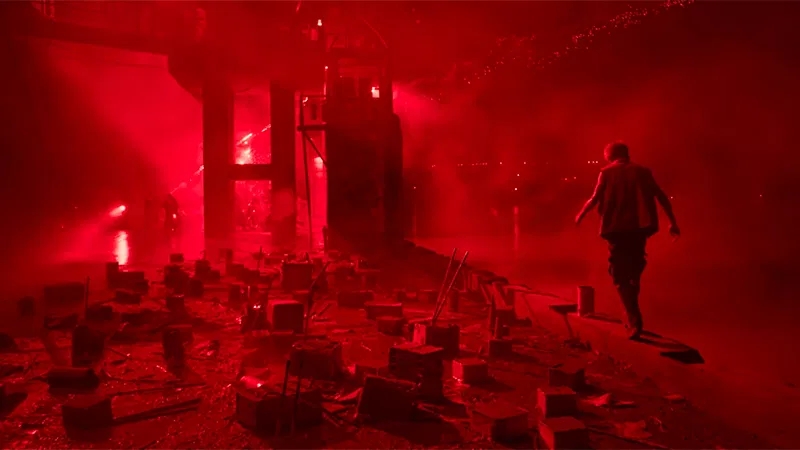
The Deliriant now finds himself in a verdant green landscape, picking up a hose that shoots water. She steps on the hose, stopping the flow. The camera mechanism bursts into flame. He holds, smells a daisy. A narrator tells us that the lady photographer kills the Deliriant by closing his eyes, but that reel of film prolongs his life for another hundred years. He falls into a deeper place, perhaps on a train, a clock suggests a vast train station.
The milieu has moved from 4;3 Academy format tinted silent film to letterbox format colour movie images with sound effects in a world which seems to be permanently night time. The narrator continues: he cannot tell if he is the monster’s shell or the person he can see in the mirror.
In a first dream, the Deliriant sutures his torso. Plain clothes men led by an inspector (Mark Chao) enter the train with pistols and proceed to search, ransack it. They find the sheet music. The Deliriant is taken for examination. He has wounds in both ears. Papers reveal his name: Qiu Moyun. The inspector gets a phone call, which could be an except from a movie or the ravings of a lunatic. He hangs up. The Deliriant, in his cell, imagines a man on the run making his way along train tracks. Questioned by the inspector, he recalls a house full of mirrors, in which he couldn’t tell which reflection was him. Why did he kill him? He was stuck in there for ages, until the man got him out. Images show a man picking him up off train tracks, then trying to get him to lay down in the path of an oncoming train. One of them has a knife.

Listening to a tape, the inspector starts to annotate the score, now revealed as by Bach. The Deliriant is hung upside down and beaten. His answers to questions become increasingly obtuse. Their two pairs of eyes eyes reflected in separate car windscreen mirrors, the inspector drives him through tall grasslands to first the burning tree, then a mirror shop where, at gunpoint, he gets the Deleriant to open the heavy, portable box belonging to the murdered musician (Yan Nan). Inside – a theramin. The inspector shoots the Deleriant several times, but all his bullets do is break mirrors; these are mere reflections. Sometimes, a breaking mirror reveals a reflection of the inspector beyond. This recalls the mirrors sequence towards the end of The Lady From Shanghai (Orson Welles, 1947).
“What organisation do you belong to?”, asks the Inspector. “I belong only to myself”, replies the Deleriant, suddenly stabbing the Inspector in the ear. A train pulls in. The inspector, in order to hear, stabs himself in the ear. He opens the box and begins playing the theramin. He stabs the Deleriant in the back and starts to cut the latter’s flesh so that the light can shine through from inside his victim’s body and he can hear the heavenly, choral music. Fire engulfs the moving railway carriage.

In a second dream, Twenty years later, the Deleriant is in a town in winter where extensive work is going on. A gang are robbing a temple of its statues. Dismissing the gang for a hot meal, its boss wants to know whether there is anything inside the statue the Deleriant is inspecting. To the Deleriant’s surprise, he cracks it open for the boss. After being woken from a dream when a voice tells him how to break open a statue, he uses a statue fragment to take out a troublesome tooth and throws it away in a snowball, only for it to turn up as a man claiming to be the Spirit of Bitterness (Chen Yongzhong) who resembles his father. The narrator notes the Deleriant subsequently turns himself into a dog.
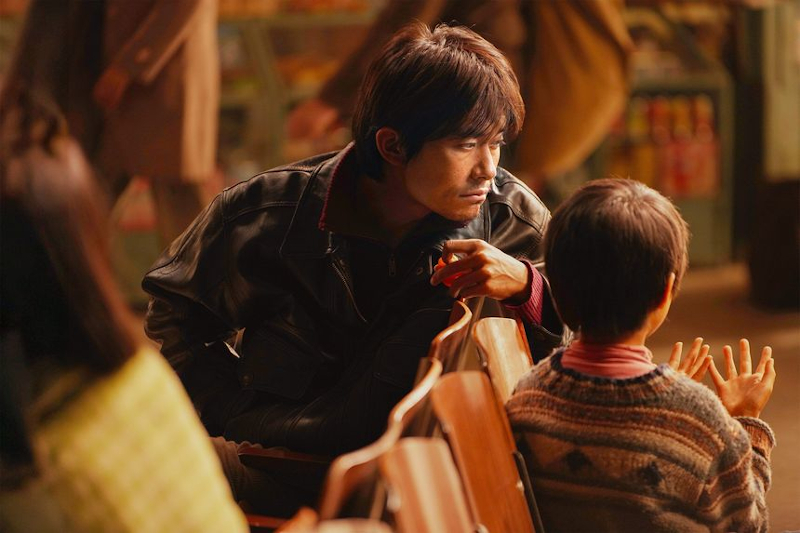
In a third dream, ten years later, the Deleriant and another man find some money that someone has accidentally dropped and split it 50-50. He checks into a hotel room and learns from the receptionist that the old man has a stranger smell. Of formaldehyde. He finds a partner to work with, a young orphan girl (Guo Mucheng) who you could be forgiven for thinking ia boy. He takes her to see a big boss (Zhang Zhijian) and they make a killing blind reading playing cards. Then he tries to get a bus out of town, but is caught by the partner of the man with whom he split the earlier money. Later, he escapes on the rooftop of a bus.
The big boss, meanwhile, hooks up the young girl to a lie detector test. He has a burned letter from his estranged daughter who died in a fire, and he been unable to read it. He wants the young girl’s help.
The widescreen image increases in height (dropping below the area where the subtitles appear). The narrator tells us that the Deleriant’s time is running out as he arrives at the last night of 1999.
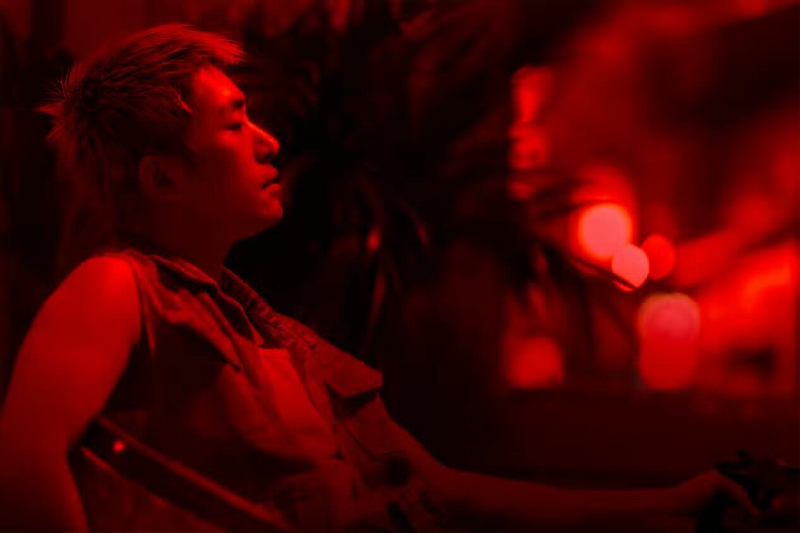
In a fourth dream, as Apollo, the Deleriant meets young woman Tai Zhoumei (Li Gengxi). They wander the night streets, ending up at a nightclub where gangster Mr. Luo (Hwang Jue from Better Days, Derek Tsang, 2019; Long Day’s Journey into Night) faultlessly sings a ballad while in the background, his men beat the Deleriant up with fists, clubs and candelabra. Luo questions the Deleriant, who shoots him through the hand. Luo takes it all in his stride; after he’s left, Tai Zhoumei sings another ballad. Outside the window, like a film on fast-forward, people go into time lapse. In the blue, early morning light, the Deleriant and Tai Zhoumei run through the millennial streets towards to sea, leaping onto a docked barge, which they steer out of the harbour. He asks her to bite him; she does so, on the neck. She is apparently a vampire. They embrace and kiss, bloody mouthed until he loses consciousness. The boat heads out towards the sunrise. This whole sequence recalls the director’s earlier, delirious and frankly superior Long Day’s Journey into Night.
Only two hours have passed for her, says the narrator, but a hundred years for him. She infiltrates the Deleriant’s final dream. She straps him to an operating table, winches him upright, shaves his head, and refits his prosthetic monster mask and glove hands from the silent movie opening. Resetting him to horizontal, she wheels him through dry ice to a lift, descending to a floor where they are outside a large chamber. She opens the door, a mirror on its inside. Now he floats in mid-air. Now he moves forward – he is descending, not moving forward, into liquid below. She initiates a final conversation with him “using the log-forgotten language of cinematography.”
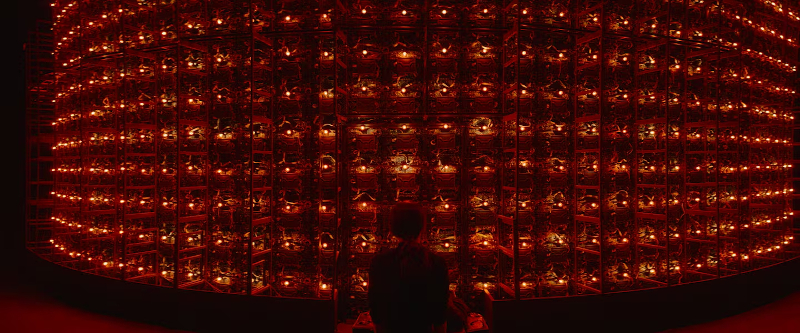
Finally, in an Academy, sepia image, silhouettes of bright light gather in a ruined cinema auditorium to sit and watch the screen. The film ends, and they fade out one by one. The seats fall away. The place starts to slowly melt.
The first half hour or so – the silent movie sequence – is enthralling, and you wonder where the film is going to go after that. As the dying Deleriant plunges into his four subsequent dream sequences, the problem is that these are really four separate short stories, and the spinal story about the Deleriant isn’t really enough to hold them together.
Yet, each of the stories have their moments and their merits.
I particularly liked the sequence near the start when pigeons congregate around the window of the lady photographer’s studio as she gazes out. It doesn’t so much add to the overall piece as provide a satisfying moment, which tells you everything that’s wrong with the film as a wider whole.
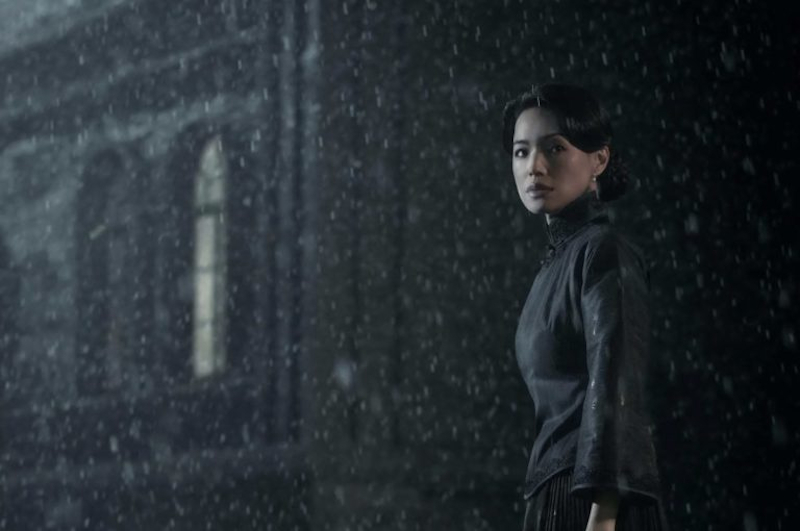
Others sequences that are real winners include the Deleriant holding a cake of poppies placed on it lake candles, an homage to the early devices for making moving images at the birth of cinema. And finally, Mr. Luo’s delivering an entire ballad, from start to finish, as the Deleriant gets beaten up behind him on the screen.
For the rest, while some of the images leap out at the viewer in an arresting manner, the whole thing after the terrific opening half hour feels overly long and indulgent. Which is a pity, because as it starts off, it seems to have a lot of promise.
Resurrection is out in cinemas in the UK on Friday, March 13th.
Trailer: