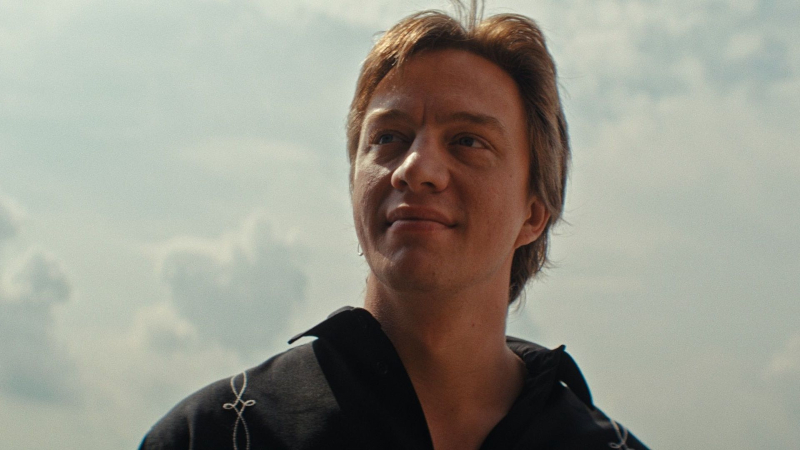
Mo Amor (Mo Amor)
Director – Eeva Mägi – 2026 – Estonia – 78m
*****
At her isolated, converted boathouse home, a young woman juggles her three male suitors – premieres in the Critics’ Picks Competition of the 30th Tallinn Black Nights Film Festival
Eeva Mägi, who is Estonian, has the distinction of being the only director to date to return to Tallinn’s Critics’ Picks section in its five year history. I rather suspect she likes Bergman’s films, because watching both this new film and her earlier Mo Papa, which played Critics’ Picks in 2025, I found myself thinking of moments in The Seventh Seal (Ingmar Bergman, 1957). This new film, however, also reminded me of the central conceit of what many consider Bergman’s masterpiece, Persona (Bergman, 1966).
Both of Mägi’s films feature beaches to a lesser (Mo Papa) or greater (Mo Amor) extent. The new film might reasonably be described as a chamber film. Where the earlier film’s trajectory freewheeled through urban Tallinn, this one is locked into a specific location, a converted boathouse in which central character Niina (Ester Kuntu from Mo Papa; Firebird, Peter Rabane, 2021) lives.

Not that we start with Niina, but with two men near the lighthouse near the boathouse. One, who we will later come to know as Kaur (Jarmo Reha), takes a picture of the other (Ivor Mikker), then starts telling him Niina’s story. She was always dissatisfied because she was searching for something. She had three suitors. The Mentor, the Stonemason, and the Writer. All of them are there in the flashback which forms the main body of the narrative, sitting on chairs or sofas. They observe her from the Writer’s camera on a tripod. Or rather the Writer does. The others can’t see her.
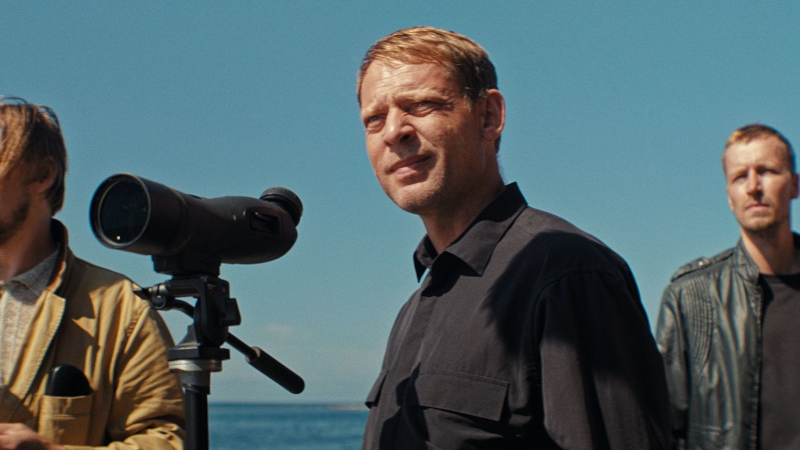
The Mentor is Allan (Andres Mähar) – the father figure. He’s helped her with her photography. Their ten year relationship is over. He asks why she doesn’t want his child. She feels guilty.
The Writer is Hannes (Tambet Tuisk) – her intellectual support. The Mentor’s half-brother. He gives her a vase. Reads her a poem from a book.
The Stonemason is Villu (Sander Roosimägi) – her best friend. He treats her as a living person, not a stone statue. Playing his sax in her presence, for instance.
In her black and white nightmares, she is humiliated by a white dress, and feels trapped by the web she has woven for the three man and also for herself. She howls but no sound escapes her mouth.
As this story of one woman and three men at the woman’s isolated home plays out, I couldn’t help thinking of Persona, a story of one woman and her female carer at the woman’s isolated home. Just as persona can be read as one woman with the two characters representing aspects of the greater character whole, so Mo Amor can be seen in terms of (1) the two characters in the frame story similarly representing parts of a larger, single character and (2) the three male suitors representing parts of another greater character, who in turn might combine with Niina to represent a greater whole still.
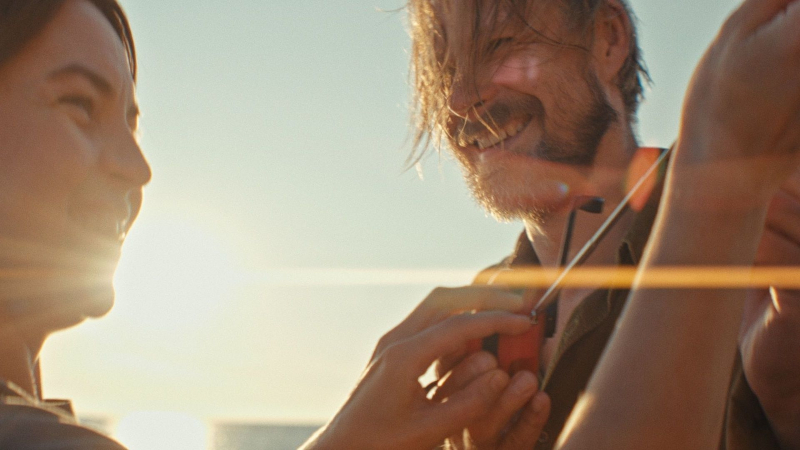
Indeed, Niina undergoes a journey in the course of the narrative which sends the whole thing in a very specific direction.
She watches the Writer winding a wind-up radio. It only works when she puts her hands on it. He mimes to I’m too sexy for my body. They talk. Or rather, he does. A story about a man who couldn’t understand a woman. Until one night he cut her open and went inside. He wanted to understand what was inside his beloved. He understands, but when he comes out, the soul is gone.
She offers the Mentor a piece of her land, in the middle of her island, but his laugh makes her feel humiliated. But he attempts to insist on paying for it.
The Stonemason questions her as to her game. Yet, his questions are obtuse and elusive. What are you up to? What are you hiding?
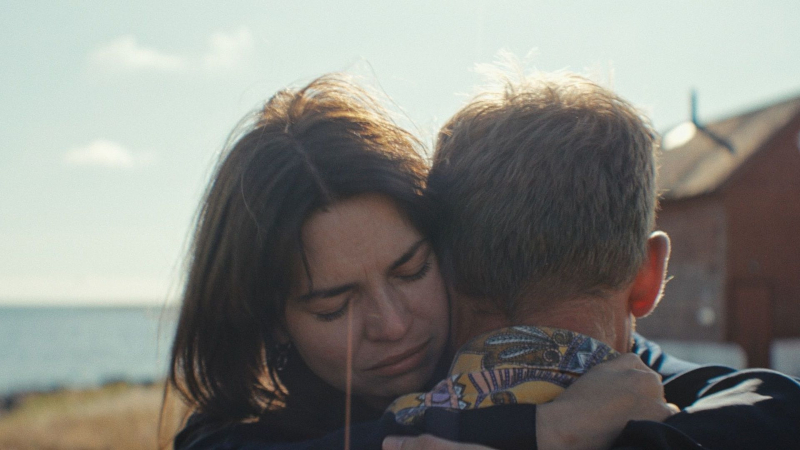
She places her hands in the clear water at the sea’s edge, as if searching for something. She worries, says the narrator, that the understand what she’s up to and that she will lose them all. In the present, to the sound of a drum kit, the two men walk around the lighthouse until the boathouse comes into view. They go down to it. In black and white, the three men, under a white veil, feed on her body. She tries to row away from them in another boat. Which doesn’t move. Their demands press in upon her.
In colour, the narrator tells us she had caught herself in her own net. Eventually, she ended all three relationships and locked herself, as it were, in her castle, away for a long time, facing her fears.
She invites all three men to her birthday. Leaving therm a poem bookmarked in a book. None of them has seen her for three years or more. The three wait for her at her boathouse, concerned about her…
There’s more to it than that, and I didn’t really expect the narrative to go where it eventually goes. Like Mo Papa, Mo Amor is a small scale film, yet strangely satisfying, if very, very different. Judging by both this film and its predecessor, Eeva Mägi is something of a wild card. You’re never quite sure what she’s going to do next, and going by the evidence of what she’s put onscreen in these two films, this is a good thing.
A lot is going on here among Mägi’s small group of characters, and the cast do a sterling job of bringing them to life before the camera. The small scale of the production enables the filmmaking process and consequently the onscreen results to achieve a certain intimacy (again, like Bergman). It’s all about what happens when actors work in front of a camera, without huge production logistics to get in the way of the pared down process. In short, this is something very special indeed.
Mo Amor premieres in the Critics’ Picks Competition of the 30th Tallinn Black Nights Film Festival which runs in cinemas from Friday, November 6th to Sunday, November 22nd 2026.
Trailer:
Critics’ Picks mashup trailer:
Festival teaser trailer: