Until Dawn (حتى الفجر)
Director – Mohamed Zineddaine – 2026 – Morocco – 85m
***1/2
On the cusp of adulthood with an arranged marriage fast approaching, a young man learns a thing or two about life – premieres in the Critics’ Picks Competition of the 30th Tallinn Black Nights Film Festiva
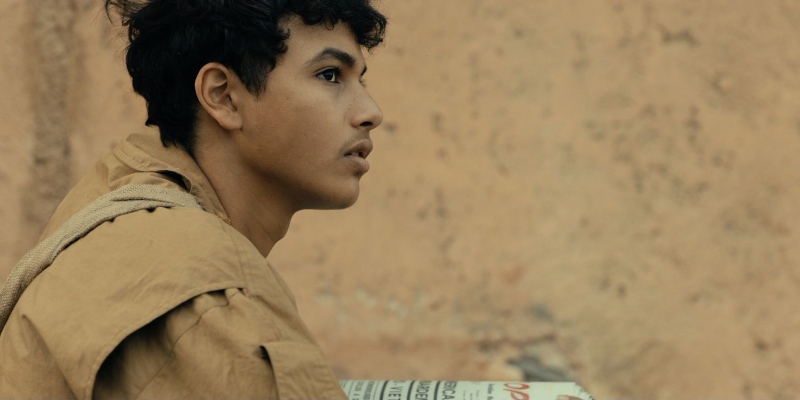
A teenage boy stares out towards… What? His proposed future? His memories of recent events? That’s the opening of this adaptation of Mohamed Zafzaf’s novel Attempt at Life / Tentative de Vie, and it repeats at the end so that this functions as a bookending device. Just as this suggests, director Zineddaine cares less about crafting a script than about making his images work which means that the film drifts and meanders rather than focusing on straightforward narrative.
That might sound like a negative comment, yet I don’t mean it in that way: it’s rather that it gives the film a particular feel, of memories merging into one another rather than straightforward storytelling.
The young man’s cousin Daoui (Yassir Kazouz) fixes up Hamid (Rida El Hadi) with a newspaper delivery round, advising him, don’t hand it over ‘til you’re paid.
Interviewed by the boss Neri (Pietro Ragusa) and his assistant Yousseff (Fathallah Saadi), Hamid says he’s “16”. He’s asked if he smokes, drinks or can read. No. Does he know the city? Yes. He’s assigned the port cafés area. The boss doesn’t speak Hamid’s dialogue, so his assistant has to translate.
Hamid starts off badly, turning left not right out of the main gate. The other kids, deriding him as a bumpkin and a hick, invite him to taste French wine from a barrel. He drinks through tubing, but spits it out. His cousin warns him against hanging out with idiots. He reaches the port cafés and starts selling.
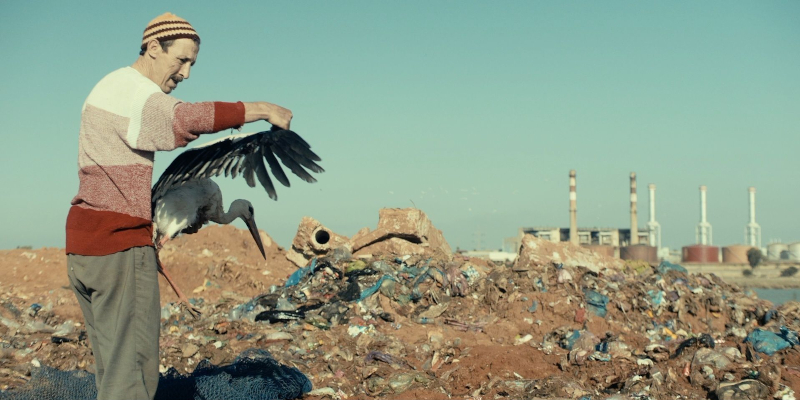
And then we shift to shots of magnificent storks nesting atop cranes or other waterfront furniture. A wandering man observes seabirds and cattle on the beach. Prises out something lodged in the stork’s beak. The man Lahcen (Moustapha Rachidi) is asked by Mr. Larbi to come and see him.
A woman with a boat offers to help Hamid across the river.
At home, Hamid’s parents argue. Lahcen, his dad, doesn’t work, and doesn’t have the connections at the port. His mum made a deal with the bride’s family, but his dad already gambled the required money away. That doesn’t stop Lahcen complaining to another that the boss has ruined their land, turning it into a dump which doesn’t sustain the animals. He later rescues a stork which has become tangled in an abandoned fishing net.
Hamid, on his round, window shops, looking at fine ladies’ dresses. He watches lifts ascending and descending in an apartment block. He tries hawking papers at Milk’s bar. He likes the ambience, the electric blues music. People buy the paper.
Two whores sit by the bar. In the ladies, Ghennou (Hafça El Khal) complains that Momo roughed her up. The other helps her make up a black eye so it’s no longer visible. She complains about him. Hamid, hiding in the lavatory cubicle, hears all this. He returns to Ghennou the purse that she left behind in the bathroom.
Hamid is out with his father on foot as they visit an outdoors food stall in the market. Lahcen greets Mansoura (Mansoura Mahdhi) as she passes by with his niece her daughter Faytouna (Aya Jabrane) and the young boy Mohamed.
The newspaper boss enters the bar and talks to Ghennou, who is being complained at by her boss Momo (Mehdhi Mellouk) for not bringing in enough money. The newspaper boss witnesses an unprovoked fracas between a customer and Hamid, coming to the latter’s aid.
Night. As two men fight over Ghennou outside the hotel, Hamid gives her a lift on his bicycle away from the situation. She invites him into her apartment. She lives there alone – she hasn’t seen her (girl)friend who she used to share with for a week. She offers him food, but he’s not hungry. He falls asleep on her couch and she covers him up with a blanket. He wakes in the light to see a black-haired girl. The blonde hair was a wig. She says, you men like blondes. He says, he likes her hair the way it is.
Hamid is back out on his paper rounds when a street vendor tries to sell him a mirror in a little hexagonal frame which he can’t really afford. When the boss later asks him why he’s late for work, the latter is horrified when told Hamid’s parents want him married.
He waits for Ghennou, and gives her her present – the little mirror. He walks alone in her sheets as she prepares some food. He is fascinated by her items of underwear, which are lying around. She gives him the house keys – for whenever he needs to rest.
At the hotel, he runs into his cousin who tells him to come home. He’s ruined his cousin’s position with the boss. But Hamid doesn’t want to come home for his wedding next week. At Ghennou’s, he cooks, puts music on the radio, and sweeps the floor.
At home, his dad tends to Hamid’s wounds from when he slipped. He dreams of his dad telling him he needs to get married and give him grandchildren.
One night, Ghennou comes in with a bruised face. Hamid wants to know who hit her. She says it’s none of his business. Apologising later. Gives him bracelets wrapped in tissue for safekeeping. He gives them to Faytouna who takes them to Mansoura as the completion of Hamid’s dowry.
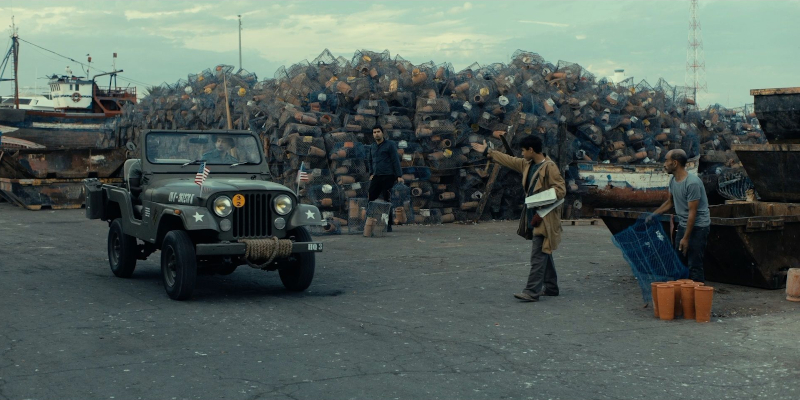
The newspaper boss and others turn up for Hamid’s wedding. He’s told to put the bottle of wine away. The women turn up in a procession. There is dancing and pipe-playing . Hamid’s hair, under his white hood, is greased back for the occasion. In the hut, his bride removes her hood and takes his hand. He sits beside her. He offers him a fig. They smile at each other.
But then Hamid storms out saying, she’s not a virgin. The voices start. That girl has no honour. She has no place here, He has caused her life to implode in a second, and you can see the confusion on her face as the camera lingers on it.
Hamid, meanwhile, cycles to the port as the sun comes up. The film ends where it began, the frame freezing as Hamid looks out on an uncertain future.
All this may meander a lot, but there’s something about it that holds your attention as it does so. Zineddaine and his cinematographer Salvo Lucchese have a great eye for local colour in an area that’s largely seedy and run-down. The newspaper offices and depot have a brisk, businesslike feel of efficiency. The various hotel bars with their clientele feel like an accurate reflection of the social world with the very poorest elements absent.
People’s living places – the hovel in which Hamid lives with his parents, Ghennou’s hotel room which she used to share with a working girlfriend but is now hers alone – feel comparatively basic.
El Hadi, Rachidi and El Khal, along with the many smaller bit-part players, are very watchable. Ulytimately, however, the film’s real strength lies the way it captures the feeling of a young man, on the cusp of adulthood, trying to get his head round a grown-up world he doesn’t really understand.
Until Dawn premieres in the Critics’ Picks Competition of the 30th Tallinn Black Nights Film Festival which runs in cinemas from Friday, November 6th to Sunday, November 2nd 2026.
Trailer:
Critics’ Picks mashup trailer:
Festival teaser trailer: