Ana, en Passant (Ana, en Passant)
Director – Fernanda Salgado – 2026 – Brazil, Portugal, France – Cert. tbc – 90m
*****
A woman from Paris travels to Belo Horizonte, Brazil where she hopes to unearth something of her family history – from the BFI London Film Festival 2026 which runs from Wednesday, October 7th to Sunday, October 18th in cinemas and on BFI Player
This opens with a profusion of images and a child’s voice asking: “mummy, what is a map?” The images are moving images treated in painterly ways, animated postcard-like holiday snaps putting themselves into order, flashes of memory as if printed on an unusual under-texture. Then an image of a baby scanned in the womb. More images – fish in the ocean, talk by the little girl of whether fish follow maps too – then we settle into the film proper.
Which is to say that, rather than the film’s form constantly shifting, it suddenly settles into a more formal, less abstract, fixed form of 2D animation as Ana (voice: Jéssica Pierina) – the little girl asking the questions earlier, perhaps? – leaves the Paris Metro with its familiar Hector Guimard art deco, wrought iron entrance, wanders satisfyingly along the bank of the Seine and finally enters her apartment, where she tidies broken pieces of china off the floor, binning them.
The language switches from French to Portuguese as the woman’s grandmother (voice: Zezé Motta) describes how she was impressed with the (Eiffel) tower when she first arrived in Paris. Much of the dialogue that follows is in Portuguese, but whenever it switches back to French, which it does quite a bit, it does so effortlessly.
It’s snowing outside, so she shuts the windows, but then, after knocking over a bag containing small seashells and tidying them into a nearby plant’s pot, reopens them, puts on an LP, and dances to throbbing, ethnic rhythms. Then her grandmother is there dancing too. It’s at once exhilarating and exhausting.
Back to reality. The wind has scattered papers over the floor. She opens an envelope and hears her grandmother’s comforting voice as she reads, the tears rolling down her face. Listening to a big seashell, the white outlines representing her body fill up with a stylised image of flowing water, aquatic life, an angler fish navigating becomes a poster on a cafe wall.
We are now in Belo Horizonte, Brazil’s sixth largest city. (If the film has a weakness, it’s that in places the narrative is so dreamlike that it fails to tell the audience it’s shifted from one continent to another, although anyone familiar with both cities will probably be able to tell. I personally found this aspect of the narrative confusing, although it didn’t prevent me becoming completely absorbed by the whole thing.)
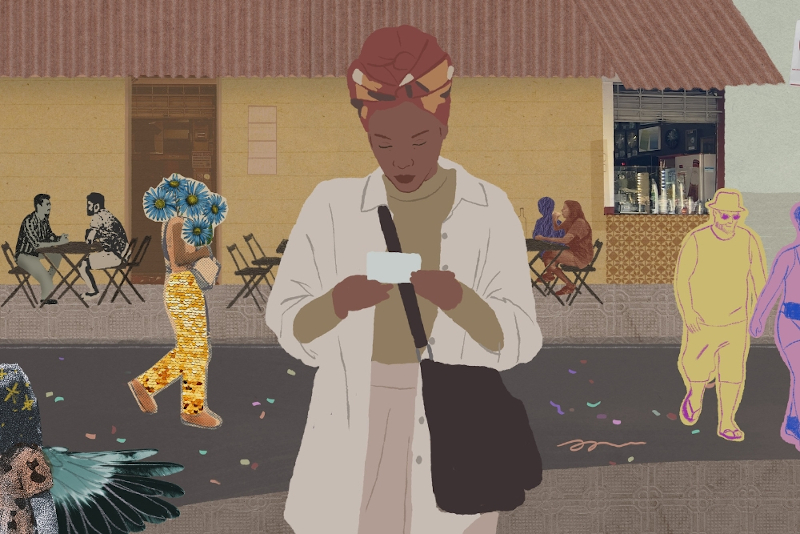
People dance, it rains heavily, joyous saxes play inside Ana’s head. She walks past a park’s trees in the downpour. Pieces of the image rip off to reveal alternate textures or buildings beyond. She enters one such building. An oldish man, who we will later come to know as André (voice: Carlos Francisco from The Secret Agent, Kleber Mendonça Filho, 2025), collides with her at the doorway as he rushes to get out of the rain; seawater brushes her feet.
Out of place in the apartment, she hunts for the light switches in the sepia gloom. She’s soaked. She looks at a photo. She is surprised when another woman, the flat’s occupant, appears and asks her how she got in. She explains about the letter from her mother, how the apartment was news to her, that the photo on her hand is her mother as a little girl with her parents (the woman’s grandparents). The occupant introduces herself as Alice (voice: Jéssica Pierina again). The visitor explains that her mother died in childbirth and her grandmother raised her. Her grandmother was also named Alice.
Next day, Felipe, in drag for carnival, arrives at the flat, unhappy that he’s not heard from Alice for two weeks. He suggests Ana is Alice’s twin sister. After he’s gone, Alice explains that during pregnancy, she almost lost the baby. Her “hostile womb” is represented by a torn, blood red paper construct, breathing as if it were an animate being. The local area around the apartment is known as the Forest.
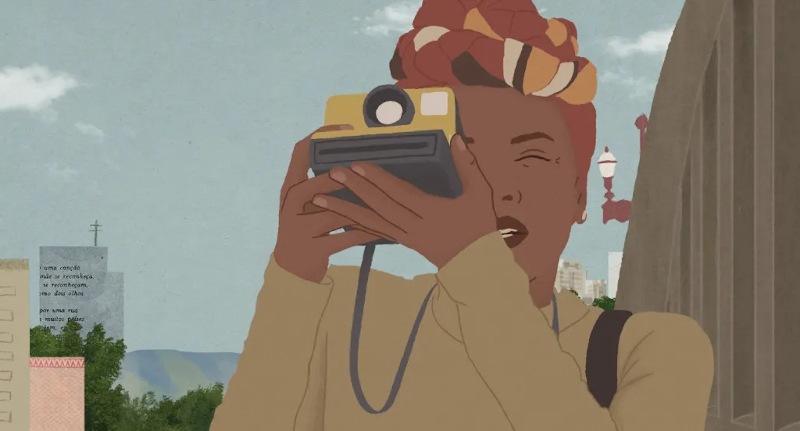
Ana takes her grandfather’s instamatic camera to be repaired. Once it’s fixed, she starts photographing everything like the boy in Time Bandits (Terry Gilliam, 1981). In the flat, Alice, a trained dancer, does her pregnancy exercises. André, from the entrance hall, drops by with a gift. Outside, the city seems to constantly reinvent itself as Ana walks – trees sprout, surfaces peel off walls to reveal new subtextures.
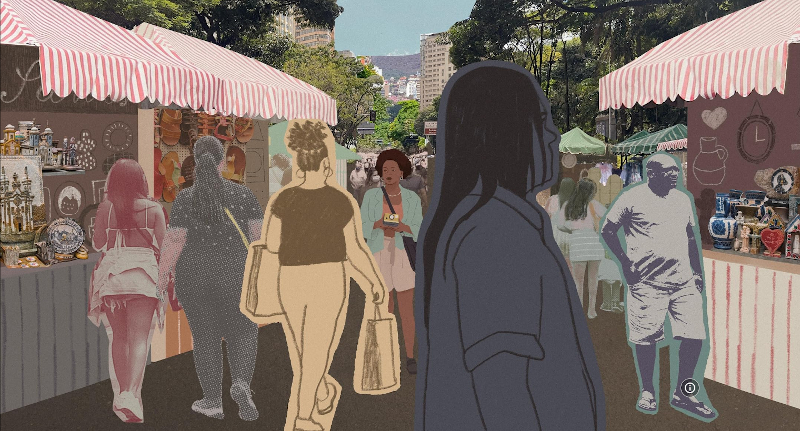
Alice, unable to sleep, dives through the mirror given her by Ana like the protagonist of Orphée (Jean Cocteau, 1950) only to find herself swimming underwater. Ana visits markets where boxes open out onto the screen to form new market stalls. Alice spends her time in the flat while Ana explores the area. On one occasion, Ana returns and, finding Alice asleep, sees a vision of her grandmother pregnant with her and talking with her grandfather (voice: Robert Frank), who plans to take their daughter to the sea for her first trip. Her grandmother tells him not everyone can be obsessed with swimming and drawing like he is.
It’s as if the house is a receptacle of her grandparents’ lives and memories, almost as if this were a ghost story, but not in any way oriented towards darkness or horror, rather towards shared family history and a sense of exploring one’s own identity.
Talking with Alice, Ana unburdens herself in Portuguese and French about her grandmother’s last 96 days. How the numbers of the countdown towards death suddenly became significant. Ana feels confused, lost without a map, and talks about leaving.
Alice, alone, dances, the blue and grey tones of her clothing merging with the sky and the sea, into which she plunges and swims. The scene contrasts with the bright faun-orange light of Ana on the rooftop contemplating sunrise, wondering if her grandma also liked the sea.
Alice, going through a pile of post, finds and opens André’s note to Ana, which talks about getting lost in the city and its paths, but that it’s also a place of memories and desires. As it happens, André tracks down Ana, talks about paths not necessarily being the straight line routes you think they are, and tells her he’s found some old photos of her grandparents from when they were living in the area.
André gives Ana the directions to her great-grandmother’s house. Where Ana’s mother and grandmother made a flower bed for her great-grandmother. Again, the image of the seashell and visual, marine patterns as Ana listens. She returns to Alice with a potted plant. She came across the Atlantic with only a photo and a letter in search of solid ground, and found inspiration in Alice.
She persuades Alice to go with her to the beach, which involves a train journey, something Alice has never done (“this isn’t Europe, Ana”). The pregnant Alice swims, transforming into a giant fish. Ana remembers sitting on the beach with her granny. She floats in the sea.
Whether in her main narrative flow or in her story’s many detours and sidetracks down memories, journeys and research, first time feature director Fernada Salgado pulls the audience in with her striking yet never forced sense of the visual, colour and texture. The film is unimaginable as live action because its sense of preconceived visual composition is so arresting throughout, an aesthetic for which 2D animation is perfect in a way that live action, quite simply, is not.
Both LFF screenings sold out, which suggests there is an audience out there in the UK for this remarkable feature. Hopefully, an enterprising UK distributor will pick it up for a proper theatrical run.
Ana, en Passant plays in the BFI London Film Festival 2026 which runs from Wednesday, October 7th to Sunday, October 18th in cinemas and on BFI Player.
Trailer:
LFF 2026 Trailer: