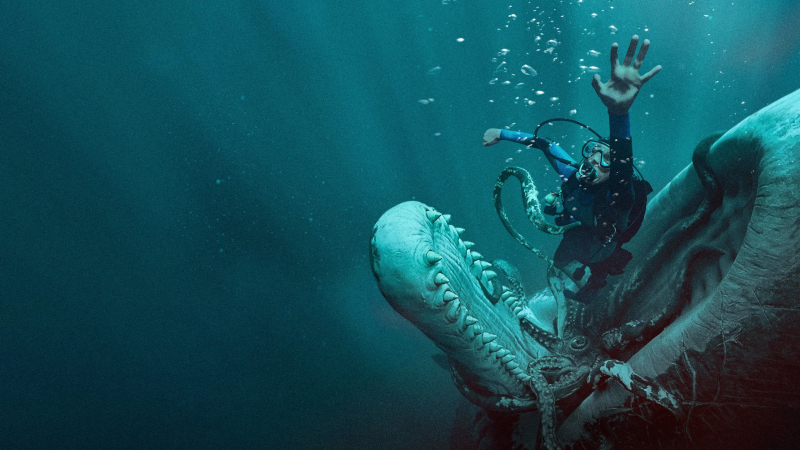
Whalefall
Director – Brian Duffield – 2026 – US – Cert. 15 – 106m
The abusive father drama (about half an hour) ***
The whale scenes (most of the film) *****
A man’s memories of his emotionally abusive father help him to survive when he is swallowed by a whale – out in UK cinemas on Friday, October 16th
This is very much a film of two elements. On the one hand, it’s about a bereaved man coming to terms with his memories of his recently deceased, abusive father. On the other hand, it is the spectacle, indeed, the experience, of a man being swallowed by a sperm whale. The whole thing, based on a novel by Daniel Krauss, is set in a coastal town and, mostly, in the nearby ocean.
In the opening 10 minutes, Mitt Gardiner (Josh Brolin from Dune & sequels, 2026, 2024, 2021, Sicario, 2015, all Denis Villeneuve; No Country for Old Men, Joel and Ethan Coen, 2007), an experienced diver losing his fight against a rare cancer named mesothelioma, steps off the side of a boat into the ocean and is never seen again. (Except in flashback.) Before jumping into the water, he seals a number of letters and puts them in a box on the deck.
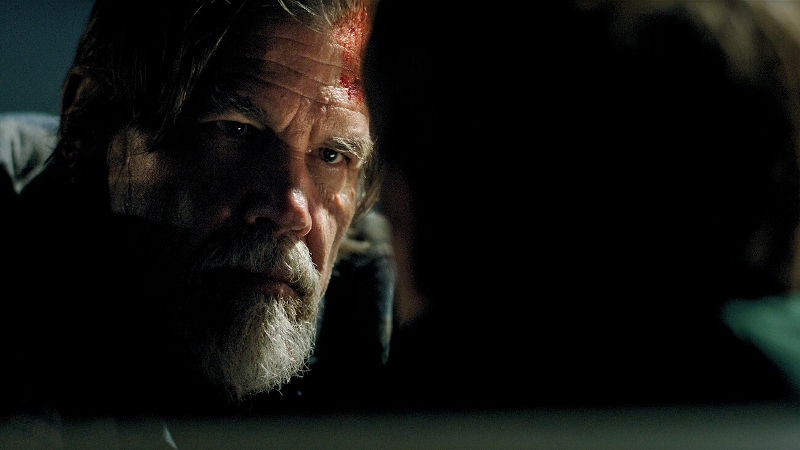
The narrative now switches its protagonist to the man’s son Jay (Austin Abrams from Resident Evil, 2026; Weapons, 2025, both Zach Cregger). We meet the rest of the family, Mitt’s wife Zara (Elizabeth Shue from Leaving Las Vegas, Mike Figgis, 1995) and two daughters Eva (Jane Levy from Evil Dead, Fede Álvarez, 2013) and Nan (Emily Rudd). We never really see the relationship of these womenfolk to the late patriarch, but judging by their behaviour, it would seem to have been fairly normal.
The man’s relationship with his son, however, is another story. Mitt was an obsessive diver and technician who schooled his son how to both behave and survive underwater and also how to look after and properly maintain the diving equipment required. He was ruthless in achieving this goal to the point of brutality. So much, so that, even when he and everyone else around him knew he he was dying, his son refused to go and see him. There is clearly, no love lost between them. The son still has his father’s letter, which he has thus far refused to open.
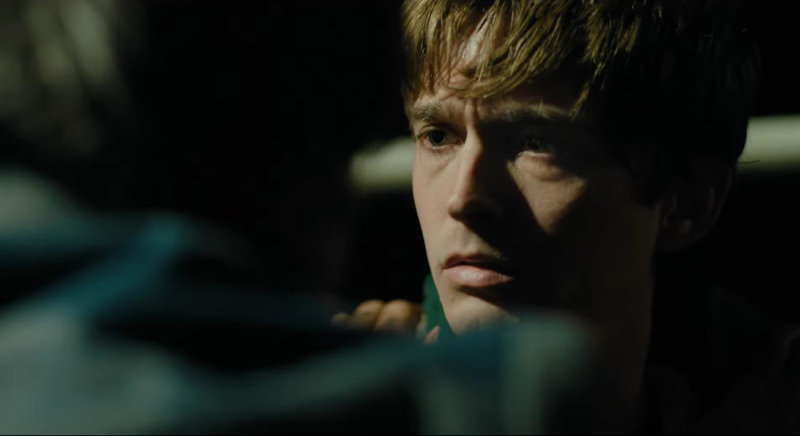
The family scenes that follow are a mixture of scenes with the womenfolk and scenes with the father and the son, with the emphasis on the latter. The father’s scenes are flashbacks to two different points in Jay’s shared history with his father, some featuring Jay as a young boy, some much more recent.
The first 10 minutes of the film does nothing else. And I have to admit that, having seen a trailer in which a man was swallowed by a whale, I was rather thinking, come on, get on with it.
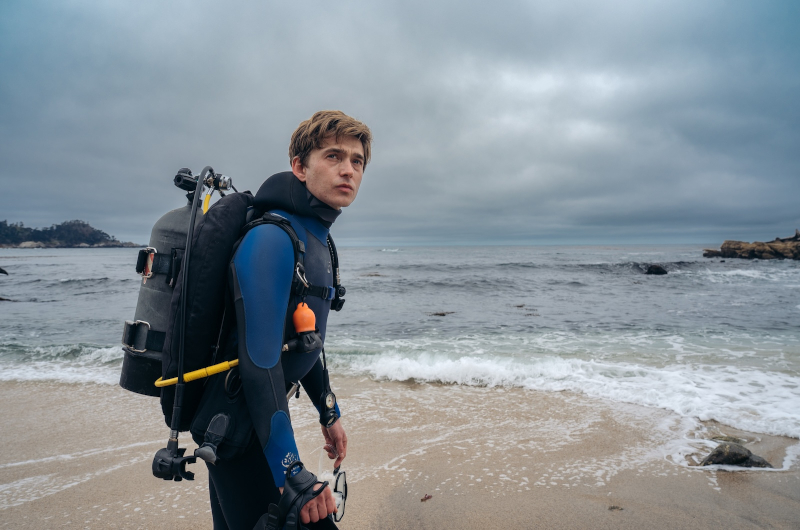
But then, the young man, clearly a deeply troubled soul, decides to take a dive. He swims out in full diving gear, complete with oxygen tank. to the point where the shallow shelf drops into the deep ocean. He starts to descend into the dark, majestic, terrifying void.
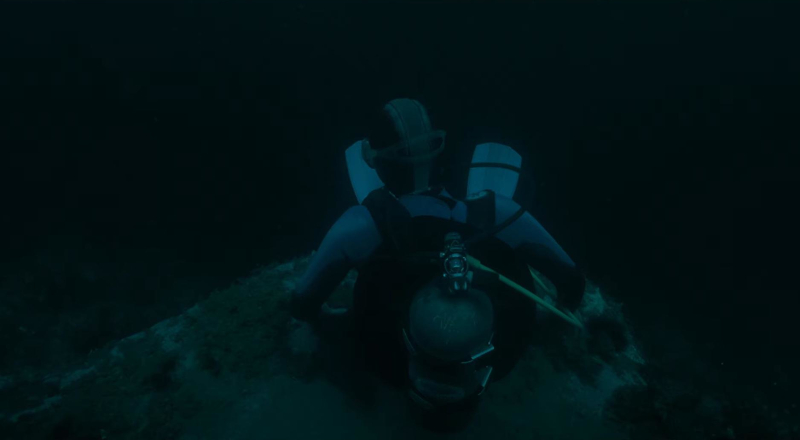
Little ridges in the underwater cliff face afford useful resting places. In one, he kicks an urchin off its narrow shelf. Almost immediately, he glimpses a huge squid, maybe three or four times his body length, and a huge sperm whale. There is a tussle in which the whale eats the squid which would make for an incredible spectator experience were it not that, unfortunately, one of the man’s feet gets caught in this struggle, then trapped in the whale’s jaw.
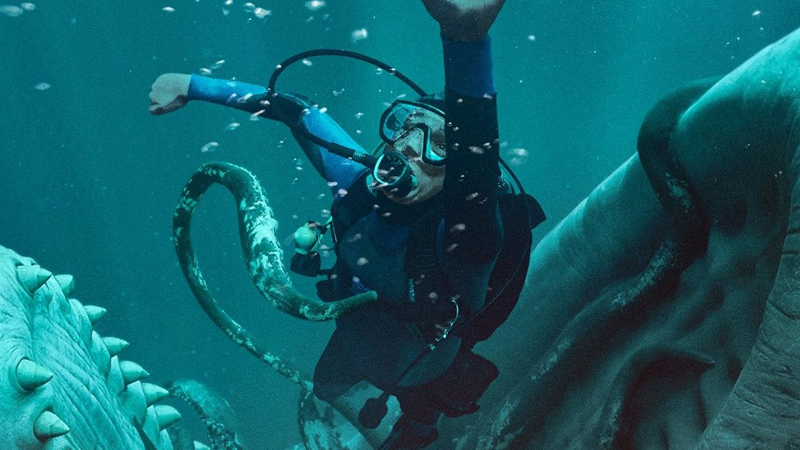
This results in his eventually being dragged inside the whale after the squid. It’s not really a spoiler alert to describe this since it’s in the trailer, and anyway, you’ve come to see a film about a man being swallowed by a whale. What you don’t know is whether or not he escapes. The rest of the film is mainly the man in the various chambers of the whale, contending initially with the squid, which is still a lot still very much alive, and then with the dissolving properties of parts of the whale’s innards, which it uses to consume and digest eaten prey.
You might wonder how much of the film’s running length could be taken up with a man trying to survive the various internal chambers of a whale: the answer is, pretty much the whole of the film from the first 10 minutes – although, as previously mentioned, this is punctured by various flashbacks of Jay’s relationship with his father, as their past relationship unfolds.
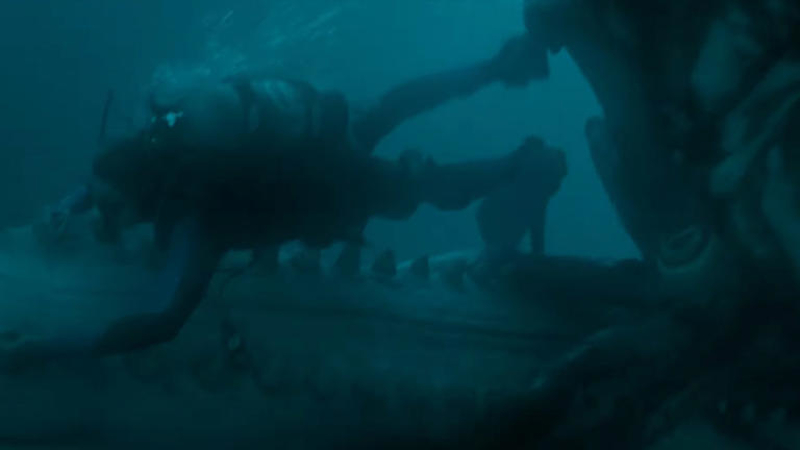
Jay’s father’s brutal treatment of him, as well as alienating him, also equips him for survival in the ocean and indeed, for from his current unexpected, predicament of being inside the whale. So, there’s a sense that all these flashbacks sequences contribute to his ability to survive as long as he can, perhaps to escape.
Whatever else he was, his father was a fighter and a survivor and he has transferred that ability to fight and survive to his son. Whether had this abusive relationship not occurred the son would still have been able to survive for as long as he does is a moot point; that is not the character we see trapped inside the whale, and consequently, we will never know how the man would have fared inside the whale had he not suffered this internal trauma.
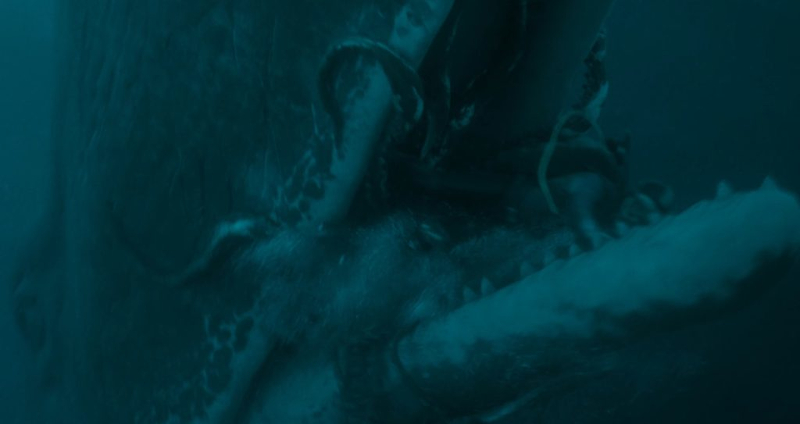
While there’s no denying Josh Brolin gives a terrific performance as the father in the 30 or so minutes in which he appears in flashbacks scattered throughout the film, I must confess that, personally, I was far more interested in the ability of the diver to survive or not survive in the insides of a whale. And, indeed, the physiology of how a whale’s body works and what’s inside it, and how a human man would fare in that environment. Then I was watching a film about an abusive father and his relationship with his son.
Presumably that relationship material comes from the book, the idea being that that makes the character come alive and gives him a reason to fight to try and survive his ordeal, however it’s only towards the end, where the last two or three flashbacks help give the swallowed man the ability to fight in his attempt to survive against near impossible odds, that that element seems to work. Before that, it’s a hard slog getting there, and not in a good way. ed to take a long time getting there.
The bulk of the film, however, is not the dramatic flashbacks, but, rather, a man being swallowed by and trying to survive inside a whale.
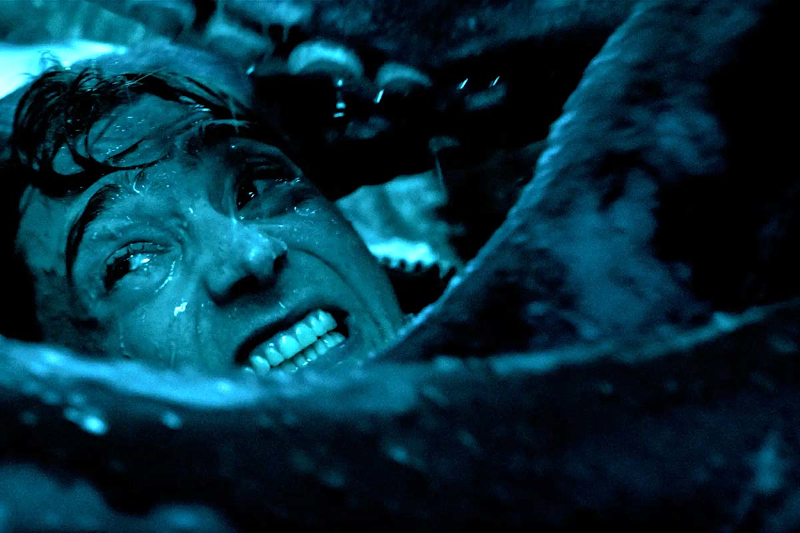
The giant squid is compelling to watch, putting to shame the computer generated kraken in Pirates of the Caribbean: Dead Man’s Chest (Gore Verbinski, 2006), the spirited, stop-frame octopus in It Came from Beneath the Sea (Robert Gordon, effects by Ray Harryhausen, 1955) and even the terrific, mechanical, giant squid at the end of 20, 000 Leagues Under The Sea (Richard Fleischer, 1954). There’s lots of footage of the the squid in the current film, too, including inside the whale where the man is trapped, but in a sense, like the father son relationship, the squid is a sideshow, with the bulk of the film the man quite literally alone inside the belly of the beast.
The sequence in which the whale swallows first the squid and then the man in quick succession is over very quickly leaving you to wonder with what the makers of the film are going to fill the the remainder of the narrative.
The squid, which appears to be have been rendered by computer animation is a fantastic piece of work by all concerned which convinced me that I was watching images of a real giant squid on the huge Cineworld IMAX screen in London’s Leicester Square where the film was pressed screened.
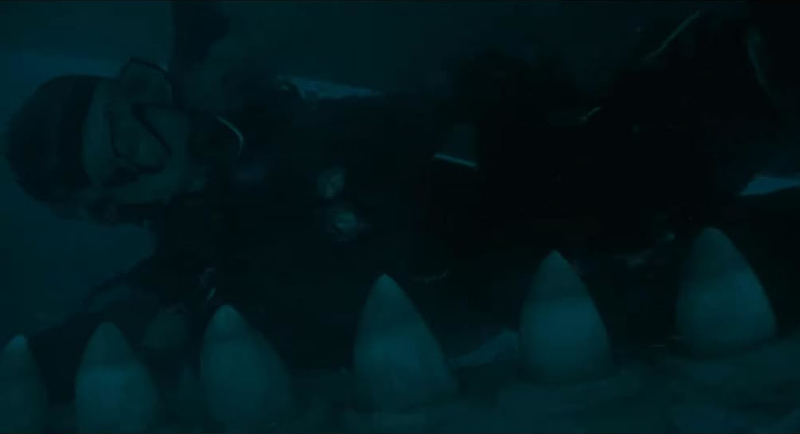
Moreover, the sequence in which the squid and the man are swallowed by the whale is not something we’ve seen before that I can recall, not even in those entries in the Jurassic Park franchise that had the good sense to actually show people being eaten by dinosaurs. In none of those, however, was there ever quite the sense of someone going into a beast’s maw and then progressing through the creature’s insides. Not that the whale is a dinosaur; it is, in fact, a mammal, yet on some level it’s clearly also a terrible beast just as dinosaurs are (the word ‘dinosaur’ comes from ‘terrible lizard’).
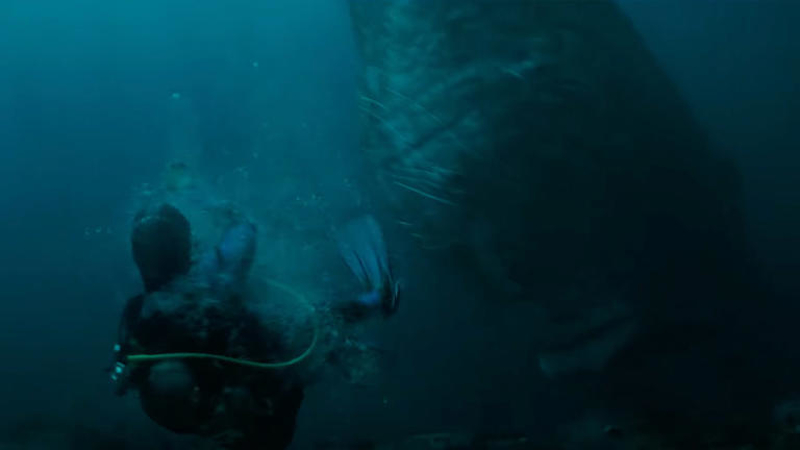
The exterior shots of the whale are impressive, too, even if they feel like they were completely computer generated for the most part, and something that we’ve seen before.
Once alongside the man, we get inside the whale and we experience the various stomach chambers. the mechanical special effects / claustrophobic sets in which these scenes take place are completely convincing. You believe you are inside the various internal chambers after a while and have to deal with them accordingly. That’s quite a feat, made all the more impressive by the performance in these appalling circumstances of actor Austin Abrams who gives one of the greatest performances of an actor working with physical special effects that I’ve ever seen. Indeed, it’s hard to think of a comparable performance by an actor put through similarly gruelling conditions.
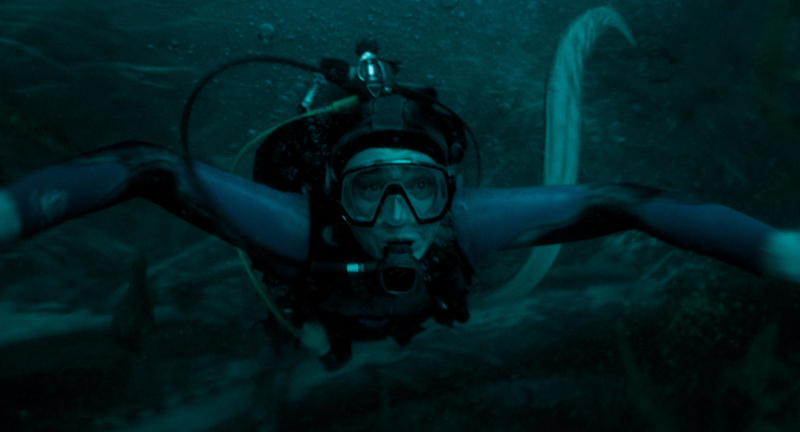
If Abrams’ performance had been wooden, the whole wouldn’t have had the emotional impact it does. So extraordinary is his performance that actually you start to wonder if the material about the father and the son in the flashbacks is redundant; would the film have worked without it? It’s probably impossible to say one way or the other, but for this writer, the sequences from the moment the man this goes over the edge of the continental shelf into the deep to encounter the squid and the whale prove totally thrilling and compelling in a way that the father son dramatic flashbacks generally aren’t.
So, with the proviso that. however well acted it may be – and it’s very well acted – this writer could actually have done without the father son drama part of the film, whereas the other part of the film in which the man is being swallowed by the whale succeeds on every level, delivering everything you could possibly want from a movie about a man being swallowed by a whale and attempting to survive the experience.
Whalefall is out in cinemas in the UK on Friday, October 16th.
Trailer: