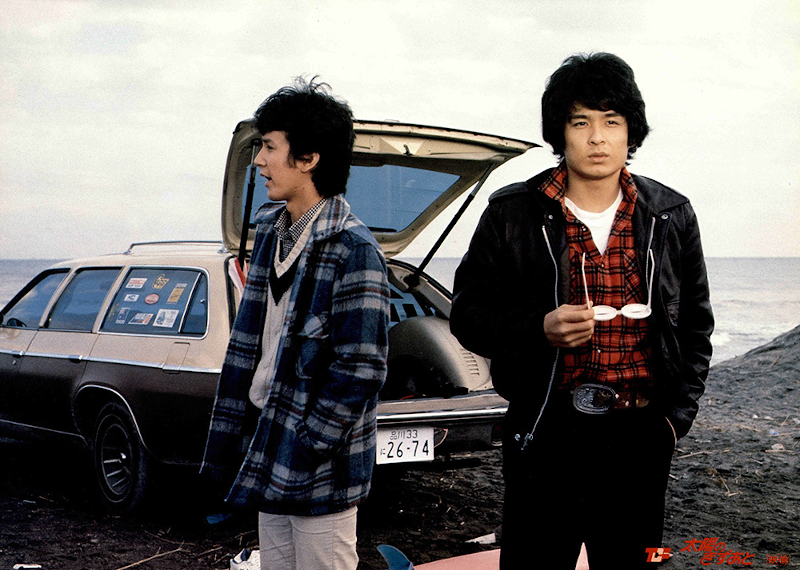
Scars of the Sun (Taiyo no Kizu Ato, 太陽のきずあと)
Director – Chusei Sone – 1981 – Japan – Cert. 18 – 99m
***1/2
A young gang leader whose father is a successful literary figure finds himself battling against a rival – part of the Chusei Sone Double Feature on Blu-ray from Monday, July 27th.
NSFW
A dull, industrial pumping sound can be heard in the background. A man in a white raincoat and a hat waits. The wind blows his open coat. He takes out a cigarette. Down the road, another man steals a white car from a garage explaining, “I’ve a funeral to attend.” He picks up the raincoat and hat man.
Another car, red, heading in the opposite direction on the other side of the highway, U-turns and joins him. Both drive recklessly until the white one narrowly avoids a collision with a bicycle.
The other man asks Shuhei (Keniichi Kaneda), in the raincoat and hat, what they do about the now somewhat battered car. Shuhei says it can be fixed using his father’s money. When he tries to sign in for the funeral, he’s told to leave because the deceased wouldn’t have wanted him to attend.
They gather with others at a bar. His companion, Kobayashi, explains that Sugeru was so good at driving that he, Kobayashi, fell asleep. Shuhei resolves to hold their own funeral for him right here in the bar. The mama-san is reading an article about Shuhei’s father, a famous literary figure. One of the men pretends to be Sugeru, so Shuhei makes him over with tomato sauce for blood.
When watching and processing films in my head, I tend to give them the benefit of the doubt in terms of narrative coherence. Some feature films are completely incoherent, and I’ll generally give those short shrift. Though, this whole approach can let you down. Trying to make narrative sense of Scars of the Sun, a perfectly watchable (if on occasion questionable) film, will only get you so far. Director Sone came out of Nikkatsu Roman Porno, where he was mentored by Seijin Suzuki, for whom he wrote Branded to Kill (1967), the Yakuza thriller that got Suzuki fired for its “incoherence”. His films as director at Nikkatsu include Angel Guts: Red Classroom (1979).
Although the current film is an indie production for Toei, you can feel Sone sticking the requisite sex scenes into the film where they jar with some of the other elements, including drama which veers from farce to genuinely affecting, and some engaging car chases and stunts.
The tone in Scars of the Sun is consequently uneven, yet is memorable in places. A strikingly backlit scene in an alley turns all the characters into silhouettes as Shuhei and compatriots beat up a man – possibly Sugeru who faked his own death. Yet, since the film never refers to Sugeru again, we never hear the full story.
Then there’s a whole strand featuring Yuko Katagiri, star of over 50 Nikkatsu Roman Pornos in eight years. Her character Mayumi is taken by Shuhei to a house where she is gang raped. In the same scene – and the scenes are generally shot in one unbroken take – another girl, Kamako, throws herself at suave gang leader Karasawa. Instead of taking up her offer, he and Shuhei waltz clumsily round the room. Gang rape and light comic farce in the same scene. Odd. Some might say misjudged.
The attitude to women here is troubling to say the least. One would hardly expect a former Nikkatsu Roman Porno director’s portrayals and use of actresses to be less than exploitative. Nevertheless, there’s something worryingly unpleasant about seeing an actress gang raped in one scene (even if the portrayal is neither particularly graphic nor explicit) and then playing in a scene a few minutes later like a happy character in a sitcom as if nothing had happened, only for it to turn into a sexual free for all in which the women, feisty though they may be, either throw themselves at the nearest man or are simply there to be raped.
In another gathering, Shuhei’s father Moji (Ken Ogata) apologies that his son just raped someone. In a carousing mood, another man Fujioka falls into the ornamental pond. Shuhei arrives and takes a phone call from someone who could be his brother Koji, promising to come over and see him at the Century Hotel. Mayumi arrives just as Shuhei, who doesn’t see her, is hailing a taxi. She is welcomed and introduced to the rest of the gathering by Moji. As the man his son raped. Apart from the extreme sex references, this could be a scene from a BBC sitcom, a Brian Rix farce, or a Blake Edwards Pink Panther film.
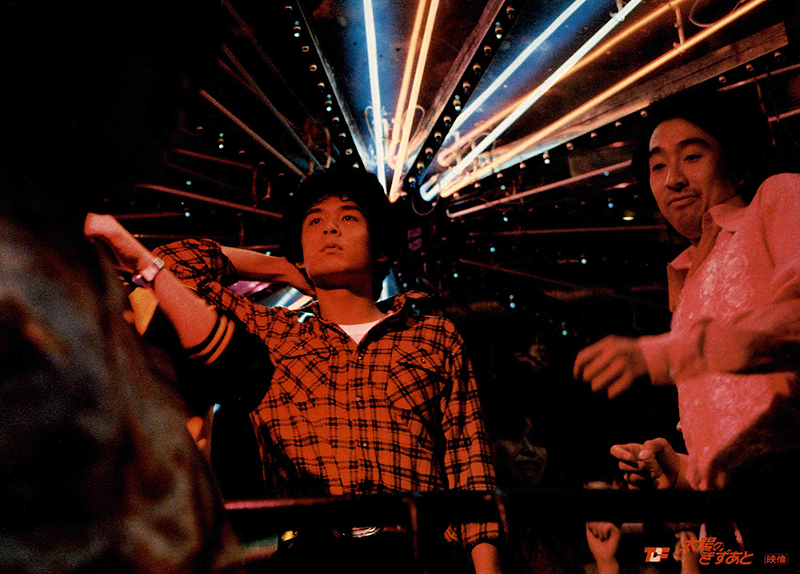
At the hotel, it switches to a more coherent drama about family ties as the two hesitant brothers see each other for the first time in 11 years, and Koji (Koji Tanaka) introduces Shuhei to his classmate Kaori Tasaka from Hakodate, who “he happened to run into in Tokyo”. Shuhei offers them a lift in his car with his two disgruntled underlings Karasawa and Takeshi. At the disco, Kaori too is unhappy since Koji said they wouldn’t meet his brother. In the gents, Takeshi points out to Koji that Karasawa is the real boss, and they’re only driving Shuhei around today.
They drive on, joined by a motorbike and getting into an argument with a lorry, who following a spirited car chase rams both cars from behind after they earlier blocked its path. They go to a beach house where friends are waiting, and watch the surfers from the beach. Clad in an impressive, full-length coat, Shuhei’s former girlfriend Kanako (“She hates me because I gave her to my underlings”) probes Koji about his broken family background and his having committed suicide in one of his father’s books.
Four of the boys fool around pretending to be the train to Hakodate. Shuhei insists he drives his brother and girlfriend home before he has to follow custom and do her before handing her to his underlings. “But I wouldn’t do that to your cute girl”, he adds. Outside of its sexism, this whole sequence anticipates the beach game playing in Sonatine (Takeshi Kitano, 1993). Koji and Kaori are later seen arguing, making up, and snogging at night.
Next day, Shuhei and pals fool around at sea on a motorboat, while in a car on the highway, Kondo (driving) and Karasawa pick up a the wandering Kaori, at which point Kanako leaves the car. Shuhei and another get thrown off the boat into the sea, while Kanako walks the along the middle of the highway, high heels in hand. Karasawa later tells the concerned Koji that Kaori is his guest, a proposition Shuhei accepts.
When his father visits Koji at the hotel, Koji doesn’t want to know, and shuts the lift doors on him.
On the beach, the boys ride a motorbike and many miniature bikes around a tower. They play ping pong at the house. Shuhei offers to take Koji home, but Karasawa steps in and says he’ll do it himself. Kaori leaves Karasawa’s parked car when they’re getting passionate (her exposed breast stands in marked contrast to the more restrained snog earlier with Koji), and he tries to unbutton her dress. But outside the car, he still manages to have sex with her, seemingly with her agreement (the exterior is in long shot).
Weirdly, this not only sets Koji up for a fight with Karasawa but also pulls him into the wider orbit of the gang, so that he bonds with other gang members and becomes part of the group, something I really didn’t expect given his treatment by their leader. And it presages the final disintegration of any relationship between the former gang leader and the ascendant one, culminating in spur-of-the-moment murder shown on the screen in a series of freeze frames and a yellow surfboard flying spinning into the air, an editing style light years from the long unbroken shots typical of the film.
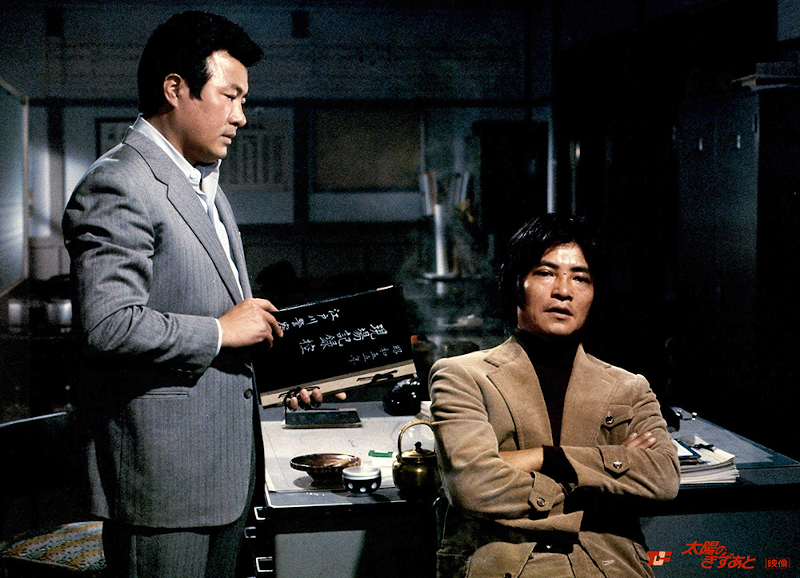
Shuhei promises to follow his brother to see their mother soon. While Mogi Rintaro gives a self-aggrandising press conference, Shuhei faces a mirror in jacket and tie, rehearsing what he’s going to say to his mother (Kyoko Enami) to whose room above the bar she runs the untalkative Koji has already returned. After talking wih a journalist (Tatsuo Umemiya), Moji has a run in with a gaggle of journalists who want to talk about Shuhei being a murder suspect. Alone in his flat with his piles of books, a redundant bouquet of flowers on the sofa and uy Unable to listen to music, he’s troubled by Shuhei’s disappearance.
While her bar below gets increasingly noisy and rowdy, against a quiet, almost meditative, plucked instrument soundtrack, the boys’ mother tries to find out from Koji the story behind his heavily bruised face (which we now see for the first time). Eventually the boy spills the beans that Shuhei has murdered someone, and is coming to the bar. Having delivered one gruelling, dramatic mother and son confrontation, the stage is now set for a second…
The whole is coherent in places with its tone veering all over the place in others. There’s nevertheless something quite compelling about it. Sone’s Blow the Night coalesces rather better than this earlier effort, but together they make for a great double bill. This first film contains an informative commentary by Jasper Sharp, really getting into his stride here (“Welcome, bold and intrepid cinephiles to this commentary track…”), plus a video essay by Dakota Noot which possibly assumes the viewer knows a lot more than they actually do, which might be something to return to when one has further explored Nikkatsu and Roman Porno generally and director Sone specifically.
Scars of the Sun is out as part of the Chusei Sone Double Feature on Blu-ray in the UK on Monday, July 27th.
Trailer: