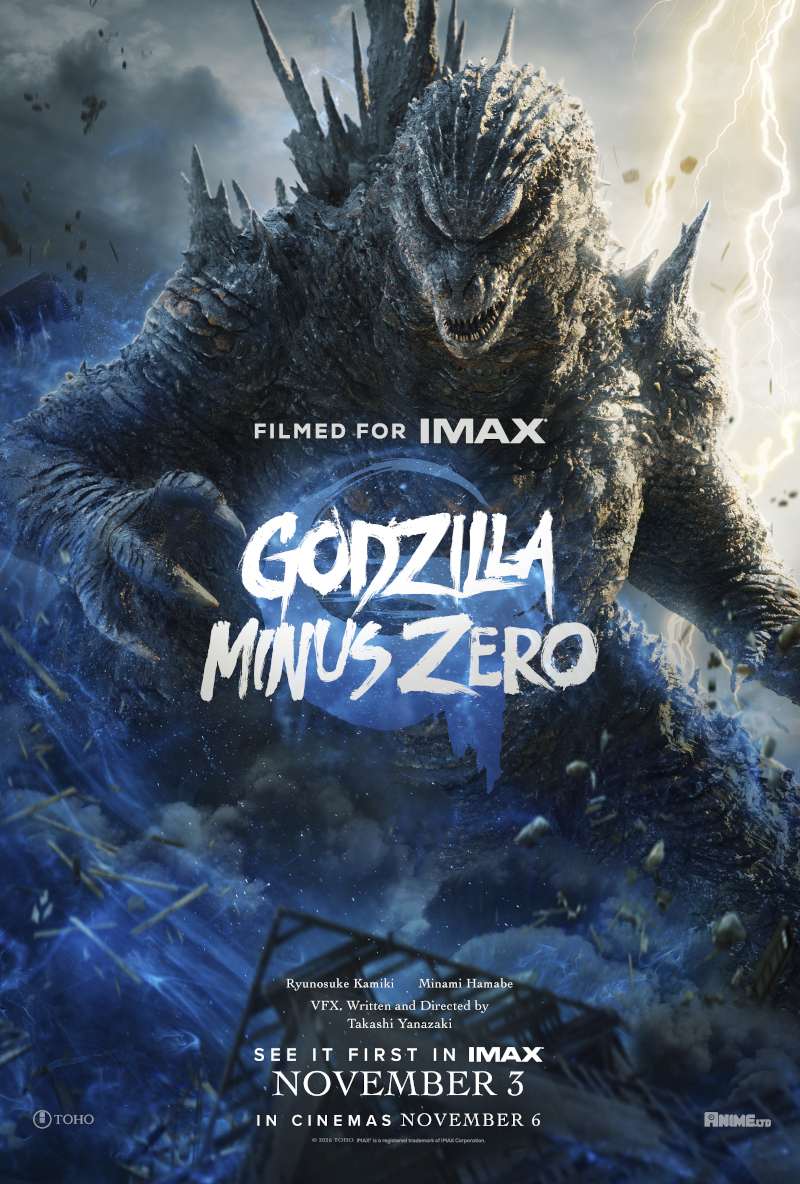
Godzilla Minus Zero (Gojira – 0.0, ゴジラ – 0.0)
Director – Takashi Yamazaki – 2026 – Japan – Cert. 12a – 135m
IMAX version *****
Regular version *****
Japan, slowly recovering from World War Two, must again deal with the seemingly unstoppable menace of Godzilla when it rises again from the depths of the ocean – out in UK and Ireland IMAX cinemas on Tuesday, November 3rd then in regular cinemas on Friday, November 6th
*** Please note: Godzilla Minus One spoiler alert in opening paragraph. ***
“Is your war finally over?”, redeemed Kamikazi pilot Koichi Shikishima (Ryunosuke Kamiki) is asked by Noriko Oishi (Minami Hanabe), the woman who he has taken in to his home along with a baby only for her to be subsequently blasted away when pushing him into a building recess to save him from Godzilla during its attack on Ginza, at the end of Godzilla Minus One (Takashi Yamazaki, 2023). Miraculously, she survived that incident, which scarcely seems possible. Although perhaps writer-director Yamazaki shrewdly included the conundrum to enable him to kick around some ideas as to why she might have survived beyond mere luck.

One such idea makes it into this new film, and a fascinating idea it is too, one of a number of script elements for which Toho have asked journalists to keep the specifics under wraps so as not to spoil the film for audiences – which seems reasonable enough given that critics had the privilege of seeing the film before any reviews had given anything away. It also makes the reviewer’s job near impossible as it effectively scuppers talking about a number of major aspects of the plot.
Unlike Godzilla Minus One, which opens on a very human scale with its pilot landing his allegedly damaged aircraft on an island in the Pacific war zone, Godzilla Minus Zero starts off with sound and fury from frame one. We had a long build up to the appearance of the giant monster in the first film, and Yamazaki clearly doesn’t want to do exactly the same again.
So, immediately as Godzilla Minus Zero opens, it delivers loud noise. A couple of slow booms. Sound effects. Of a monster attack. And then the image: an unstoppable, giant monster causing urban devastation. With the accompaniment of a score which appears to consist of the very first musical phrase of Wagner’s Ride of the Valkyries (the first and only the first of several short rising tones before the recognisable tune kicks in) repeated over and over.

As well-connected, former ship’s captain Kenji Nota (Hidetaka Yoshioka), now a boffin running Japan’s newly-formed Disaster Response Bureau, aptly puts it following the attack: “Dealing with giant creatures. That’s what we’re here for.”
The score ought not to work, but it does, ramping up the tension to an almost unbearable level. Which, if you’re going to make a kaiju movie as effective as you can, is surely the way to do it. You might keep wondering how the score is going to develop, yet it seems to repeat the trick over and over, which one would imagine would become boring but in fact has the opposite effect. The score is by Naoki Sato, music editing is credited to Yoshitaka Fujimura, and given the extraordinary integration of sound effects and music, it would be remiss not to mention that the sound effects are by Natsuko Inoue.
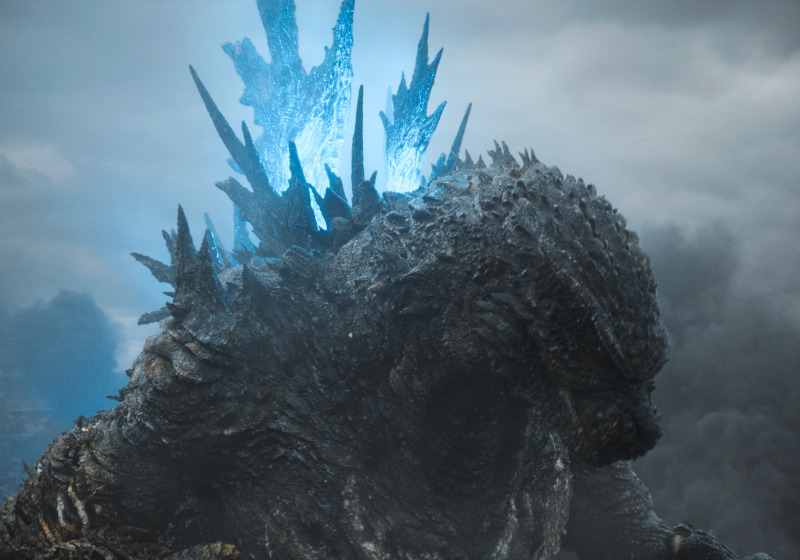
The big surprise is not that, despite having been apparently destroyed at the end of Godzilla Minus One, Godzilla rises again from the ocean to stomp his way across Japan. You know going in that’s going to happen. Because, otherwise, there’s no movie. The big surprise is that while Godzilla gets plenty of screen time, he doesn’t get anything like as much screen time here as Ghidorah, the flying dragon with a long, bendy neck who first appeared with three necks rather than one in Ghidorah, the Three-Headed Monster (Ishiro Honda, 1964) where, as here, he attacks the city of Matsumoto.
Toho probably wanted Ghidorah’s appearance kept under wraps too, with his image completely absent from official press stills (and thus this review) and given one brief mention by name and one as an ‘enemy monster’ towards the end of the film’s production notes.
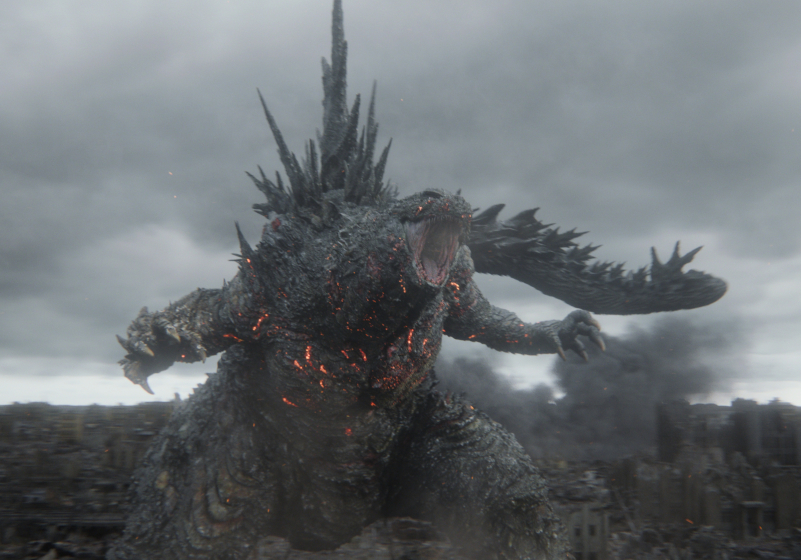
Yamazaki, credited as director, writer and visual effects, possess a real gift for showing off the majesty off these creatures which, lest we forget, began their cinematic life in Godzilla (Ishiro Honda, 1954) as human performers in creature suits shot at high speed to create the impression of huge size and bulk, a tacky form of realisation which had about it a certain endearing charm. Movie special effects have come a long way since those pioneering days; these monsters aren’t performed by (and don’t look anything like) men in creature suits here – they feel like solid, scales and blood kaiju: convincing and terrifying.
As in Godzilla Minus One, the parts of the narrative in which kaiju appear and wreak havoc are balanced with the story of the various human characters and their concerns and relationships, their lives inevitably linked with the cross-country rampages of Godzilla and Ghidorah. At the film’s centre once again are the nuclear family who never actually were a nuclear family – pilot Koichi Shikishima who was never actually the husband of Noriko Oishi and the little girl Akiko (Sae Nagatani, back from G-1.0, now slightly older) they care for who was never their birth child.

Indeed, in G-1.0 it was made very clear that the couple never actually slept together. Curiously, in G-0.0 none of that is ever addressed – it’s as if they are an ordinary husband and wife with a little girl, and anyone coming to see this film without seeing its predecessor will read the characters in those terms. (You don’t come to a Godzilla film to see a “married couple” sleeping together – and, sure enough, no scenes here feature such things. Why should they?)
Curiouser still, the press handouts give the woman the man’s surname, implying that they are now married. Yet anyone who watches G-1.0 again before seeing G-0.0 will read them as they appeared there. Presumably, the couple are supposed to have got married between the two films. Or perhaps she just changed her family name.
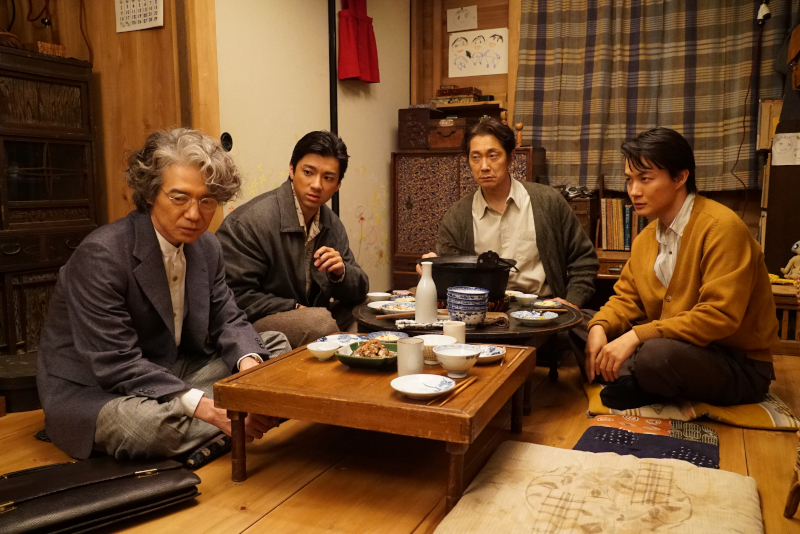
Other characters returning from the previous film include Ota (Sakura Ando), now running an orphanage, Shikishima and Nota’s former fellow boat crew members Seiji Akitsu (Kuranosuke Sasaki) and Shiro Mizushima (Yuki Yamada), and rival ship’s captain Tatsuo Hotta (Mio Tanaka).

Notable new characters on the Disaster Response Bureau include innovative weather woman Makoto Aoyama (Masami Nagasawa), who may remind British viewers of Andrew Scott’s similarly disruptive meteorologist in Pressure (Anthony Maras, 2026), top boffin Dr. Ogata (Jun Kunimura), and biologist Kanji Murakami (Min Tanaka), a survivor of the Ghidorah Matsumoto attack who brings back filmed footage of that event and whose motives turn out to be more complex than they at first appear.
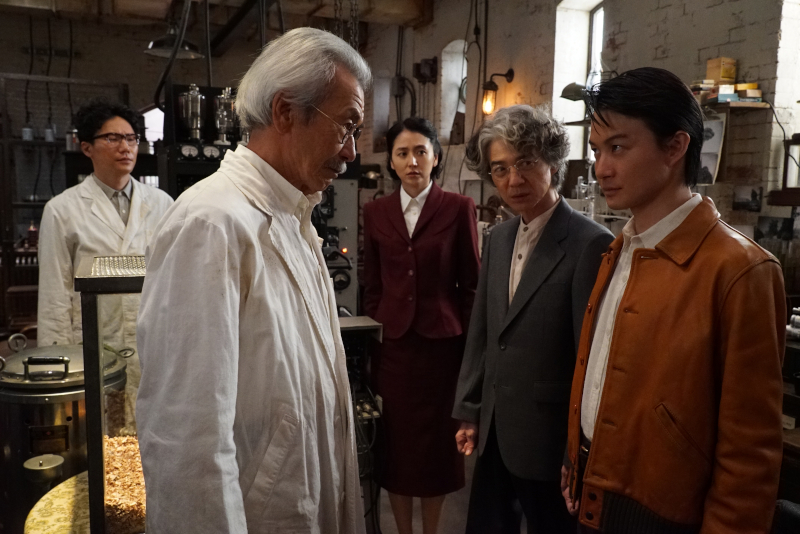
The big problem in making this sequel is that the first film was all about its protagonist’s cowardice and guilt, Koichi having failed as a kamikaze pilot who was subsequently redeemed by being prepared to sacrifice himself to destroy Godzilla. One that’s resolved, however, it’s resolved, and director Yamakazi doesn’t come up with anything quite as compelling this time round. Still, his new plot has enough spine to work well enough as a narrative, with those fair few surprises Toho want kept under wraps, and his two onscreen kaiju are both plentiful in terms of running time and, frankly, utterly awesome.
This writer first saw an early, non-IMAX press preview of G-0.0 in which the film was presented in an aspect ratio of approximately 2.35;1. Reading between the lines of the production notes, it sounded like the IMAX version was framed completely differently. Unlike The Odyssey (Christopher Nolan, 2026), which this writer only saw in regular, non-IMAX, and which frustratingly felt like image material was constantly missing stuff off the top and bottom, the 2.35:1 G-0.0 looks absolutely fine; I never felt like I was seeing the inferior version the director and cinematographer didn’t care about.
That said, I suspected the IMAX version would be better in terms of seeing more within the frame. It is, after all, something of an historic landmark: the first ever Japanese film to be specifically filmed for IMAX.
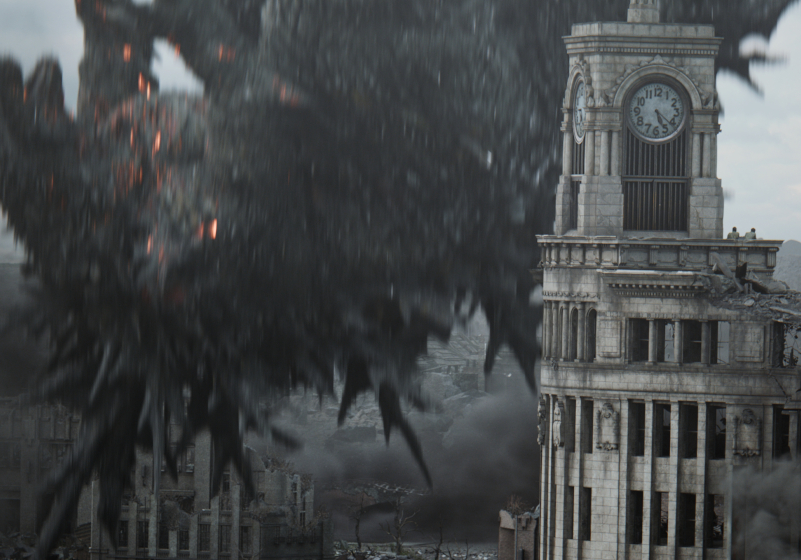
The IMAX version, apart, obviously, from being a bigger and therefore more detailed image, is indeed in a completely different aspect ratio – or rather ratios, because while the whole film uses the full width of the IMAX screen throughout, it switches between the full 1.43:1 height of the IMAX screen and crops down to 1.90:1 for some of the more human character-based dialogue-y scenes.
Not that you’d notice the ratio switches unless you’re specifically watching out for them, as this writer was. G-0.0 contains considerable amounts of the spectacular and the action-packed, and all that material is presented in 1.43:1 IMAX with, as it were, more room to breathe. A sequence involving a small group of planes attempting to outmanoeuvre the airborne Ghidorah is particularly effective in this format. It almost goes without saying that the sight of the massive Godzilla rising from the ocean, swimming, or stomping his way across urban Japan derives a certain extra something from being viewed in this format.
I saw the IMAX version about two weeks after the regular version. That was enough time for me to enjoy it second time round. It’s rare that I enjoy re-watching a movie quite as soon as that.
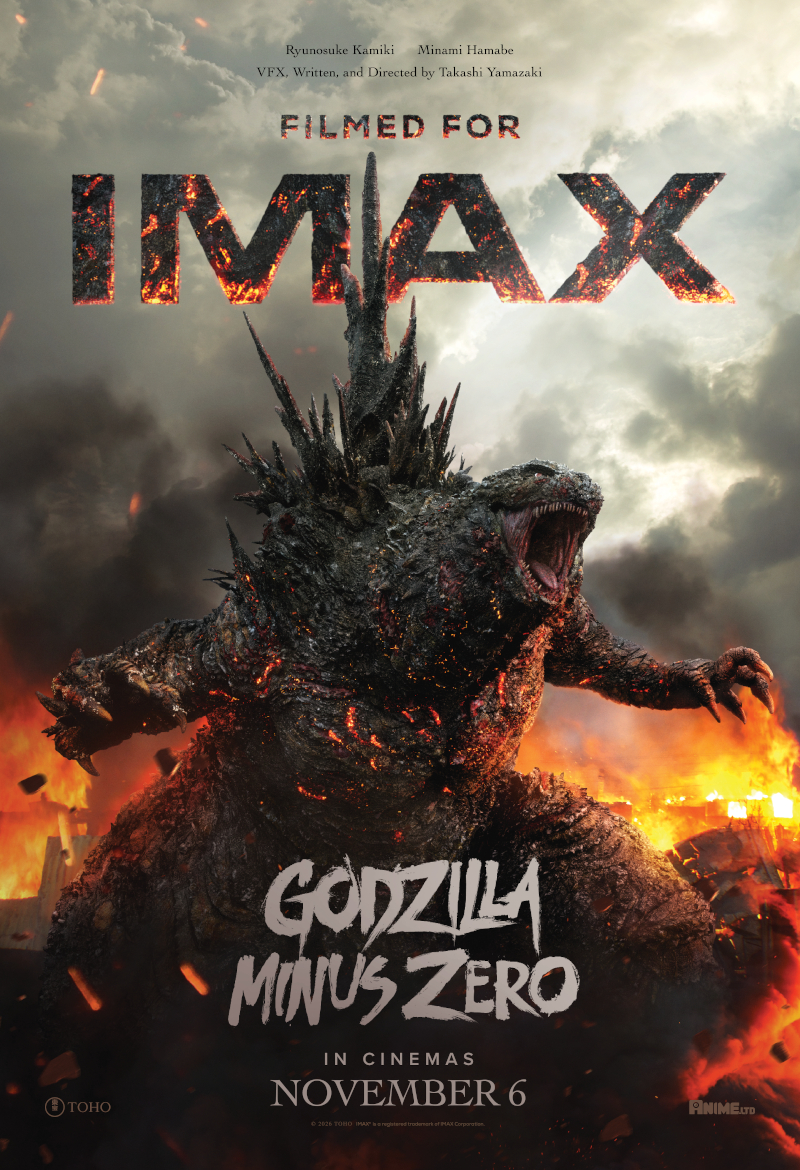
And yet, while I wouldn’t hesitate to recommend viewing the film in IMAX, I remain, frankly, surprised by just how good the non-IMAX version is. Yes, material is cropped off top and bottom, but director Yamazaki and cinematographer Kozo Shibasaki have taken considerable care to make the film look fantastic in both the aspect ratio used for the regular version and the two used for the IMAX version. I feel privileged to have watched the film in both versions, and am genuinely thrilled that anyone who can’t get a decent seat at a cinema as well equipped as the BFI Waterloo IMAX, where I saw the IMAX version, will be well served by seeing the non-IMAX version playing their local cinema.
True Godzilla nerds are likely to enjoy seeing this in both versions. Preferably, in both cases, in a cinema with a really clear, loud, sound system.
Godzilla Minus Zero is out in IMAX cinemas in the UK and Ireland on Tuesday, November 3rd Friday, then in regular cinemas on November 6th.
Teaser Trailer:
Trailer:
Trailer (1:43:1)