Mongrels
Director – Jerome Yoo – 2024 – Canada – Cert. 15 tbc– 106m
*****
On the Canadian Prairie, a Korean father helps cull wild dogs, his teenage son grapples with identity, and his young sister misses her absent mum – from LKFF, the London Korean Film Festival 2026 which runsin cinemas from Monday, November 2nd to Tuesday, November 16th
Aside from an opening in which a man in his underwear in the woods speaks in Korean of his dreams – taken from towards the end of the first of the film’s sections – this film is split into three headed sections, one for each member of its central family by descending age – father, teenage son, young girl. These Koreans have emigrated to Canada, and now live on the Canadian Prairie. It’s the early 1990s, or thereabouts.
The three sections are: i – god, ii – cowboy, iii – blonde.

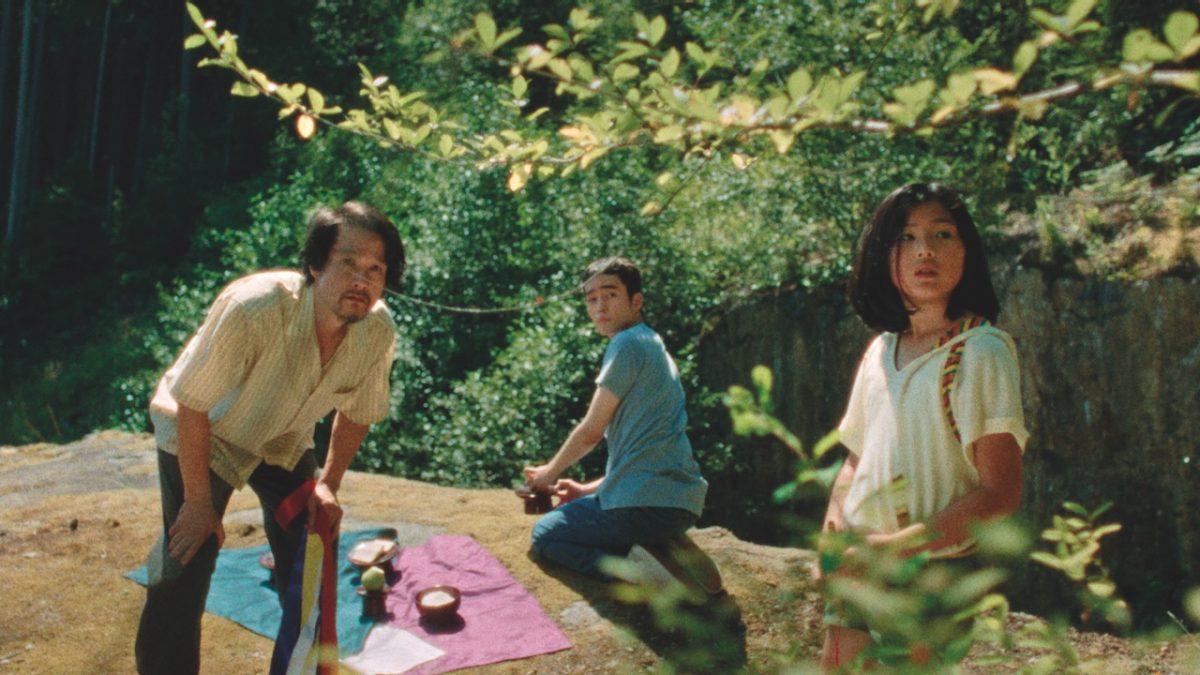
In i – god, the father Sonny (Kim Jae-Hyun) holds a ceremony for his two children Hajoon (Jeon Ho-Young) and Hana (Jin Sein) in which all three bow to show gratitude for their protection. Sonny is a key figure in Scott (Morgan Derera) the local farmer’s attempted cull of wild dogs in the nearby woods, the shootist most likely to bag a dog then put it out of its misery with his knife. On Scott’s farm, when family dog King Kong barks uncontrollably, it is Sonny who looks the creature in the eyes and successfully pacifies it.
Yet this belies the man’s own troubled nature. He is suspicious of the white man’s culture, joining with his family at Scott’s table for a meal but refusing to drink the wine in his glass after raising it for a toast. He treats his son brutally in an attempt to instil manly values such as endurance into the boy, who is quite unlike him in terms of personality.
When King Kong comes to Sonny one night, at the end of this first section leading up to the woodlands underwear scene which opens the film, as Sonny hears mongrels yapping and howling – perhaps these are in his head – he asks the animal if it thinks he, Sonny, is a god to whom to pray, to beg for mercy. He describes his hands as sinning and stained with blood, and life as unfair.
Yet he feels the dog is suffering, like him. A dog stands on four legs, a god on two. Like the dog, as he understands it, he suffers. He wonders if, were he to release the dog from its misery, would it repay his kindness by taking away his suffering?

In ii – cowboy, Hajoon is clearly not his father, however much he might recite “strong fists, strong heart, strong mind” in the bathroom mirror. Outside the house, he hears voices calling for King Kong after Scott’s teenage son Noah (Jedd Sharp) tells him a number of dogs in town have gone missing. Hajoon goes out to the fields with with Noah and the other teenage white kids, and hesitantly joins them in drinking beer. He spends time in Noah’s room swapping notes on LPs, K-pop and rock music, and moving to the rhythm. They talk about his mother, back in Korea. Coming over soon, hopefully.
His father comes upon him out in the woods having caught a dog in his trap. Instead of killing it as ordered, Hajoon lets it go. Unlike his dad, he doesn’t want to kill dogs, that his mother would protect life rather than take it. He wishes he could see the world as she naively does, in terms of dreams. Alone, on headphones, he listens to the track with the line, Mother’s Hand is a Healing Hand.
As images switch between mongrel vision and teens partying in the woods near a parked car. Hajoon seems to fit in, but you’re wondering if he feels out of place. Later, he confronts his father over King Kong’s disappearance…

In iii – blonde, Hana lays out in the fields and can hear her mum’s voice (voice: Karen Choi Hyeyeon) talking to her. “If you catch and eat a hundred airplanes, you can make a wish come true.” Which provides a motif through this whole section as she looks at airplanes in the sky, traps them between finger and thumb, puts them to her lips and eats them. If she gets to a hundred, she can make a wish. This catching of planes recalls a similarly surreal, dramatic device in Dogtooth (Yorgos Lanthimos, 2009).
She gets on ok with her brother, but when she admits to him that she misses her mum’s cooking, he offers to cook, and she suggests kimchi stew. What she really needs, given her otherwise all-male household, is female companionship, which she finds in Scott’s wife Laura (Candyce Weir) who admits she always wanted to make over the daughter she never had for a beauty pageant.
Eventually, Hana is inspired to dig out the traditional Korean dress her mother gave her to wear once she grew to the appropriate size, while Laura helps her paint her nails a shade of red that matches both aspects of the dress and Laura’s own nails. Laura also posesses a tub of what appears to be skin cream to render the girl’s complexion blonde.
But then, disappearing in the woods, Hana catches and eats her hundredth airplane from the sky. Playing a wind instrument, dogs perk up and run. She is surrounded. She leads them, a pied piper in traditional Korean costume. Meanwhile, everyone else is panicking because she has vanished.
The three episode device is hugely effective in conveying the internal experience of the three family members, one after the other, with the third female section very different from the two male sections which precede it. Each of the three characters draws us in in their own way. The father is admirable because he sticks to his tried and tested principles, even if this threatens to turn him into a toxic, testosterone head. The son is inspiring in the way that he attempts to straddle two cultures whilst having one foot in each, also for the way he kicks against his father’s views in an attempt to sort out his own. And the daughter, the youngest of the three, provides the gateway into an almost naive way of looking at things so envied and desired by her elder brother.
The whole thing provides a fascinating portrait of a Korean immigrant family coming to terms with the fact that their fourth member, the mother, is no longer with them. Her lack is felt in the first two sections with their almost exclusively male bias, then in the completely different third section with its obvious female flavour.
The airplane device notwithstanding, it’s not like any other film that springs readily to mind beyond the loosely defined genre of the Korean-American experience movie. A genuine original.
Mongrels plays in LKFF, the London Korean Film Festival 2026which runsin cinemas from Monday, November 2nd to Tuesday, November 16th.
FURTHER PROGRAMME INFORMATION:
Facebook: @theLKFF
Twitter: @koreanfilmfest
Instagram: @london_korean_film_festival
Homepage: https://www.koreanfilm.co.uk/
Trailer:
Trailer (LKFF 2026):