The Uprising (2026)
Director – Paul Greengrass – 2026 – UK – Cert. 15 – 128m
****
A farmer, a priest and an ex-soldier lead a march on London that will later become known as the Peasants’ Revolt of 1381 – out in UK cinemas on Friday, October 9th
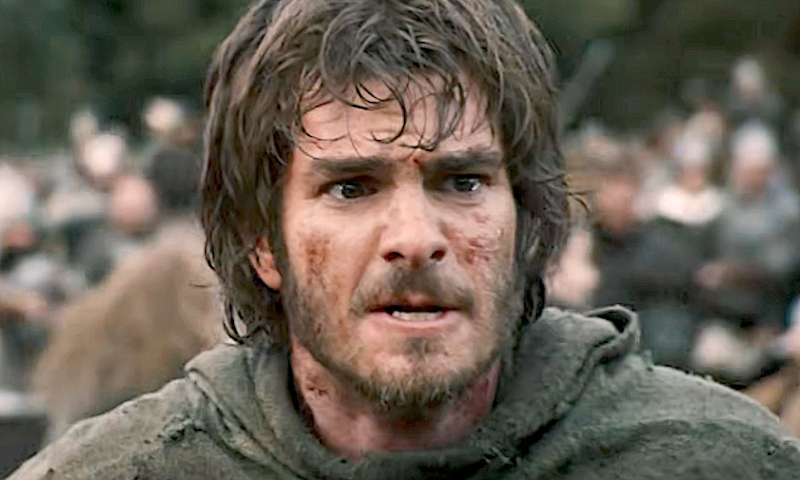
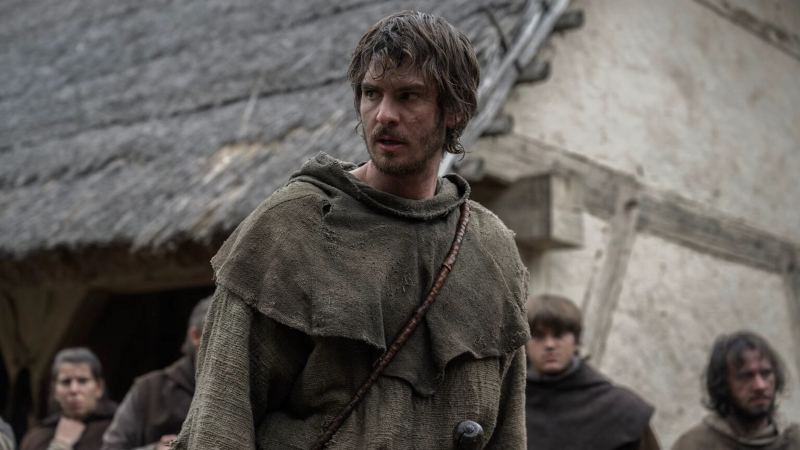
1381. South East England. Ploughman (Andrew Garfield) stands, a lone figure in a desolate landscape. A commoner.
At a local village, backed up by a small retinue of soldiers representing the Crown, a tax collector is collecting annual revenue from each and every adult male, which has increased to a point where ordinary people who work the land can no longer afford to pay it.
It comes out that Ploughman has lost his wife and kids to the recent outbreak of the Black Death, and he loses his composure and gets into a fracas with a soldier over the latter’s inappropriate treatment of a woman. You expect at this point for Ploughman to get carted off and imprisoned, but somehow his act inspires others to stand up to the soldiers, and he comes through the experience rather better than the official, who is forced to leave.
Meanwhile, the 14-year-old King (Woody Norman) is a spiritually troubled young man beset with nightmares and doubts. His mother the Countess (Katherine Waterston) is concerned that he lacks the mettle to take the right decisions and rule his subjects. For the present, he is easily swayed by the views of his court, a group of well off men led by Sir Robert Hales (Tom Hollander) and Archbishop Sudbury (Stephen Dillane) who are intent on raising taxes on the mass of poor people to maintain their personal wealth and status.
Technically this may be to enable the Crown to pay for wars fought abroad, but as you’re watching after seeing the squalor in which the ordinary people live, it feels like privileged types determined to maintain their privileged status.
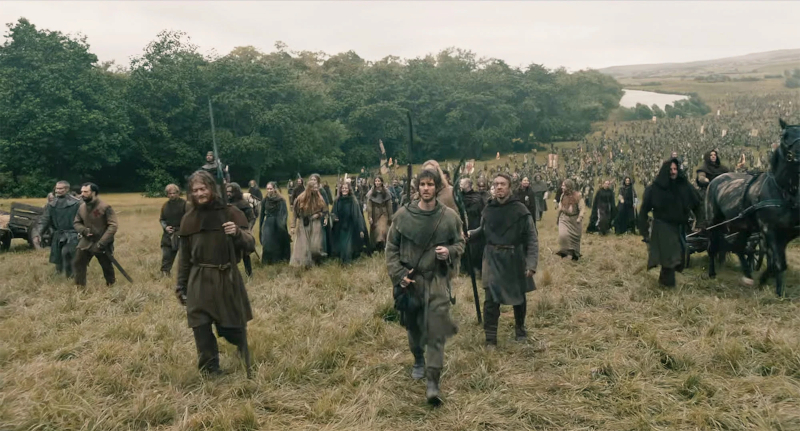
The illiterate Ploughman finds himself the figurehead in a march to London to present a petition to the King demanding the lowering of taxes on the common people. He is a staunch monarchist who believes the king will see reason if a common man talks with him.
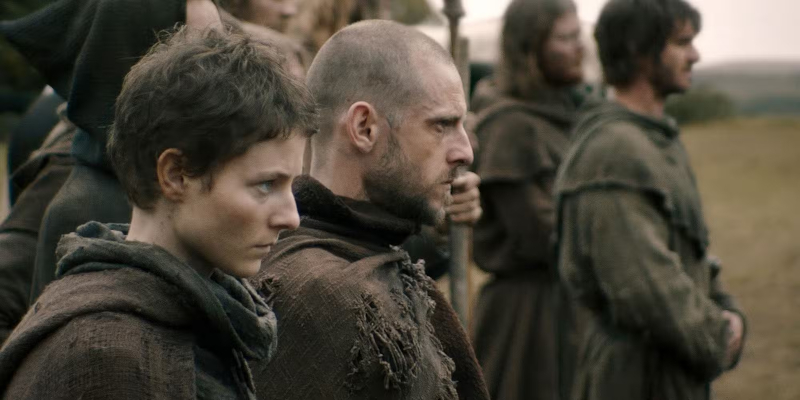
Perhaps this is not so far from one of the other leaders, the priest John Ball (Jamie Bell), who has been branded a heretic for preaching that all men are equal; however, it’s a long way from the views of Wat Tyler (Cosmo Jarvis), a military man who has fought for the Crown in the past and who believes in taking power by force, who makes sure the useful figurehead of Ploughman never hears such views.
The Ploughman finds himself befriended by Alyce (Thomasin McKenzie), a vengeful woman who has her own reasons for being on the march.
After arriving in London only to discover that it’s actually Canterbury and their journey isn’t yet complete, they march to the Thames, where the King agrees to meet with them. In the event, however, the King never leaves the royal barge, sending an emissary to the shore to hear the people’s grievance.
A march on London will follow, where the group will turn into a mob as they attack and seize the capital. Listening to Lord Mayor of London William Walworth (Jonny Lee Miller), the King, to the satisfaction of his concerned mother, develops the wisdom and wiles needed to maintain the status quo and the monarchy’s grip on power…
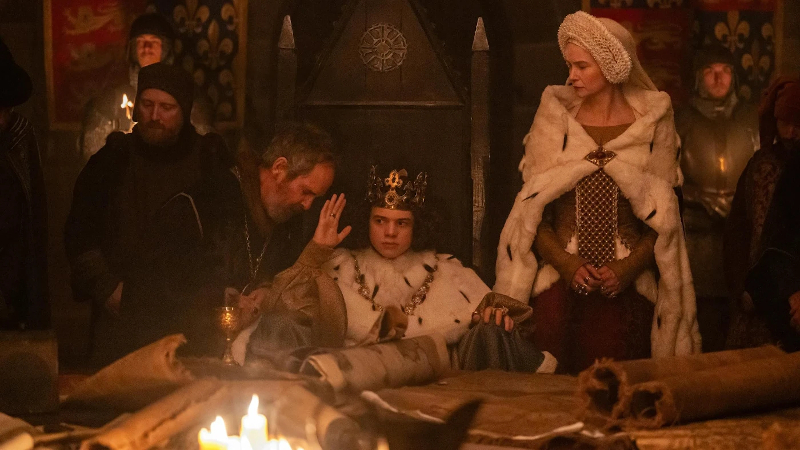
Director Greengrass recreates medieval England in terms of both the common people and the King and the court which surrounds him. The basic nature of the peasants’ clothes contrasts with that of the clearly better off officials and court. The village’s poverty represented by its functional wooden buildings (barns, houses) likewise contrasts heavily with the grand architecture in which the court is situated, including stone pillars and high-vaulted ceilings. The King himself has a private bedchamber and an extremely comfortable-looking bed.
There is the sense here, chiming with our own time, that those at the top of the social pile are so well off that they lack any comprehension of the hardship experienced by those at the bottom.
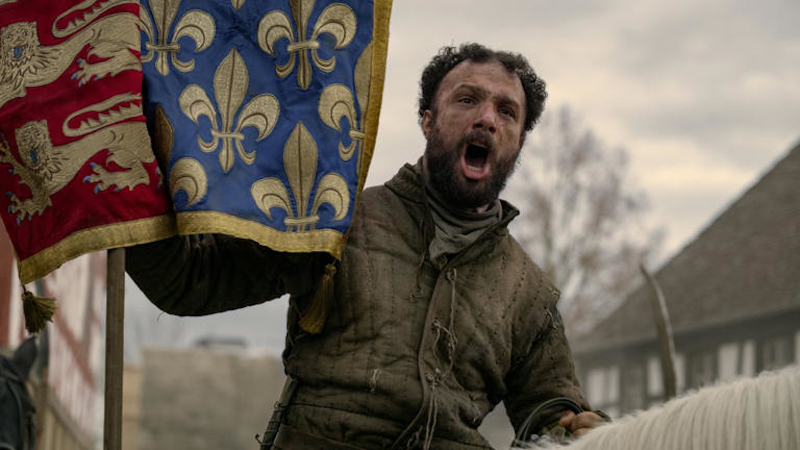
Although this delivers plenty of spectacle and action, its quieter moments impress just as much. Garfield’s Ploughman is ostensibly the protagonist, yet Norman’s king, who lives in a very different world, turns out to be equally significant, with the latter’s troubled performance one of the piece’s highlights. At one point, Ploughman finds himself talking to the King, who confesses his nightmares and unease, which makes the former, standing in for the audience, believe the two men have much in common. And yet, this is only one facet of the king, and – as it happens – not the dominant one which will ultimately decide the path of history.
A curious coda set one year later attempts to place the whole narrative in a completely different light, although this writer is not convinced it really adds anything. That relates to the film’s controversial marketing campaign in the US but not the UK; however, if you don’t look the film up on the web, the coda may come as a genuine surprise (and you’ll enjoy the film more). The UK trailer (below) doesn’t give the game away, either.

Overall, it’s not hard to see why Greengrass (Captain Phillips, 2013; The Bourne Supremacy, 2004), who previously dramatised both the 9/11 passenger aircraft hijacking in United 93 (2006) and a significant incident in the Northern Irish troubles in Bloody Sunday (2002), would want to do the same with the historical event of the 1381 Peasants’ Revolt. The current docudrama may be in the same vein of shooting the film as if you’re actually there, but it’s vastly more ambitious. This is partly because you’re not dealing with a modern mindset, but have to get into the heads of people seven hundred or so years ago, and partly because the geographic and social scales involved are so much larger.
As it stands, the film resonates with a world where people have lost faith in their out-of-touch ruling elites, which may or may not chime with the historical incident on which the narrative is based and characters’ thought processes given the mindset of the period. While it will certainly resonate with a contemporary audience, it may, by the same token, feel overly simplistic.
The Uprising is out in cinemas in the UK on Friday, October 9th.
Trailer: