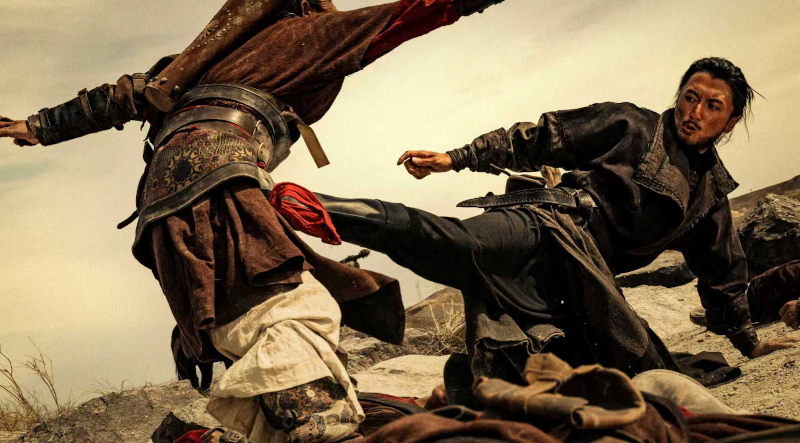
Blades of the Guardians: Wind Rises in the Desert
(Biao Ren Feng Qi Da Mo, 镖人风起大漠)
Director – Yuen Woo-Ping – 2026 – China – Cert. 15 – 126m
*****
In ancient China, a bounty hunter with his small nephew in tow must transport a man across a desert to Chang’an – out in UK and Ireland cinemas on Friday, April 17th
The synopsis opening this review might make it sound like a bad film. It’s not. Humour me.
China’s Sui Dynasty (581 to 618 AD). Bounty hunter Dau Ma (Wu Jing from Ride On, Larry Yang, 2023; The Battle at Lake Changjin, Chen Kaige, Dante Lam, Tsui Hark, 2021; The Wandering Earth, Frant Gwo, 2019; Wolf Warrior, Wu Jing, 2015) travels with his small nephew Xiao Qi (Qianlang Ju) in tow. At an incident at a village inn he demonstrates his considerable fighting skill against a mark and his thugs to force the man to pay Dau Ma triple the price on his head to leave him alone.

Dau Ma is summoned before the town’s Governor Chang (Jet Li from Hero, Zhang Yimou, 2002; Black Mask, Daniel Lee, 1996); Once Upon a Time in China, Tsui Hark, 1991), who wants him to sign on to train Chang’s cavalry – an offer Dau refuses because as an ex-cavalry officer he has long since decided he is better off outside than inside the military system.

He returns to the inn, where the innkeeper turns out to be a warrior known as Two-headed Snake (Zhang Jin from Pacific Rim: Uprising, Steven S. DeKnight, 2018; Ip Man 3, Wilson Yip, 2015; The Grandmaster, Wong Kar-wai, 2013), joining forces against Chang when he attacks, Chang having not taken Dau Ma’s job offer rejection well. The pair’s alliance is short-lived, however, since Two-headed Snake dies mortally wounding Chang.

The bounty hunter and the boy saddle up and ride through the desert to the oasis of Mojia Village, where he accepts a request by head man Lau Mo (Tony Leung Ka-fai from The Shadow’s Edge, Larry Yang, 2025; A Better Tomorrow III: Love and Death in Saigon, Tsui Hark, 1989; Prison on Fire, Ringo Lam, 1987) to take scholar and leader of the so-called Flower Rebellion Zhishilang (Sun Yizhou with a distinctive painted face) to Chang’an.

Lau’s daughter Ayuya (Chen Lijun) joins the party, as she has always wanted to visit Chang’an, insisting on bringing along her friend Ani (Xiong Jinyi). Both will turn out to be skilled archers.

They all set out across the desert, joining forces with a stagecoach in which another bounty hunter Shu (Yosh Yu Shi from Creation of the Gods I: Kingdom of Storms, Wuershan, 2023; Born to Fly, Liu Xiaoshi, 2023), aka the Jade Ghost, is transporting professional sex bomb Yan Ziniang (Li Yunxiao) who he has chained by manacles at her wrists and ankles to prevent her getting up to any mischief.

Their various adventures, basically numerous spectacular fight scenes against different adversaries, eventually cause the group to return to Mojia as it is being razed to the ground. By the end they are still travelling, presumably towards further adventures in Blades of the Guardians 2.

It’s a hard world in which ostensible allies can sometimes turn out to be enemies. Yet, the ordered tranquility of Mojia Village, at least before its enemies under the command of Pei Shiju (Zhang Yi from Scare Out, Zhang Yimou, 2026; Black Dog, Guan Hu, 2023; The Eight Hundred, Guan Hu, 2019) decide to lay waste to it, and Zhishilang’s handing out flowers to his loyal followers, suggest a more harmonious existence is possible.

As numerous other characters appear and disappear, subplots include both despotic (and would-be Khan) He Yixuan (Ci Sha from The Shadow’s Edge; Creation of the Gods I: Kingdom of Storms) – who apparently hasn’t understood that he is no longer betrothed to the unwilling Ayuya and intends to take her by force – and a pair of members of Dau Ma’s former cavalry regiment Di Ting (Nicholas Tse from Raging Fire, Benny Chan, 2021) and Kui Zhi (Liang Bi-Ying) – who are tracking Dau Ma.

If you can keep up with the plot, you’re doing well. (It wouldn’t surprise me at all if the whole made more sense to anyone for whom Mandarin is their first language. Thought processes and patterns differ in different languages, because they are shaped by them.)

However, if you can’t keep up with the plot – well, it doesn’t really matter. Because the reason to see this is not the plot, such as it is (and it provides enough of a narrative spine to hold the whole together and furnish it with the necessary forwards momentum). Rather, it’s the director’s vision (for which read the triumph of style and staging of action over content) and the awe-inspiring, near non-stop stunt action, augmented by the presence of the actors.

Where such recent Hollywood epics as Dune (Denis Villeneuve, 2021) or Spider-Man: into the Spider-Verse (Bob Persichetti, Peter Ramsey, Rodney Rothman, 2018) reach their conclusions only to, without advance warning, invoke audience ire by declaring themselves the first part of a longer story, Blades doesn’t have this problem, because its characters are merely transporting a man across a desert to a fixed geographical destination, during which the here and now of the journey is what is important rather than any narrative conclusion. You go and see Dune or Spider-Man for the story, whereas you go and see Blades for the fights – the action and its choreography.

And what incredible action and choreography it is! Yuen was the stunt director on The Matrix (Andy and Larry Wachowski, 1999) and his work in that film took by storm audiences unfamiliar with his prior work in the Hong Kong film industry. There are certain scenes in Blades where as fighting characters spin, their legs twirling through the air, you immediately recall similar moments in The Matrix. Yet Yuen’s work in Hong Kong and Chinese films are the source not the imitation.

As director, his work goes as far back as early Jackie Chan vehicles Snake in the Eagle’s Shadow and Drunken Master (both 1978) but he was working on stunts in the Hong Kong film business as far back as 1971, in which capacity he later worked on The Grandmaster , Kill Bill Volume Two (Quentin Tarantino, 2004), Kung Fu Hustle (Stephen Chow, 2004), Crouching Tiger, Hidden Dragon (Ang Lee, 2000), Black Mask and Once Upon a Time in China. Altogether, an astonishing pedigree.

Even so, that doesn’t quite prepare you for what’s on offer here. One mind-blowing action set-piece follows another, each one as thrilling as the one before. An all-to briefly seen Jet Li flies through the air via wire work in an action scene as good as anything he’s ever done. There is much swordplay and horse-riding action. A fight on a natural oilfield sees a combatant weaponise the very ground on which the scene is staged by setting fire to it. A fight in a dust storm rivals the one in in Mad Max: Fury Road (George Miller, 2015).

If you’ve never seen a Chinese action movie, this is a great place to start. And if you’re an old hand, this is an outstanding example of that genre, by a master who, despite being eightysomething years old, is still making action movies as breathtaking as anything in his prior career. Simply astonishing.
Blades of the Guardians is out in cinemas in the UK and Ireland on Friday, April 17th.
Trailer: