A Private Life (Vie Privée)
Director – Rebecca Zlotowski – 2025 – France – Cert. 15 – 107m
****
A psychiatrist with an unusual eye problem must unravel the mystery of the recent death of one of her patients – out in UK cinemas on Friday, June 26th
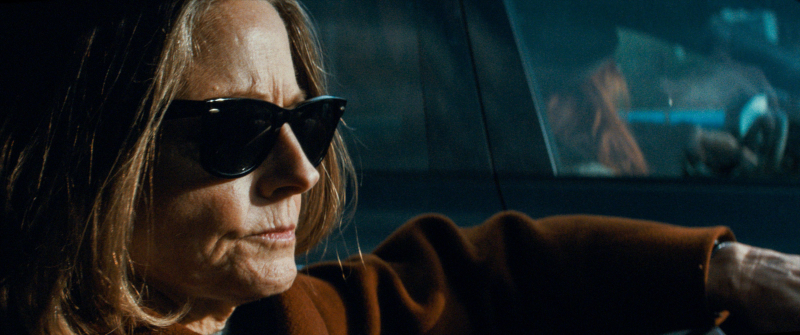
Parisian psychiatrist Dr. Lilian Steiner (Jodie Foster from The Mauritanian, Kevin Macdonald, 2021, The Silence of the Lambs, Jonathan Demme, 1991; Taxi Driver, Martin Scorsese, 1976) is having a hard time. One of her patients Pierre is terminating his sessions after years of treatment following his visit to a hypnotist who managed to cure him of his long-standing smoking habit in one session; indeed, he may sue Dr. Lilian for non-effectiveness of treatment. Another regular Paula hasn’t turned up for her last two sessions, and Dr. Lilian is chasing the invoices.
The reason Paula hasn’t turned up, Dr. Lilian learns in a phone call from Paula’s daughter Valérie (Luana Bajrami (Luana Bajrami from Portrait of a Lady on Fire, Céline Sciamma, 2019)), is simple: Paula has just died. Valérie invites Dr. Lilian to the Shemira (basically, a Jewish wake) only for Paula’s outraged husband Simon (Matthieu Amalric from Nino, Pauline Loquès, 2025; The Grand Budapest Hotel, Wes Anderson, 2014; Munich, Steven Spielberg, 2005) to tell her to get out. It seems he blames Lilian’s course of treatment – in particular her prescription drugs – for his wife’s passing. Valérie later gives Dr. Lilian one of her mother’s paper prescriptions which appears to have been amended in Dr. Lilian’s writing, although that’s not conclusive because someone may have copied her handwriting.

While there’s no real evidence that Dr. Lilian was responsible for her patient’s death, she nevertheless feels guilty about it and is haunted by memories of Paula (Virginie Efira from Paris Memories, Alice Winocour, 2022; Benedetta, 2021, Elle, 2016, both Paul Verhoeven; White Fang, Alexandre Espigares, 2018). On the other hand, she doesn’t have a particularly good relationship with her son Julien (Vincent LaCoste also from Paris Memories; Benedetta; Elle; White Fang), dropping in on him with a query at his small apartment, but not staying to see at her granddaughter, which Julian resents. Nevertheless, he is the person who helps her catalogue her minidisc recordings of her patients’ sessions.
On top of all this, she has a problem with her eyes – she sometimes sheds involuntary tears for no apparent reason. As it happens, her ex-husband Gabriel (Daniel Auteuil from Hidden / Caché, Michael Haneke, 2005; La Reine Margot, Patrice Chéreau, 1994; Jean de Florette, Claude Berri, 1986) is an ophthalmologist, so she talks to him about it since they are on good terms. Thinking her involuntary crying is not unlike Pierre’s involuntary smoking, she tracks down the latter’s miracle hypnotherapist for a session, which propels her into a bizarre dream.

In this dream, Lilian is a cellist performing in an orchestra in which Paula is not only a violinist but also her lover, while the conductor is Paula’s husband Simon, who is armed with a handgun. Uniformed Nazis in the audience and the period costumes suggest this is in France under Nazi occupation. Given that Lilian’s family and patients are Jewish, this dream has an anti-semitic undertone. She puts this to the hypnotherapist, who tells her that the tears problem is cured.
That leaves us with the mystery of Paula’s death, which might or might not indicate foul play on the part of one or other family member. It emerges that Paula had recently received a considerable inheritance from an aunt, which has gone to husband Simon and daughter Valérie following her death; also that Simon has a house in the country with another woman. Lilian drags ex-husband Gabriel into the proceedings after her office is ransacked with the disk of her final session with Paula gone missing, getting him to drive to Simon’s house in the country so she can search for the disk which she is convinced Simon has taken.

The strange thing about this mystery – one hesitates to call it a thriller exactly, because it never becomes an edge-of-the-seat experience – is that even though it can be hard to follow at times, with its complicated cast of characters and meandering multiple plot lines, there is something completely engrossing about it.
This may be in part due to Jodie Foster, who not only acts convincingly in French in a French language movie, but also occasionally talks to herself in American English if you’d never seen the actress in any previous film, this would give away that she is actually American…yet you forget you’ve never seen her act in French before).

Dr. Lilian has at some point moved from the U.S. to Paris and completely embraced her new city and country’s culture, speaking the language like a native. She is Jewish, and perhaps that side of her identity is far stronger than any allegiance she might feel to the US and its language and culture. Foster’s performance carries a strong sense of a woman alone – as well as having left her country of origin, her former marriage (to a Jewish-Frenchman) is also behind her, and even though she both lapses into occasional American English and sees something of her ex from time to time, she is very much the loner focused on her working life. And, aside from her current problems with the two patients opening this narrative, she seems content with her lot.
The only other character whose head we get inside to any degree is Gabriel her ex, a typically sympathetic portrait from the reliable Auteuil. Everyone else, to a greater or lesser degree, are pawns in a mystery which later turns into a murder mystery, and none of the cast are given the same room for manoeuvring and allowing us to fathom their characters.

It’s a very handsome looking movie, thanks in no small part to cinematographer George Lechaptois and production designer Katia Wyszkop (The Beast, Bertrand Bonelo, 2023; Benedetta; Jeune et Jolie, François Ozon, 2013), with lots of scenes of Dr. Lilian in her office with a predominance of browns from certain angles, as if to convey a sense of wood or earth, perhaps emphasising that she is strongly rooted or implying something natural and pre-industrial about the character.
If the narrative can be hard to keep up with, it’s equally capable of throwing in a new element every so often to draw the viewer further in – a house in the woods, a scene in a pharmacists, a visit to a records office. It’s also the sort of film that, after getting to the resolution(s) towards the end, you might well want to return for a second viewing to work out exactly what you missed first time round.
A Private Life is out in cinemas in the UK on Friday, June 26th.
Trailer: