Orwell: 2+2=5
Director – Raoul Peck – 2025 – UK – Cert. 15 – 119m
****1/2
A primer on the life and work of George Orwell, particularly Nineteen Eighty-Four, and its relevance to today’s post-truth world – out in UK cinemas on Friday, March 27th
This belongs to the school of documentary which creates a film out of assembling fragments of movies, found footage, archive clips and images, moving or still. The list of feature films and other source material used in this instance is astonishing, with the director given full access to the Orwell Estate. Peck also makes use of clips from various movie adaptations of Nineteen Eighty-Four (Paul Nickell, 1953; Rudolph Cartier, 1954; Michael Anderson, 1956, Michael Radford, 1984) plus Brazil (Terry Gilliam, 1985), a film so heavily inspired by Orwell’s book that it was originally entitled 1984½, and Animal Farm (John Halas, Joy Batchelor, cartoon animated feature, 1954; John Stephenson, Jim Henson Creature Shop, 1999; illustrations by Ralph Steadman, 1995). On top of this, he uses BBC Drama The Crystal Spirit: Orwell on Jura (John Glenister, script: Alan Plater, 1983) and Orwell’s essay Why I Write (1946).
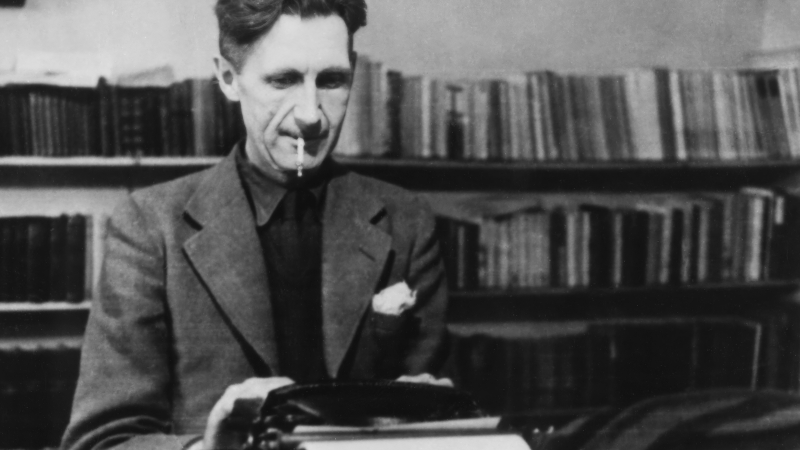
These last two are particularly pertinent, given that Peck has chosen to focus on the final year (1949-50) of Orwell’s life during which he took himself off to the Island of Jura, Scotland to finish writing Nineteen Eighty-Four and was subsequently admitted to University College Hospital, London with Tuberculosis. He had been going back and forth to Jura, and working on the novel, since 1946; he was plagued with health issues on and off during this period. Peck focuses on an episode in a car when George Orwell, real name Eric Arthur Blair (Ronald Pickup) talks to his young, adoptive son Richard (b.1944) showing him four fingers, explaining that there are people who will want him to state the number of fingers as five, not four. They are called governments.
Orwell (voice: Damian Lewis) lists his reasons for writing in the essay – to expose some lie, to draw attention to some fact, to get a hearing. At this point, Peck introduces archive footage of various historical and contemporary atrocities along with the monikers used by the governments responsible to make such acts sound reasonable when in fact they are not. It’s a horrifying list: Strategic Bombing, Berlin, Germany, 1945; Peacekeeping Operations, Mariupol, Ukraine, 2022; Collateral Damage, Berlin, Germany, 1945; Special Military Operation, Mariupol, Ukraine, 2022; Clearance Operation, Myanmar, 2017.

Before age 20, Orwell was working with the Indian Imperial Police, Burma. An Outpost of Empire. “In order to hate imperialism, you have got to be part of it.”, he says. In the police, he felt himself to be part of the actual machinery of despotism, which left him with a bad conscience. At this point, one of this film’s most disturbing images – perhaps because it operates at such a personal rather than a wider socio-political level – shows a living head emerging from plastic bag (from Myanmar Diaries, anonymous, 2022). Orwell talks about his horror at the ordinary lying practised by totalitarian states, and the opinion that art should have nothing to do with politics being itself a political attitude.
There follows a chronicle of books banned, both recently in the US and in various other countries over the last century, along with a montage of book-burning by soldiers starting with Nazi Germany in 1933 through Chile in 1973 going up to Gaza in 2024. This takes us into 1936’s Spanish Civil War and a clip from Land and Freedom (Ken Loach, 1995) in which ordinary people fighting for the left-wing POUM (the Workers Party of Marxist Unification) discuss the values they are fighting for. “What I saw in Spain has given me a horror of politics,” writes Orwell, who served in the POUM. “Atrocities are believed in – or disbelieved in – solely on grounds of political predilection. Everyone believes in the atrocities of the enemy and disbelieves in those of his own side, without ever bothering to examine the evidence.”
A clip from Animal Farm (1999) has Napoleon the Pig declare that everyone is free and they must now gear up for war to protect their way of life, complete with propaganda footage of marching geese, here intercut with shots of military parades from assorted real life dictatorships. Orwell regarded Animal Farm as the first time he had combined political purpose and artistic purpose into one unified whole. In this respect, it laid the groundwork for Nineteen Eighty-Four.

The recurring image through all this is that of Nineteen Eighty-Four’s Winston Smith being shown four fingers and asked to believe it as five, included as clips from a number of the film adaptations, the variants in the different production values of each interpretation serving to make the underlying metaphor all the more powerful.
We are also shown Putin framing Ukraine as Russia taking back a territory that belongs to it, Netenyahu proclaiming that Israel seeks peace, Trump speaking favourably of his supporters storming the White House. In Nineteen Eighty-Four, Newspeak is the language used to alter reality and manipulate just as, in today’s world, political language is designed to make lies sound truthful, and murder respectable. Towards the film’s end, we are reminded of the three slogans of the Party in Nineteen Eighty-Four: Freedom is Slavery, War is Peace, Ignorance is Strength. Peck’s vision of Orwell’s Nineteen-Eighty-Four suggests that what the writer chronicled (rather than prophesied, because these were things he saw happening in the world around him) is, horrifically, very much part and parcel of our world today.
For anyone unfamiliar with Orwell’s life and Nineteen Eighty-Four, and its relevance to where we are now, this documentary is a great primer.
Orwell: 2+2=5 is out in cinemas in the UK on Friday, March 27th.
Trailer: