Director – Johannes Roberts – 2025 – US – Cert. 18 – 89m
****1/2
A girl and her friends discover her family’s pet chimp has turned violent and trapped them in the house – out in UK cinemas on Friday, January 30th
Coming in commendably under 90 minutes, this is a hugely effective thriller about people trapped in a confined space with a monster. Which makes it all the more curious that it missteps for its first couple of scenes, making you wonder if you’re going to regret seeing the film. First up is a scene in which a vet ventures into a house’s exterior enclosure and is attacked by Ben, the distressed chimpanzee, who lives there. The problem is not the scene itself, which is both genuinely scary and sets the scene for what is to follow – indeed, it establishes that there is a chimpanzee in the house about to turn bad – but the fact that it’s almost impossible to relate the scene to the remaining narrative, apart from the fact that it takes place 36 hours earlier. Who was the vet? At what point in the unfolding flashback does this attack take place? The ensuing mayhem won’t leave you any time to ponder such questions, so it arguably doesn’t matter, but for me, because I couldn’t make any sense of it in the scheme of the wider film, it proved annoying.
The next scene couldn’t be more different: twentysomethings Lucy (Johnny Sequoyah from Dexter: New Blood, TV series, 2021-22) and her friend Kate (Victoria Wyant from Foundation, TV series, 2025) Kate’s friend Hannah (Jessica Alexander from The Little Mermaid, 2023), and Kate’s brother Nick (Benjamin Cheng) leave the plane and come through the airport on their way to Lucy’s family home. Clearly intended to ground the characters and make us feel sympathy for them before the action proper starts, which is probably a very good idea in terms of making the film work effectively in terms of engaging the audience, it had the exact opposite effect on this introverted male writer, making me dread spending the best part of 90 minutes in a movie theatre with these irritating characters. It felt like a scene from a romcom that I (personally) would have no desire to see. There’s nothing wrong with romcoms, they just aren’t my kind of thing. It also felt like a film where you feel no sympathy for the characters and want the monster to finish them off as quickly as possible.

And then the four friends get to the house. Also in the house is Lucy’s younger sister Erin (Gia Hunter) and Ben, the beloved family chimp Lucy has known since she was a child. The girls’ dad Adam (Troy Kotsur from Foundation; CODA, Sian Heder, 2021, The Mandalorian, TV series, 2019), a deaf writer, is absent for work reasons. The spacious, secluded house is a dream, built into the side of a mountain, with a swimming pool. With Ben turned from friendly, devoted family pet to dangerous aggressor, that dream will turn into a nightmare.
In case you need a rationale for his behaviour, it’s later explained in the dialogue that Ben has been bitten by a rabid mongoose and caught that disease himself. Given that information, everything Ben does is completely believable, although if you’re being pursued by an aggressive chimp, you’re less likely to ponder the reasons for his behaviour (because, frankly, you don’t really have any time) and more likely to escape or, if that’s not possible, at least get out of his way.
Once the film gets going, which is to say once it gets past the gratuitous violent vet scene and the irritating girls at the airport scene, it doesn’t miss a trick and sets about doing what it intends to do at full throttle. It follows the template of a group of characters trapped in a confined space with a villain / monster / aggressor / predator, skilfully first showing us the layout of the house interior with its various levels, including an upper floor with assorted rooms and balcony and a lower floor with a swimming pool.

To describe the exact plot would be something of a spoiler for a film like this. It’s worthy of note that, with the exception of the deaf father, who returns to the house late on in the chaos, the males here (excepting the chimp) are generally a pretty feeble lot while the women and girls are extremely resourceful, which puts you on their side emotionally and more than compensates for the airport scene. Early on, Nick makes an error of judgement regarding his ability to successfully confront the chimp and pays for it by going over the balcony, falling several hundred feet and being rewarded with a gory close up of his cranium impacting on the rocks below. That description of the close up probably tells you whether or not this is a film you want to see. The close up definitely falls into the it’s so over the top it’s funny category – we laugh at out innermost fears. (Personally, I loved every suspense-filled, sometimes gory minute once we got through the opening scenes before the girls reach the house.)
As well as Nick, there are two jocks Drew (Charlie Mann) and Brad (Tienne Simon) who later come over to the house at the girls’ invitation via mobile phone unaware that the girls’ plea for help is not an invitation to get laid. Again, bad things happen to them.

The girls themselves, however, are another matter. Where the boys in this film do stupid things, the girls generally don’t. Trapped in a situation with no obvious way out, Lucy resolves to find her mobile phone and call for help, but the phone is somewhere in the house and so is the rabid, unpredictable Ben who at one point crashes through a glass door, adding in the additional hazard of a floor with broken glass shards for barefooted girls.
While many of the perils here hardly suggest cinematic originality, the pleasure and indeed brilliance of this film lies in the skill of its choreography, the way it’s all put together. For instance, when Adam the deaf dad comes back to the house towards the end of the proceedings, unaware that Ben has rabies and is therefore dangerous, he navigates the premises, as he always does, without sound. Director Roberts incorporates Adam’s inner world into the scene via some silent shots in which, if Adam could hear, he would hear Ben making noises behind him (which the audience can’t hear either, but they can see Ben appear visually, albeit sometimes briefly).

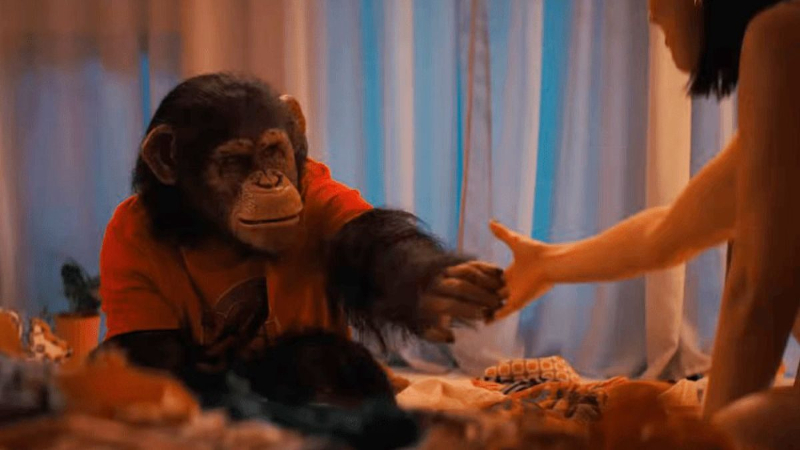
As for Ben the chimp, he is performed in an astonishingly convincing chimp suit by character actor Miguel Torres Umba and gymnastically-trained stunt double Nadia Nansell on different occasions. Combined with Stephen Murphy’s skilful cinematography and Peter Gvozdas’ judicious editing, it creates a sense that you’re never quite sure where Ben is – sometimes he might come out of a dark space or from just outside of frame edge. Prosthetics are in the mix too, as for instance when Ben rips off a character’s jaw. These effects being mostly practical rather than CGI allow the actors to interact with them, which goes a long way to make the piece convincing. Indeed, so convincing is the representation of Ben the chimp that this writer could not have told you how it was done; while I was watching, I fully believed I was watching a real life chimp.
Film history is full of movies like this that fail due to lack of convincing effects. Or are so bad that they become unintentionally and hilariously funny. Happily, that isn’t the case here.
Nor is the physical make up here like that in Planet of the Apes, Franklin J. Schaffner, 1968), 2001: A Space Odyssey (Stanley Kubrick, 1968), or Sasquatch Sunset (David & Nathan Zellner, 2024), where you’re watching actors in ape suits, who are obviously actors in ape suits, yet you are drawn in by their skill as actors. Whenever Ben the chimp appears on the screen, you’ll believe he’s real. That said, the skill of the actor in the suit and his stunt double play a part, but the convincing naturalism of the ape is way, way above that in those other films.

For that matter, whenever you’re in the house and he’s not on the screen, you’ll feel he’s lurking somewhere in the house and the sense of danger is palpable. In this respect, the film is a lot like Halloween (John Carpenter, 1978), which has been described as the cinema’s most effective device for saying “boo!” And with Primate’s use of physical and in camera effects as opposed to the contemporary reliance on CGI, which it does actually use, albeit only sparingly, it harks back to the classic horror films of the 1970s and 1980s.
Finally, it should be mentioned that Roberts has cast his film well and elicits solid performances from his cast. Just compare what’s here to any number of horror films where the cast members have all the charisma of cardboard.
In short, leaving aside duff opening scenes, from which it swiftly recovers, this is a pretty effective protagonists in peril, suspense thriller once it gets going. There’s a certain, undeniable viewer satisfaction in that.
Primate is out in cinemas in the UK on Friday, January 30th.
Trailer: