Categories
Books

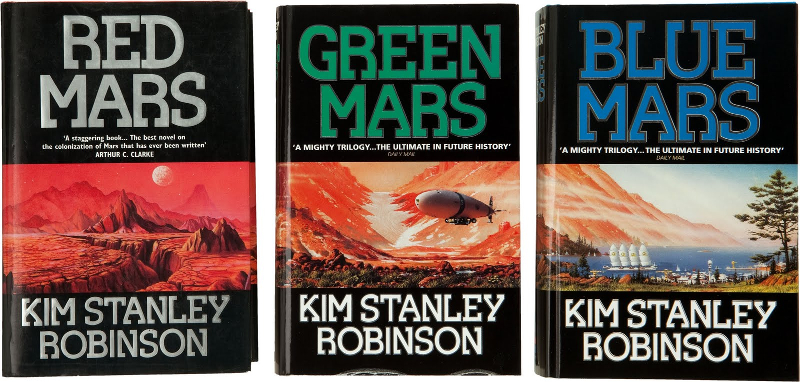
The Mars Trilogy

Blue Mars

Kim Stanley Robinson, VOYAGER £15.99, Hbk.

Red Mars, Green Mars

VOYAGER both £5.99, Pbk.

As Mars is terraformed, its dusty red surface shifts through the green of vegetation to the blue of ocean waves as its north polar ice cap is melted – the three volumes in Kim Stanley Robinson’s trilogy being named accordingly. Although Blue Mars can be read alone, it not only continues on from where the second book left off (the Terran flood disaster of 2127 and subsequent Martian bid for independence) but contains so many references to what has gone before that one can get far more out of Blue Mars if its read following the two preceding volumes. For instance, the opening crisis as to whether the radical terrorists should or should not destroy the (second) cable elevator link with the asteroid New Clarke relates to a whole prior history, including the destruction of the original cable and the freeing of the first Clarke from orbit, with the spectacular and devastating collapse of miles and miles of cable furnishing the unforgettable finale of Red Mars.

Not that the Mars trilogy is purely for techno-geeks. Principle characters are members of 2027’s original group of settlers, appropriately named the First Hundred even though their number also includes a hidden hundred and first member, a concealed stowaway later nicknamed Coyote.… Read the rest
Categories
Features Live Action Movies

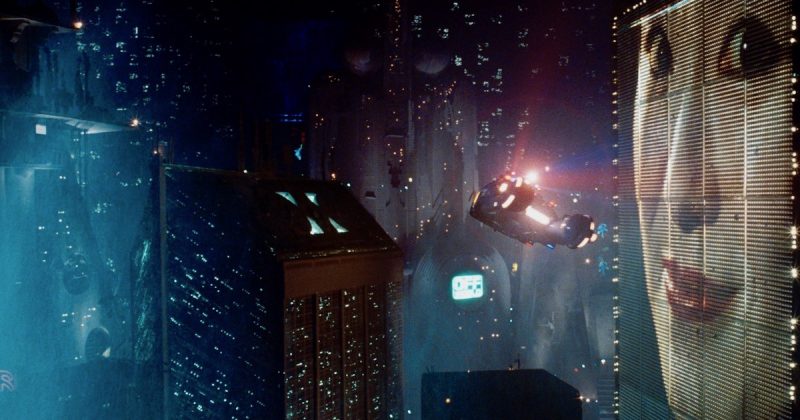
Blade Runner –
The Director’s Cut

Director – Ridley Scott – 1993 (1982) – US – 15 – 116 mins 29 secs

*****

DO FILM EXECS DREAM OF ELECTRIC UNICORNS?

One of the two main motivating forces behind the current Tetsuo II: Body Hammer (Shinya Tsukamoto, 1992) – the other was Videodrome, (David Cronenberg, 1983) – Blade Runner turns up in the cinema here some ten years after its original release in a Director’s Cut.

According to the press handouts, this isn’t just the original cut prior to Warner Bros.’ encouraging director Ridley Scott to remove the downbeat ending and insert a film noir voice over to explain what was going on – the film has additionally been re-edited by the director to make it work for a nineties audience.

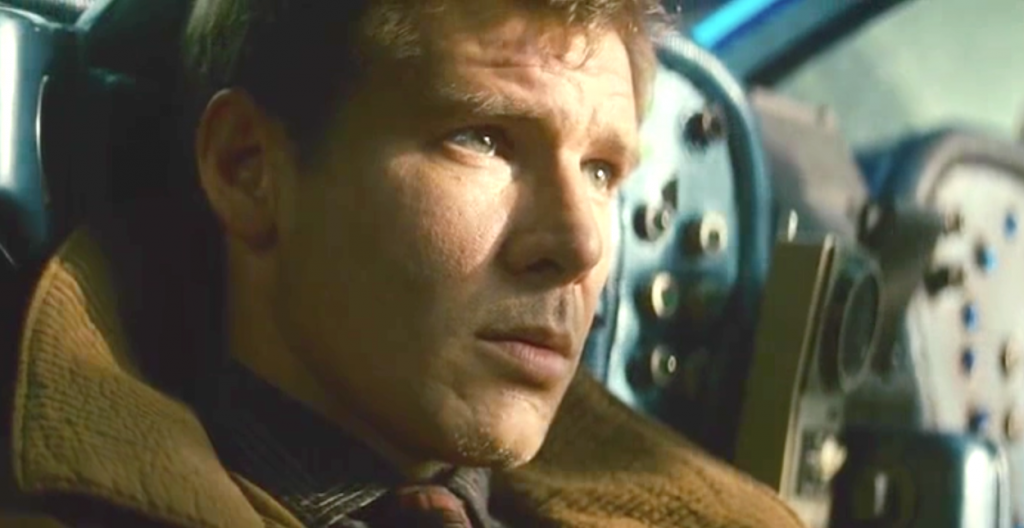
Thus, the redundant voice over has gone and the original down ending is back – to make more sense of the story. There’s also a new and crucial sequence in which Harrison Ford as Deckard (an ex-cop, or ‘blade runner’, who forcibly retires renegade androids known as ‘replicants’) dreams of a unicorn which looks suspiciously like an out-take from the director’s later big budget fairytale flop Legend (1985). The relationship between Deckard and the state-of-the-art replicant Rachel (Sean Young) (“she doesn’t even know,” he comments bitterly) is expanded too.… Read the rest