
Director – John Patton Ford – 2026 – UK, France – Cert. 15 – 105m
****
A disinherited son culls the seven family members standing between him and the fortune of his super-rich family one by one – US reimagining of Kind Hearts and Coronets is out in UK cinemas on Friday, March 13th
Sentenced to death for murder, Becket Redfellow (Glen Powell) asks for a priest to visit his cell on death row so he can recount the long story behind his incarceration. The priest arrives, and Becket starts to tell his tale…

Mary Redfellow (Nell Williams) has a child, Becket (Grady Wilson), with a man her wealthy family, the Redfellows, consider beneath her station. As a result, they cut her off. She nevertheless teaches the child to be mindful of gaining his true inheritance. She has him learn archery and piano. At a piano recital as a child, he meets Julia (Maggie Toomey), a monied girl his own age, and the two immediately hit it off.
As an adult, the family’s rejection of Becket and his mother is made crystal clear to him when his mother dies and he attempts to get family funding for her funeral, the refusal coming in the terse form of a three-line letter delivered by chauffeur-driven car to the family estate gates where Becket is waiting. Her final request of burial in the family mausoleum has been denied.

Becket starts taking an interest in the fortunes of various members of the Redfellow family. Unlike them, he needs to earn a living, so gets a job as a retail assistant in a shop which requires he wear a suit. One day, the now grown up Julia (Margaret Qualley) comes into the shop and recognises him. She asks about his inheritance, and tells him to let her know when he’s closer to accessing it.

Becket contemplates killing off those family members standing between him and his inheritance. Perhaps it’s a whim which he doesn’t really intend seeing through. Be that as it may, he starts to walk the walk to see what will happen. Taylor Redfellow (Raff Law) is a party animal, busily squandering the family fortune, scattering banknotes from a bag over a pool party before diving in from a helicopter.

In what is arguably the film’s strongest scene, Becket’s gaining access to Taylor’s yacht where the latter is collapsed in a drunken stupor proves surprisingly easy. When Taylor, assuming him a lackey, instructs him to fetch the anchor, it’s simple enough for Becket to tie the anchor rope round the leg of the barely conscious Taylor. Dropping the anchor over the side – which would drag Taylor to death by drowning – is far harder. It’s a red line. If Becket drops it, he is embarking on the first step of a pre-planned killing spree. And then, while grappling with the moral complexities of what he might be about to do, Becket accidentally loses his grip and the anchor goes over the side. He has embarked on his course of action – but, in the end, it wasn’t an active decision.
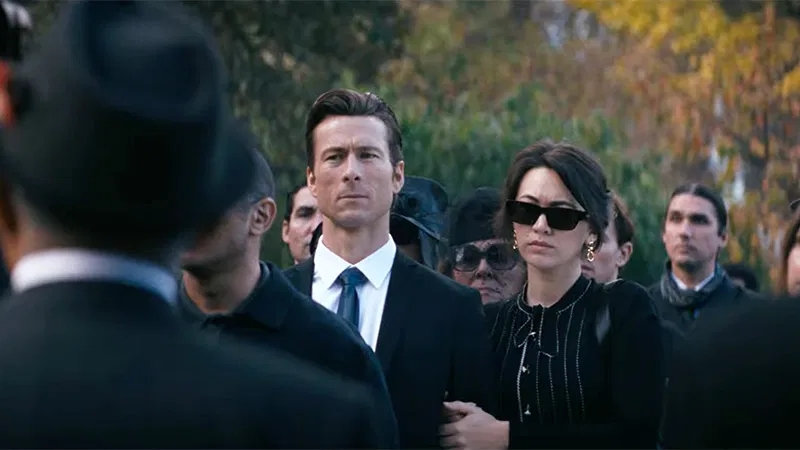
Becket attends the funeral and introduces himself to his uncle Warren Redfellow (Bill Camp), who confesses to feeling guilty about never having got in touch with Mary and gives Becket a job in the Wall Street business he runs. While it’s true there’s some nepotism involved, he is the one Redfellow who treats Becket like a family member, a mark of decency which looks set to upset Becket’s plans further down the road.

Before that dilemma comes to a head, however, there follow various despatchings of the other Redfellows standing between Becket and his inheritance – privileged and therefore culturally redundant artist and photographer Noah Redfellow (Zach Woods), fraudulent religious guru Steven Redfellow (Topher Grace), explorer McArthur Redfellow (Alexander Hanson) who is about to launch himself into space, self-styled philanthropist Cassandra Redfellow (Bianca Amato) who raises orphans from various foreign countries, and unpleasant family head Whitelaw Redfellow (Ed Harris), the one responsible for Mary’s ostracism.

Meanwhile, Becket’s murderous activities are interspersed with not only an ongoing romance with Noah’s girlfriend (and later widow) Ruth (Jessica Henwick) but pursuit by Julia. Ruth seems a genuinely nice person, while the seductively manipulative Julia has entitlement and privilege written all over her. In the end, he will have to choose between them, which may prove a harder choice than it sounds…

This is described in the end credits as inspired by Kind Hearts and Coronets (Robert Hamer, 1949), one of the classic Ealing Comedies. Anyone familiar with that film will immediately recognise the plot of this one: a man whose mother and her descendants have been disowned by their wealthy family kills off the family members one by one in order to secure his inheritance. That’s the essence, but there are lots of other plot similarities too, perhaps not surprisingly given that both films are adapted from the same novel – Israel Rank: The Autobiography of a Criminal (Roy Horniman, 1907).
There are, however, some major differences between the two films. Kind Hearts is set in England and is about the English aristocracy. Killing is set in America and is about the bluebloods. Kind Hearts’ family members are a foolish young man, his banker father, a photographer, a clergyman, a general, an admiral, a suffragette (the one character that ties the Ealing version firmly to the early twentieth century), and the ruthless family patriarch. Killing’s are a foolish young man, his successful Wall Street father, an artist obsessed with pre-digital photography, a fraudulent megachurch religious leader, an explorer, a woman who virtue-signals by raising foreign orphans, and the ruthless family patriarch.
Considerable thought has gone into translating the characters into the American idiom in writer-director John Patton Ford’s screenplay, and this element is for the most part extremely successful.

Kind Hearts’ eight family members are played by one actor, Alec Guinness; Killing’s seven are played by seven separate actors.
Kind Hearts is blackly and amorally comic in tone, and very, very funny; Killing is black and amoral, but not particularly funny,. While the two films are in many ways remarkably similar, Kind Hearts is a comic masterpiece to return to again and again over the years, while Killing is a reasonably efficient crime caper likely to be forgotten ini the space of twelve months.
(Note: Although this is made by a US writer-director, it’s backed by French / British distributor StudioCanal by way of indie British production house Blueprint Pictures. So it’s a French / British movie.)
How to Make a Killing is out in cinemas in the UK on Friday, March 13th.
Trailer: