1 IN 2
Director – David Nicholas Wilkinson – 2026 – UK – Cert. 15 – 141m
*****
David undergoes treatment for his bowel cancer, trying to find out why it went undetected by the NHS until it reached stage 4, despite FIT tests and colonoscopy–this film could save your life – out in UK cinemas on Friday, November 13th
Note: I mostly refer to the subject and maker of this film by his first name rather than his family name because that is how he is mostly referred to in the film.
This is a hard review to write in the sense that, as a critic, one is supposed to be completely objective. Occasionally, however, films come along which have some aspect to them so close to one’s own experience that maintaining objectivity proves difficult. I am in remission for cancer, which is to say that, although I am constantly watching for its reappearance and have to take medication for five years, I am basically cured. (Unless I’m not. This stuff messes with your head.) I am also one of those rare cases that hardly ever happens. In my case, while breast cancer is very common, it rarely occurs among men.
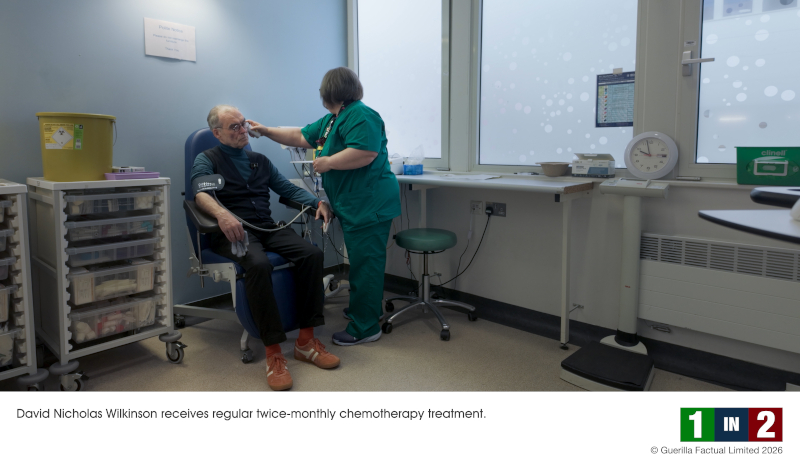
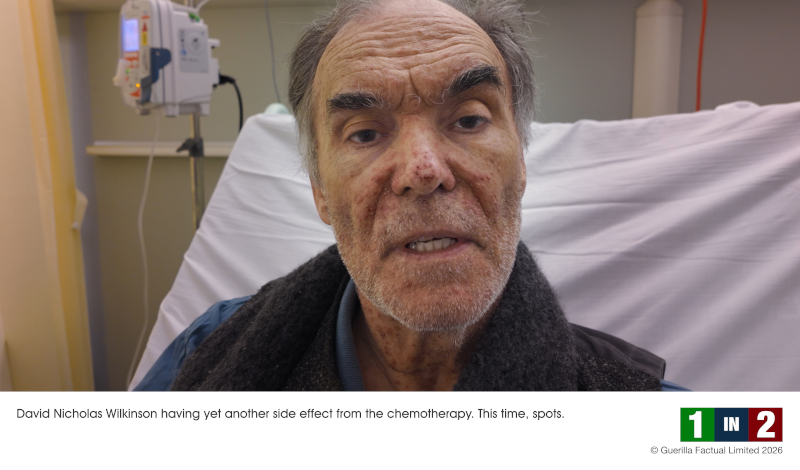
David, however, is basically not cured and has to live with his cancer. Or I should say cancers, because he was already living with prostate cancer when his second cancer, an entirely separate bowel cancer, was diagnosed. He regularly undergoes chemotherapy. He, too, is a rare case. The thing about rare cases is that, if they happen to be you, they don’t seem rare at all. There is a history in his family of males dying of prostate cancer, although he wonders in retrospect whether they, like him, in fact had prostate cancer then separate bowel cancer. This film is not about prostate cancer but about bowel cancer.
Nor is it about how treatment was 30 or 60 years ago, when a cancer diagnosis was pretty much an automatic death sentence and treatment, whilst not exactly a walk in the park today, was far more gruelling. Today, cancer caught early (stage 1) can often be cured. It also costs the NHS far less to cure a stage 1 than to manage an incurable stage 4, so if the condition can be spotted early, it’s in everyone’s interest and makes economic sense too.
All this sounds horribly serious. And so, of course, it is. And yet, the whole thing is infused with Wilkinson’s wicked sense of humour. At one point her delivers a long series of fucks (as in, fuck cancer!), and muses that someone will want him to cut the footage out. I’m glad he kept it in.
I particularly like the sequence where, adopting the persona of the presenter in a documentary explaining a situation to the audience, attempts to explain a hospital visit and, in a series of shots, keeps getting interrupted by members of staff who enter into the area being filmed by the patient to carry out their various jobs upon his person. In places, the film is surprisingly funny. Such is cancer: sometimes, you have to look on the bright side of things to get you through the dark times.
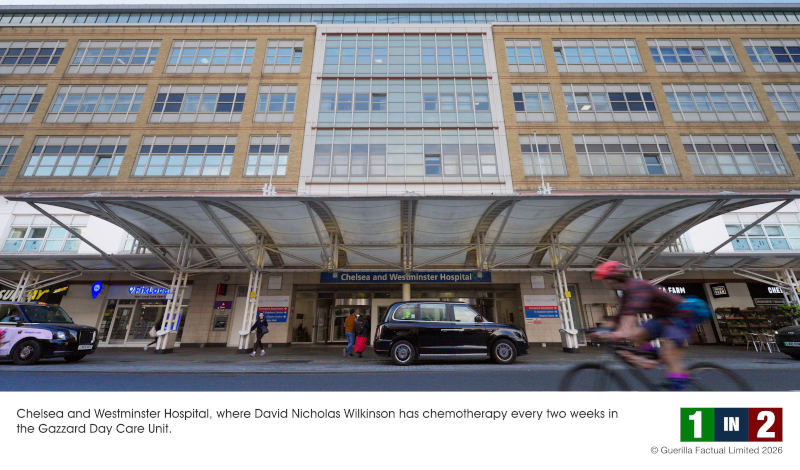
To those outside of this world, cancer is cancer is cancer. If you’re in it, though, you tend to get to know about the cancer (or cancers) that affect you personally. Other cancers, not so much. And there are as many cancers as there are diagnosed cancer patients. Every cancer is different. Every patient is different. This film is about bowel cancer. It is also about the system tackling it, and one patient’s navigation of that system – and because David is a UK resident, it’s about our amazing National Health Service which was founded post-WW2 on the principle of free healthcare to all at the point of need. Living in South West London, and for his treatment being shuffled between three different Trusts: Chelsea & Westminster (where he has chemotherapy every two weeks), Imperial, and the Royal Marsden.
David suspected his experienced standard of care was very high, and was therefore keen to find out how other parts of the UK compared. So he searched throughout the land for patients as well as healthcare professionals who might be able to shed light. Little maps appear with a radio button showing a hospital or person’s location in the British isles, or highlighting differences in detection or care in certain areas – this is where we learn that if you’re going to get bowel cancer, Northern Ireland is the area where it’s least likely to be spotted.
Which brings us to the driving force of this documentary; as his hospital visits started, David noticed that while he was a man around age 70 who’d lived his life, there were also people with bowel cancer who were much younger, for instance 40, or in a few cases even 20. We meet a number of these in the film, but lest we forget this condition can be a killer, a number, who are very much alive when David’s small crew filmed them, have since died from the disease.
Early on, when a friend informed an audience at a screening of one of his earlier films in Galway about his condition, friends who learned it was bowel cancer pointed him in the direction of one Clodagh Downing, a bowel cancer patient who was a strong advocate for those with the condition. He read her writings, which he found inspirational. They talked on the phone. She bombarded him with invaluable information. He planned to interview her, but within two weeks, she had died.
When he began working on the film, I don’t believe he knew whether he would in fact still be here to complete it, or whether the latter part of the job would fall into the hands of trusted collaborators. Happily he is still with us, but that fact is not to be taken for granted.
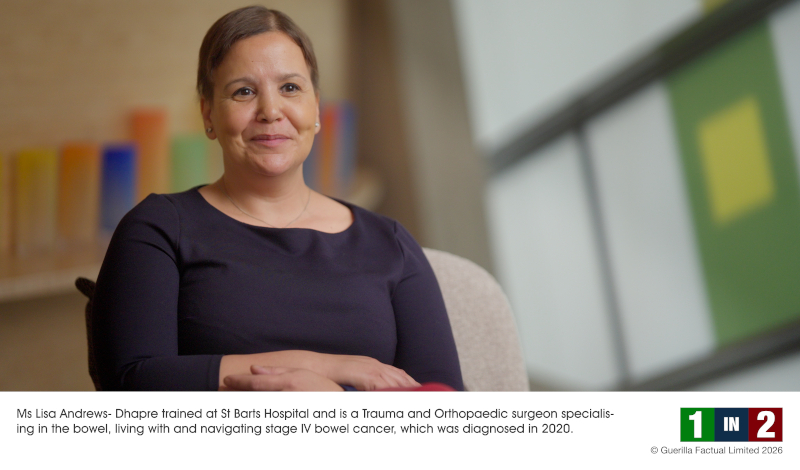
Interviews with patients and practitioners form a large part of this film. Some of them have died since being interviewed. One such is Ms. Lisa Andrews-Dhapre, who trained at Barts as a Trauma and Orthopaedic Surgeon specialising in the bowel, and found herself in a similar position to David, in that the system, herself included, missed the symptoms until she was later diagnosed with stage 3 bowel cancer herself, giving her a unique, double perspective. Sadly, she passed away this Summer, yet the woman who is interviewed on the screen feels so very alive.
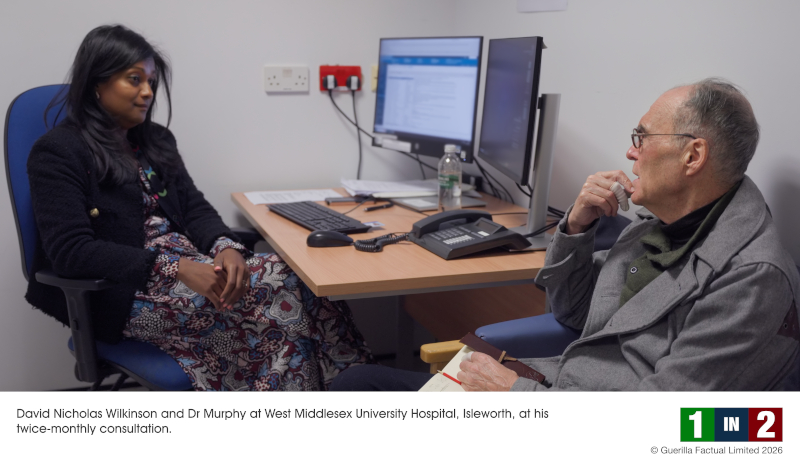
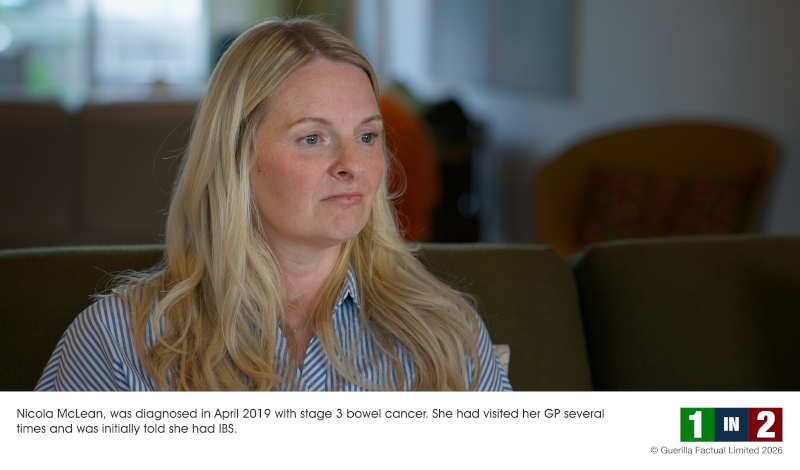
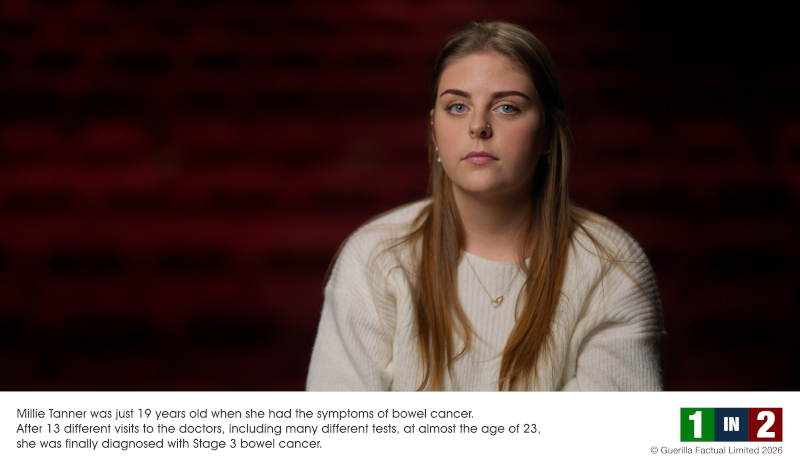
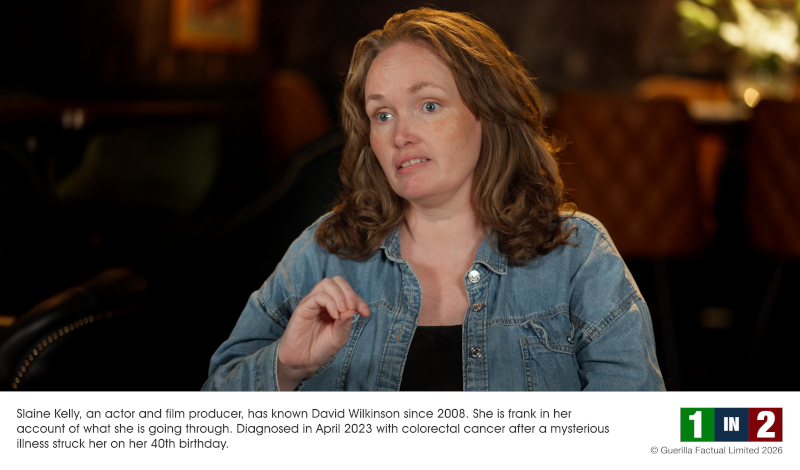
There are numerous remarkable interviewees. Too many to go through in full here. On the patient side, Slaine Kelly, Nicola Maclean and Rene Shawcross were eventually diagnosed with the condition at Stage 3 or 4 a few years before or at 40, Milli Tanner at a mere 22. All should have been diagnosed about three years earlier; Milli Tanner’s case is particularly harrowing in that the NHS fobbed her off because of her young age. On the professional healthcare side, Dame Laura Lee runs the cancer care support charity Maggie’s (whose array of Pukka teas in at least one of their drop-in locations is surely the very definition of homely), while Ravindhi Murphy is David’s oncologist at Chelsea & Westminster.
Something else that’s great about this documentary: it captures the feeling of attending an NHS hospital or hospitals and being looked after as you undergo the various procedures. Now, it’s possible I’m writing this having experienced chemotherapy, as David does in the course of the film, and clearly I relate (as many patients, for cancer and other conditions, likely will) to the experience of going in and talking to the doctor, or the various health professionals at their various levels within the hospital getting on and doing their job.
In addition – and I don’t think this is ever verbally stated – watching these assorted NHS professionals at work, it quickly becomes apparent that they hail from a variety of British ethnic backgrounds. We live in a time when the far right is constantly trying to demonise immigrants and ethnic minorities, yet it is obvious, watching this film, that numerous people who over the decades have found their way to Britain from abroad have ended up in the NHS where they do a really good job, and the NHS is all the richer for it. This is very much an aside to the main purposes of the film, yet it’s most definitely in there, and you feel it as you’re watching. And a very good thing it is too.
Overall, this is a remarkable documentary and, yes, it could indeed save your life. Never boring, I found it compelling, if, at times, overwhelming. And it’s a film which absolutely deserves, indeed cries out, to be seen.
1 IN 2 is out in cinemas in the UK on Friday, November 13th.
Trailer: