Project Hail Mary
Directors – Phil Lord, Christopher Miller – 2026 – US – Cert. 12a – 156m
*****
Hail Mary, Full of Grace. A school teacher is sent to a star 12 light years from Earth to determine why it is surviving the emergent life form killing all other stars, including our sun – out in UK cinemas on Friday, March 20th
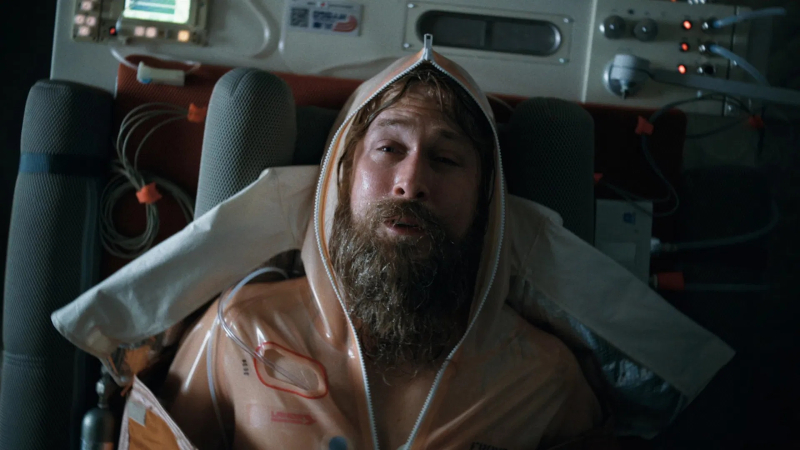
“What is 2 + 2?” Rudely awakened from cryogenic sleep by the ship’s computer (voice: Priya Kansara from Polite Society, Nida Manzoor, 2023), Ryland Grace (Ryan Gosling from Blade Runner 2049, Denis Villeneuve, 2017; La La Land, Damien Chazelle, 2016; Drive, Nicholas Winding Refn, 2011) comes under a barrage of questions designed to check his medical status. While he is perfectly healthy, his fellow crew members – the captain (Milana Vayntrub) and the pilot (Ken Leung from Joker: Folie à Deux, Todd Phillips, 2024; Lost, TV series, 2008-10; Rush Hour, Brett Ratner, 1998) – have died in their sleep chambers. Who is he, how did he get here? Memories come flooding back, building a picture of his past and revealing the answers, even as he goes about his mission.

Back on earth, Grace was a middle school teacher. Helping kids ask questions, solve problems. He loves what he does and seems to be good at it. His world is turned upside down the day science administrator Eva Stratt (Sandra Hüller from The Zone of Interest, Jonathan Glazer, 2023; Anatomy of a Fall, Justine Triet, 2023; Toni Erdmann, Maren Ade, 2016) shows up, accompanied by a big guy named Carl (Lionel Boyce) who could be her chauffeur, or security detail, or both, or much more. Grace has no choice but to go with them.

She reminds him that in his former career as a molecular biologist, he once wrote a paper positing life forms based on chemicals other than hydrogen and two carbon (water). This was so controversial that it did for his career. He had unshakeable belief in the face of intractable opposition, and that is why she wants him.
Life forms have been detected on the sun and they appear to have journeyed to Venus, forming the Petrova line between the two celestial bodies. The life form has been dubbed Astrophage (Star Virus) since it appears to eat stars. Not only is our own sun dimming, which will lead to the rapid cooling of the Earth, but the same thing is happening to all the other stars. Except one, Tau Ceti, 12 light years from Earth.

A collected sample of the life form is held in a chamber with an argon atmosphere. Grace must go in and test its composition. Which could prove the thesis in his controversial paper. Once inside, he is gutted to discover the life form is water-based. It’s a single cell organism. He works out that it takes energy from the Sun then travels to Venus where carbon dioxide will enable it to breed.
Stratt takes Grace to an aircraft carrier hosting a conference of scientists debating the issue in what is known as Project Hail Mary “because it’s a long shot”. The plan is to to send a ship, the Hail Mary, to Tau Ceti to find out what is preventing that star from dimming like all the others. The ship will be powered by Astrophage, which has been discovered to be an excellent source of rocket fuel. Unfortunately, there is only enough Astrophage to get the ship there: it won’t be coming back. This is a one way mission.
There are no plans for Grace to be part of the crew, although (as is obvious from the start of the film when he wakes up on board the Hail Mary), things change. We won’t give away how.

Back to the other narrative strand, wherein Grace is alone on board the Hail Mary. Remembering how he got there. This is quite some way into the movie. The computer warns him about Blip A, an incoming object, which turns out to be a gigantic spaceship maybe 20 times the size of the Hail Mary. Now it’s on top of him. Then Blip B, which is a tiny projectile sent from the alien ship, like an object he’s supposed to catch. He must space walk to catch it. He doesn’t catch it.
All is not lost, however, because a second projectile, Blip C, follows soon after and he catches that one. Alien technology then proceeds to build a walkway between the two ships, so he walks down it in his spacesuit to meet… an alien. Behind an alien barrier. The alien looks like a spider built out of rocks, with five limbs and no discernible head. The alien clearly wants to communicate with him. And he with it. Between them,. They must work out how to do that. Eventually, they get there, communicating via math, and exchange names. The alien name doesn’t really work in any Earth language, so Grace christens him Rocky (voice and lead puppeteer: James Ortiz).

Rocky is an Eridian, from the planet Erid. He is here for exactly the same reason as Grace: he wants to find out what different about this star that means is is not dimming like all the other stars so that he can save his home planet. Solving that mystery is what drives the narrative, but in a way, that’s not what the movie is about so much as the relationship of Grace the human to Rocky the alien as they learn to work together.
Rocky’s appearance briefly recalls the stone creature in Galaxy Quest (Dean Parisot, 1999) but that entity has no personality beyond a marauding monster. One can argue that there are three basic types of aliens in the movies which are sketched to any degree of complex character detail – the nasty ones with teeth in Alien (Ridley Scott, 1979), the cuddly ones with glowing fingers in E.T. the Extra-Terrestrial (Steven Spielberg, 1982) and the very different ones in less well-known outing The Arrival (David Twohy, 1996). To these, we can now add a fourth type, the rock with five rock legs.
Like his human counterpart Grace, Rocky is surprisingly engaging. Once the latter appears on screen, he’s very much part of a double act.

We’ve already seen Ryan Gosling playing a character who believes himself completely out of his depth – he ‘s not the captain who understands the Hail Mary nor the pilot who knows how to fly it – dropping litter wherever he eats on the ship, and generally muddling through. It feels like much of Gosling’s performance was improvised, with the actor having a lot of fun with it and taking the audience along with him for the ride. With all the previously-back-on-Earth memories going on too, you’ll be thoroughly engaged with his character and his mission before Rocky appears.
Yet once Rocky is in the picture – and from the point he appears, he’s in the space sequences as much as Gosling’s Grace, the pair of them, in their relationship and co-operation toward the same goal, despite the challenges of their obvious differences, is what forms the core of the movie. Praise must clearly go not only to Gosling, but also to Ortiz, who performs Rocky, and, obviously, the chemistry between the two of them.

The movie was initiated by SF novelist Andy Weir, who approached Gosling with a view to getting his novel turned into a movie with Gosling as the lead and the film’s producer. Gosling bought in more experienced producer Amy Pascal, who in turn enlisted directors Phil Lord and Christopher Miller and, for the adaptation process, screenwriter Drew Goddard. All these appear to be good choices, because you sense that all of them are making the same movie, and it’s the movie that novelist Weir originally envisioned.
In short, this is a highly original and skilfully realised slice of sci-fi that breaks the mould of what you might expect from that genre. Yes, it has spaceships and aliens, and a ton of scientific ideas which will (perhaps) make sense to geeks and go over the heads of everyone else, but at its core this feels more like a movie about two very different characters collaborating towards a common end. In a world where people are increasingly divided from anyone else with a different point of view, it’s a welcome call for people to embrace their sometimes considerable differences and try to get along and get good things done.
Project Hail Mary is out in cinemas in the UK on Friday, March 20th.
Trailer: