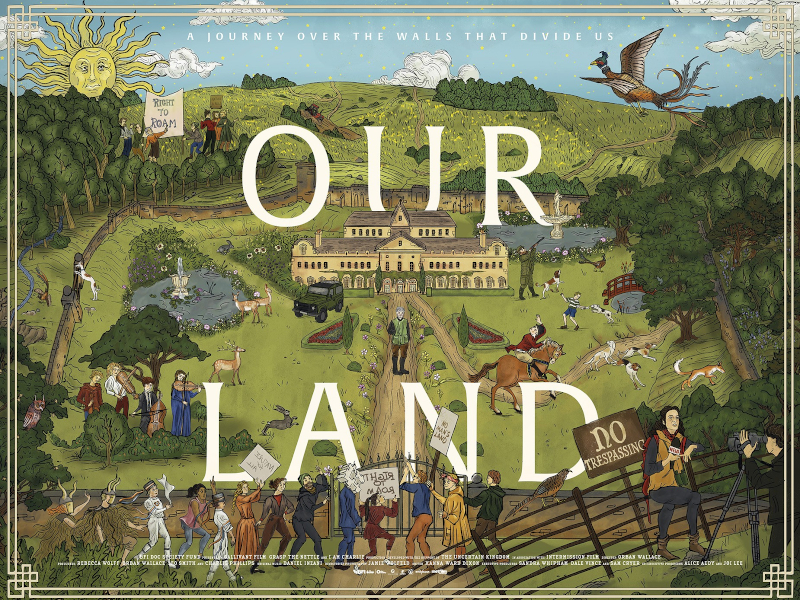
Our Land
Director – Orban Wallace – 2025 – UK – Cert. 12a – 90m
***
An exploration as to why the English people only have the ‘right to roam’ over some eight per cent of their countryside – out in UK cinemas on Friday, May 8th, with previews Tuesday, May 5th, Wednesday May 6th
This sets out its stall with a bold move: an arresting animated sequence by May Kindred Boothby in the style of woodcut prints accompanies a brief, verbal historical overview by Robert MacFarlane (the nature and geography writer whose book of the same name was recently turned into the documentary Underland, Rob Petit, 2025) of English land ownership. It goes back to the 1066 Norman invasion by William the Conqueror who declared land the property of the Crown (!) and then doled that land out to the barons that had helped him become King of England. Prior to this, any English person had the right to go anywhere within the countryside.
What follows after that visually inventive and historically informative introduction admirably manages to avoid one of the common pitfalls that far too often beset documentaries whose subject is one specific issue. Namely, presenting one point of view as the irrefutable final word on the matter. Instead, the filmmakers seek out interviewees with a variety of views and allow them to speak. This has the effect of presenting a healthy debate, allowing the viewer to make up his or her own mind regarding the subject under discussion.
Plenty of documentaries over the years have sought to portray a particular viewpoint on their subject, then refused to entertain differing views, preferring to shut down debate and push their preferred line. It seems such an obvious mistake that one shouldn’t need to make a point of it, yet, sadly, one does. Anyway, it’s a pleasant change to watch a film that avoids this trap.

English culture cuts people off from the land. The concept of ‘trespass’ runs very deep with ordinary English people, because for the best part of a millennium, they haven’t been allowed to access 92% of the countryside without ‘trespassing’ on private property, unless the owner has granted access rights to the general populace, a decision which comes down to the owner’s personal decision either way.
The film doesn’t really explore the ‘trespass’ concept outside of the land ownership issue, but it occurs to me as an English person (and has never done so prior to watching this film) that this concept pervades England and its culture. As activist and nature conservationist Nadia Shaikh points out, it’s as if landowners wish to say to the rest of us, this is our property, we generously allow you the right to be here. This peculiarly English malaise is to be found everywhere in the country. So everywhere English people go, there is the constant feeling that they are trespassing on land which is not theirs.
(I’m writing the above paragraph on a London tube platform which reminds me that “for your safety and security cameras are installed in stations”. Or, this is our land, and we are allowing you the privilege of accessing it. I’m not singling out London Transport here, by the way, merely using them as an example of how entrenched these ideas are in wider English culture)

Perhaps this undermines my unease about another documentary Wilding (David Allen, 2023), the otherwise inspiring story of the rewilding of Lady Isabel Tree’s family estate, which in many ways I liked a great deal. Yet, at the same time, a part of me was asking, why does this one family have all this land? It was a malaise I didn’t quite know how to articulate, almost like a subliminal form of outrage, and it doesn’t diminish my admiration for that film, or the Trees’ remarkable achievement, at all. Yet, the current film is a helpful pointer to the unspoken unease I feel contemplating that earlier one.
But before the Norman Conquest, this was not so. Anyone could go anywhere – and perhaps more importantly, graze their livestock anywhere, and make a living off the land.
The spirit of St. Karl hovers over this debate, in his mantra “property is theft”, although the film never states that philosophy quite so baldly and he may not necessarily have been thinking of land when he coined the phrase. (Or perhaps he was: the left-wing filmmaker Ken Loach once entitled a film Land and Freedom.)

We watch author Nick Hayes find a way in for himself and attendant camera crew to private land on a mission to plant a copy of his paperback The Book of Trespass at a folie where Richard Drax, the landowner of the Charborough Estate, 14 000 acres, Dorset, will find it in due course. Drax’s landowning family has a long association with the slave trade.
Francis Fulford, who owns the Great Fulford Estate of some 3 000 acres in Devon, talks about it as his garden. He seems a pleasant enough man, but the idea of one man (or his family) owning all that land by dint of birth is likely to make your blood boil. Still, kudos to Fulford for agreeing to be in the film and honestly representing his point of view within it.

His perspective is contrasted with a right to roam mass trespass event where walkers trespass upon / enjoy a route across the South Downs. They sit down in a field, with ominous (if small numbers of) police officers keeping an eye on them, where Guy Shrubsole, Wainwright Prize-winning author of Who Owns England? and The Lie of the Land, points out that (1) 1% of the UK population own half of England, (2) we have a right to roam over just 8% of England and (3) 50 million pheasants were released into the English countryside last year “so maybe we can make a little more room for us peasants and a little less room for the pheasants.”
A good ten minutes or so subsequently explores a pheasant shoot on the Great Fulford Estate.
One of the at first glance understandable concerns of the landowning class is the problem of whether ‘trespassers’ on the land can be relied upon to behave themselves. The right to roam people are quick to point out the importance and value of the Countryside Code, which they endorse, the legal protocol of how to behave in the English countryside, e.g. the importance of shutting gates behind you as you proceed on your way. They are keen to raise awareness of the contents of the Countryside Code, and in this respect would seem to be very much on the same page as the landowners.

You will note that this review has discussed the right to roam in terms of England, not the UK (technically, the organisation named Right to Roam campaigns on England and Wales) because Scotland was outside the land declared owned by William the Conqueror. Unsaddled by the English historical precedent, Scotland enshrines a legal right to roam, with a responsible roaming country code type caveat, for all its citizens. As is demonstrated in the film, it is possible to straddle the English / Scottish border and have one foot legally planted in Scotland while the other foot illegally trespasses in England. Whatever fears English landowners might have about the land (“their land”) being spoiled, the example of Scotland suggests that, provided the right constitutional provisions are put in place, such fears are ultimately ungrounded. (If you’ll pardon the unintentional pun.)
Other landowners interviewed contribute further helpful perspectives. Hugh Inge-Innes-Liliingston is from the family of Inge (to rhyme with Sting not Cringe) which has owned the Thorpe Estate in Staffordshire for nearly 400 years. He puts the problem down to enclosure of land – “before that, you had Merrie England” (which, it occurs to this writer, was admirably portrayed in the heroine of Hamnet (Chloe Zhao, 2025), bringing up Imposter Syndrome because “deep down, nobody owns the land.” He invokes the concept of Stewardship, pointing out that you can do with the land what you will, or you can try and meet any obligations you feel the position requires, “and everything in between – there’s no one position.”

The landed estates have probably done more to preserve the landscape than anybody else,” opines Fulford. Counters Nadia,via a judicious edit, “they really do believe that they are stewards of the land.” She thinks all of us, landed and not, are under a spell, that it’s quite nice for these families to have had these large areas of land for hundreds of years.
John Mildmay-White, who has inherited the Flete Estate which comprises 5 000 acres of Mothecombe, Devon, talks about “managed access” rather than “open-source access”. His father in law, Rob, now John’s car park attendant, talks about history and good and bad monarchs, and suggests it’s the same with landowners. John talks about his three beaches, which are fully open to the public, and “the joy on someone’s face when they spend time at places like this.” He talks in terms of the amazing effect that public access of such places can have on people’s mental health.

Nadia says she can understand, on a human level, why if you owned a big fuck-off house with acres of land to match why you’d want to hang onto them, and be able to pass them on to your kids. Nick Hayes comments that he doesn’t want to stop people owning the land, merely to allow everyone access to the land to be able to enjoy it, and have it work its magic on their mental health. Hugh is the only one to mention the idea of rewilding, which isn’t much good in terms of people’s access to the land. (No-one challenges this statement, and it makes me wonder whether you couldn’t in fact rewild an area and allow, say, responsible walkers access to it.) Guy highlights how little the government has been spending to promote the Countryside Code.
Nadia takes the film in another direction altogether talking about how the English countryside has been commodified to exclude people of colour. She herself is a Briton of mixed race heritage. Maxwell Ayamba explains the significance of a re-enactment by people of colour of the mass trespass of 1932, many of whom are experiencing the English countryside first-hand for the first time as part of this event.

A Scottish landowner’s perspective is provided by John Grant, 13th Earl of Dysart, Rothiemurchus Estate, 17 500 acres, Cairngorns, Scotland. “In Scotland,” he explains, “You only have the right of access to the land of you access it responsibly, as written out in the Scottish Outdoor Access Code.” Access was established by the Land Reform (Scotland) Act of 2003. Grant, who welcomes joggers, campers and others on his land, says Scotland is giving people the information necessary for them to behave responsibly. Nadia, who has moved to Scotland’s Isle of Bute, says that because you have the right to roam in Scotland, the countryside seeps into you in a way that it doesn’t in England.
As a confirmed child of the city, without knowing much about right to roam beyond thinking that it sounded like a good idea, I learned a lot from this documentary and commend it for managing to present a number of varied viewpoints from different sides of the issue. There is plenty left to talk about – and, for that matter, plenty of land to roam – after watching.
Our Land is out in cinemas in the UK on Friday, May 8th, with previews Tuesday, May 5th, Wednesday May 6th. Get free preview tix here.
Trailer: