Director – Alexandre O. Philippe – 2025 – UK – Cert. uncertificated – 76m
*****
An essential addition to the canon of work surrounding and helping audiences to understand the power of one of the cinema’s greatest works– out in UK cinemas on Friday, April 3rd
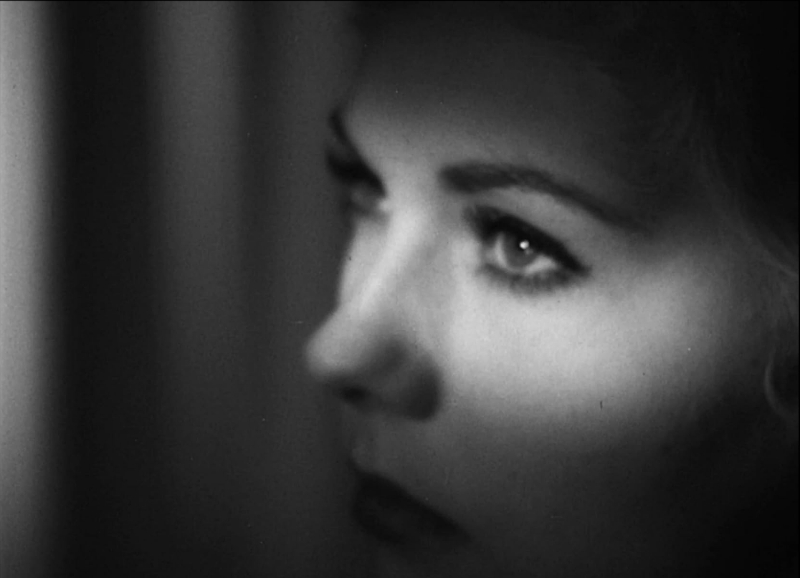
The opening black and white scene features actress Kim Novak, probably shot in the 1950s, as if through a peephole. This recalls Norman and his peephole in Psycho (Alfred Hitchcock, 1960). Novak here seems to know she is being watched, looks directly at the camera, then rolls her head so her eyes go into the darkness of shadow. Then, colour footage of present day, images that could be out of Spellbound (Hitchcock, 1945): a gate opening, a passage along a country roadway, a wooden memorial to someone. All this accompanied by the voice of Kim Novak, now in her twilight years, talking about her life on the soundtrack – her present difficulty in getting breath, how awful it must be to gasp for breath prior to dying.
All this has a Hitchcock connection. Novak is familiar to us from her twin roles in Vertigo (Hitchcock, 1958), the favourite film of director Philippe (and also, as it happens, of this critic) who specialises in documentaries about movies and made the definitive documentary about Psycho’s shower scene 78/52 (2017). You might therefore reasonably expect the current documentary to be about Vertigo, however, it’s isn’t exactly, at least, not until its final half-hour. Philippe was lucky enough to be introduced to Novak through a mutual contact, and they hit it off. What follows arrives at its half hour look at Vertigo from its leading lady’s perspective via her thoughts on life, career, non-career, and acting. Or, rather, reacting, citing Philip Seymour Hoffmann (with clip to match) in Before the Devil Knows You’re Dead (Sidney Lumet, 2007).
Accompanied by family photos, Novak recalls her parents – her father who kept his only son as a foetus in his downstairs workshop, her mother who tried but failed to abort her in the womb with a knitting needle – and her birth in the depression years when her parents perhaps felt they wouldn’t be able to afford her financially. A clip from Jeanne Eagels (George Sidney, 1957), based on the eponymous stage actress who came to an untimely end, in which Novak strips down to her slip outside a beach house and runs carefree into the sea, illustrates her comments about learning from a bluebird tattoo on her grandmother’s arm that she was the captain of her own ship, the master of her own destiny.
That perfectly encapsulates Philippe’s approach throughout. He shoots / records Novak talking, replacing her image with other images, which include clips from her numerous films. Often, she will speak her own lines from a scene as she talks, and that’s what you hear as the relevant clip plays before your eyes. An unexpected approach to the material which proves strangely satisfying.
Music is credited to Jon Hegel, who often (but not absolutely every time) replaces Bernard Herrmann’s score in Vertigo with new music, most of which works well enough if you’re not familiar with the (incredible) Herrmann score.
In Phffft (Mark Robson, 1954), Novak is a mysterious woman behind the door of her flat, which has echoes of Scotty (James Stewart) turning up at her door in Vertigo. Philippe is seen going through cardboard boxes labelled in magic marker with legends like ‘Old Photos’ and ‘Vertigo Restored 1996/99. “Have you ever done anything like this before,” Novak asks him, “gone through someone’s attic?” “Certainly not Kim Novak’s attic,” he replies. In The Notorious Landlady (Richard Quine, 1962), she is seen closing her apartment door on Jack Lemmon.
As she gets the director talking, you start to wonder whether perhaps, unlike Philippe’s more objective previous documentaries about movies which, as well as 78/52 include Memory: The Origins of Alien (2019) and Lynch / Oz (2022), this one is going to reveal as much about the filmmaker as his subject. His earliest memory of cinema, he tells her, is as a child watching Vertigo in his parents’ home in Switzerland and noticing that the patterned crimson wallpaper in Ernie’s, the restaurant in which we first see Kim Novak, was exactly the same as the wallpaper in the room where he was sitting watching the movie. And then, out of that wallpaper came Kim Novak in a black and green velvet dress.
Perhaps the revelatory material about the director himself will emerge in a later documentary. For the time being, after this intro, he switches back to his immediate subject, romping through clips of Pal Joey (1957, George Sidney), Picnic (Joshua Logan, 1955) and The Third Girl from the Left (Peter Medak, 1973) before alighting on an aspect of her practice as a painter; when she bought and moved into her current house, she painted the walls. Nothing remarkable about that, you might think, but this is “painted” in the sense of fresco painting. Some of her painted imagery includes spirals (reminiscent of Vertigo’s title sequence) and it least one features an image of actress Greta Garbo, Novak’s inspiration. Clips from Queen Christina (Rouben Mamoulian, 1933) and Mata Hari (George Fitzmaurice, 1931) sit alongside Novak’s grave visit in Vertigo, notable amidst the black and white Garbo clips for its colour. To Novak, Garbo’s image was that of the little girl, born vulnerable, wanting approval, knowing the price was high, a point typically reflected by Novak in Middle of the Night (Delbert Mann, 1959). In the end, Kim justified taking herself out of the acting game by the fact that Greta had done it.
Bell Book and Candle (Richard Quine, 1958) brings back memories of her co-star and great friend James Stewart (they first starred together in Vertigo immediately prior to this film), “the man next door” as she says of him against footage from It’s a Wonderful Life (Frank Capra, 1946). Her first proper movie – she appears an an extra descending a staircase in The French Line (Lloyd Bacon, 1953) – was Pushover (Richard Quine, 1954) with Fred MacMurray, which was the very first draft, entitled The Killer Wore a Badge. Most of Novak’s films of the fifties (and all of Garbo’s) were black and white, so Picnic, about sibling rivalry between sisters, stands out here because, like the later Vertigo, it’s in colour. (Colour is a key element of Vertigo, but Novak doesn’t bring it up and although it’s evident in the Vertigo clips, the documentary never goes there.)
Novak talks about playing Jeanne Eagels, a character who would do anything to get ahead, a trait Novak herself doesn’t share. The role taught her to push herself, and you can see her being quite brutal towards one of her male co-stars on screen. The different roles a star plays in Hollywood contain traits of each other so that after ten or twelve movies the parts can start to take away their own identity, a fate that befell so many movie stars. She was scared of becoming Kim Novak; “I didn’t even know who Kim Novak was… Once they have you under contract, they want to make you over. Or course, it’s the story of Madeleine and Judy. But it’s my story too.”
If she was stuck on how to play a scene, she would draw. Sometimes, the drawings helped get her through, such as sketching her character Madge in Picnic when she has to cross a floor alone then start dancing with William Holden, a scene that both of them were somewhat nervous about beforehand. The drawing personalised the role for her.
As she sees it, Hollywood swallows people whole. Her art was what saved her. Over a clip of a car departing a countryside track for a public road in Strangers When We Meet (Richard Quine, 1960), she comments that she felt Movies was a detour, and that her survival mode was painting. Her current home, where this documentary was shot, is the house on the coast which her sister spotted while Kim was on location with Fred Astaire.
Alfred Hitchcock’s influence on her was huge; she faced the challenge, in Vertigo, of creating two characters you believe to be separate when they are in face one and the same. One of her paintings shows the profile heads of the two women she played in Vertigo. Birds also appear in her paintings, to her an indication that she’s heading in the right direction. Philippe can’t resist bringing up birds in Hitchcock, where they play the very different role of portents of doom, throwing in clips from early British talkies Sabotage (1936) and Young and Innocent (1937) as well as more obvious and better known examples from Psycho and The Birds (1963).
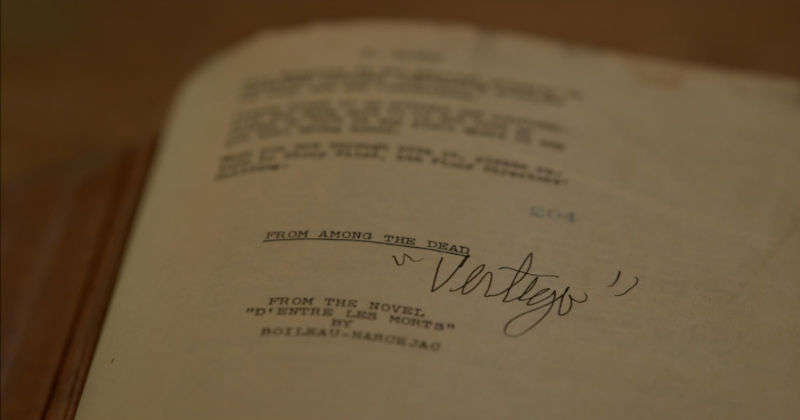
Three house fires forced her to decide what to save. Mostly it was boxes of stuff from her career, the containers in her current loft Philippe is going through; she lost a great deal of her art. One item that survived was her bound shooting script for Vertigo, originally called From Among the Dead (after the book from which it was adapted). Imperceptibly she starts talking about the character as Philippe runs the flower shop sequence. “It’s like, she’s very much Judy, but starting to feel good in her skin. Like stepping into another being, like starting to feel the fit is right.”
The fact that Judy / Madeleine is being watched sends Novak back in to explore being a reactor rather than an actor. She brilliantly articulates the mixed emotions within the character, the push pull, or, as she puts it, “I’ve got to do it / I don’t want to do it.” Harry Cohn loaned her out to Hitchcock, telling her, “it’s a terrible script”. She’d never seen a Hitchcock picture, so she had no idea what she was getting into. In retrospect, she thinks she fit that role / those roles because she dislikes people making her over, which is the subject of the film and, ultimately, the reason she left Hollywood. She believes you can never fully shake off roles like those.
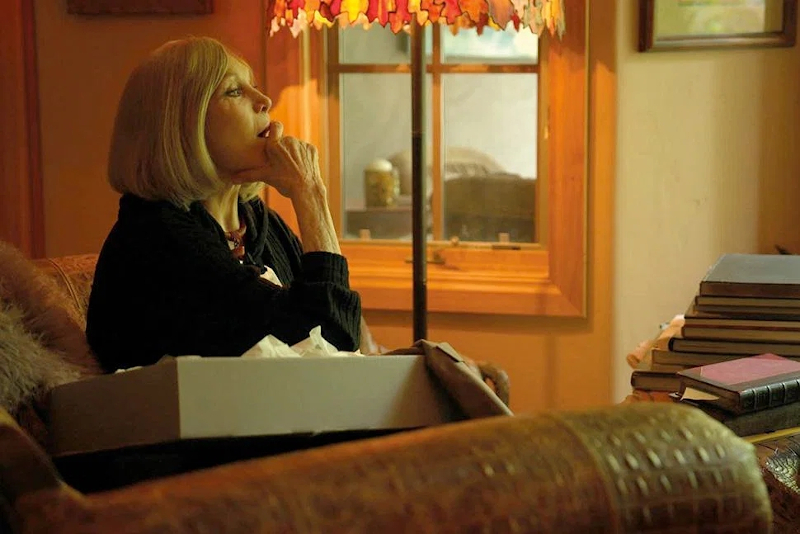
One of the attic boxes contains her dress from Vertigo which he hasn’t looked at since shooting. Inside the box is not what you expect but another box. Eventually, she gets to the grey material of the grey jacket / dress (in case you were wondering which dress it was). There are further revelations to come.
Watching all this serves to further illuminate a movie which, over half a century later, remains one of the cinema’s most potent texts. Philippe and Novak’s take comes at Vertigo through a lens not usually trained on the movie; that of the career of the extraordinary actress at the centre of the movie who inhabits its twin roles, which, to a surprising extent, reflected her own experience as a Hollywood actress. It’s not a film you could plan to turn out the way it is: this is rather a voyage of discovery and, consequently, a welcome revelation: an essential addition to the canon of work surrounding and helping audiences to understand the power of Hitchcock’s Vertigo. For anyone with even the slightest interest in that film, it’s consequently a must see.
Kim Novak’s Vertigo is out in cinemas in the UK on Friday, April 3rd.
Clip: