
Director – Park Joon-ho – 2025 – South Korea – Cert. 15 – 124m
*****
A gay man who has defected from North to South Korea must get to grips with Seoul’s gay scene and his own sexual and religious identity – from LKFF, the London Korean Film Festival 2025 which runs in cinemas from Wednesday, November 5th to Tuesday, November 18th
Sexually active, gay Seoul resident Cheol-jun (Cho You-hyun) grapples with the fact that his partners don’t stick around after physical interaction. Cheol-jun has recently escaped from North to South Korea. He works at a local store counter and attends a class to help defectors adapt to their new way of life. After class, rather than hang out with fellow defectors such as Hak-min (Jeon Du-sik), who is trying to pair him off with pretty class girl Ji-ye (Choi Yun-seol), he follows phone directions to a mixer, a club night to help gay men make friends.
Numbers are assigned. Asked why he is dressed so formally – is he from North Korea, or something – he responds candidly, “I am.” After drinking “love shots” – two men drink with arms intertwined – guests are invited to write “love notes” to the number they fancy. He writes one to 23, Hyong-taek (Cho Dae-hee), self-confessed like himself as a “top” rather than a “bottom”. No-one writes him one, though, and not being particularly outgoing – perhaps it’s the idea of declaring himself gay in public after living in a country where people have been executed for such sexuality, he goes home alone.
A man of surprises, Cheol-jun also attends an evangelical Christian church on Sundays where objects of prayer include freedom to worship God in North Korea. One Sunday, he gives a testimony about coming from the North to the South.
He texts on a gay chat forum about wanting to meet a fellow defector.

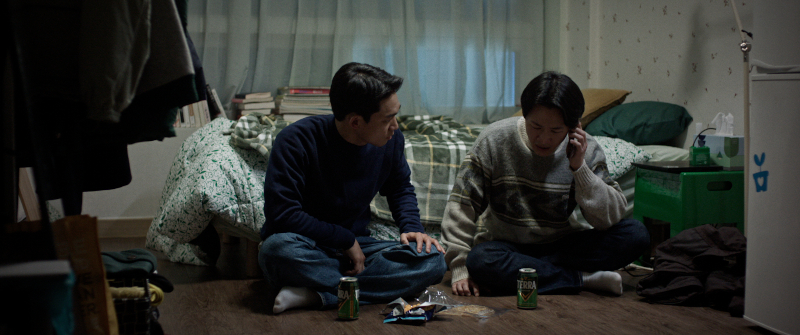
At the store, he is recognised by man from the mixer Yeong-jun (Kim Hyeon-mok) who introduces him to the gay meetup scene. You attend one of these by typing, for instance, 3672 – for Jongno 3-ga, Exit 6, 7 O’clock and your number, in this case 2, as a responder to the message. Cheol-jun and Yeong-jun sign up, go along and have a great time, the former assiduously ignoring texts from Hak-min. They become friends and spend time in each others homes. It turns out Hak-min. is anxiously awaiting calls from a broker who is helping his parents escape the North.
Yeong-jun admits to sometimes attending church – his mum is a deacon – and can fix Cheol-jun up with a lucrative gig sharing his testimony, something the defector has made money from in a number of churches. (Note: this may well go on in South Korean churches, however I’ve attended many churches in the UK and never known people to be paid for giving testimonies, and the idea of financial recompense being paid for such things doesn’t ring true to me).
After doing his friend’s gig, the pair of them talk. Cheol-jun confirms that when he was escaping, he felt his safe passage was down to God’s grace. He’s unsure as to what he thinks about God these days, although he seems to possess a faith. Yeong-jun, on the other hand, can’t really connect with the notion of God; he’s just paying lip service to keep his family happy. Besides, homosexuality “is an abomination”.
Celebrating Hyong-Taek’s birthday at another club, Cheol-jun walks away from an encounter with him in The Dark Room, preferring to spend time dancing with Yeong-jun instead. Later, their friendship sours – perhaps both of them wanted something more, but have failed to express their feelings.
More could have been made of the gay lifestyle / Christian religion theme, but it’s clear that, at least as far as these characters (and perhaps also South Korean evangelical Christianity?) are concerned, the two lifestyles are theoretically incompatible. If Yeong-jun is living some sort of double standard – a separate gay life and church life – Cheol-jun, while he may not declare himself gay in church circles, conducts parts of his life in a manner consistent with the “love one another” tenet of the faith, for instance giving Hak-min what money he can to help pay an expensive broker fee.
As for the plight of gay defectors attempting to integrate into South Korea, this feels utterly convincing, and while the North is repressive, the South doesn’t come across too well. Towards the end, Yeong-jun decides to emigrate to Canada because you can hold hands on the street there without it being an issue.
In short, an extraordinary movie, partly because of its attention to detail in portraying Seoul’s gay underground and partly for exploring the place where gay identity and defector identity meet. Cheol-jun eventually gets a response to his “defector” text, which results in his taking a gay escapee from out of town to a Seoul meet up, an act of charity for which his hitherto isolated guest is truly grateful.
Kudos to the LKFF for including this in this year’s programme, although, frankly, the film deserves a proper UK release, since it transcends Korean, gay and religious demographics to speak to a much wider audience.
Winner of four awards at the 26th Jeonju International Film Festival
3670 plays in LKFF, the London Korean Film Festival 2025 which runs in cinemas from Wednesday, November 5th to Tuesday, November 18th.
FURTHER PROGRAMME INFORMATION:
Facebook: @theLKFF
Twitter: @koreanfilmfest
Instagram: @london_korean_film_festival
Homepage: https://www.koreanfilm.co.uk/
Trailer:
Trailer (LKFF 2025):