Director – Callum Burn – 2026 – UK – Cert. 15 – 89m
****
A British tank crew on the offensive on WW1’s Western Front becomes stranded behind enemy lines when their vehicle is immobilised – out in UK and Ireland cinemas on Friday, June 26th
Doom-laden music. Historial WW1 footage. 1917. Captions explain the situation. The Allies, surrounded on three sides near Ypres, France, push forward, sustaining heavy casualties. Visuals: a lone British officer – you can tell by his revolver and moustache – moves around in the murk near a barbed wire barricade. One hesitates to say “advances” because he appears to be going back and forth. Possibly, he’s lost. A German knocks him out with a rifle butt.
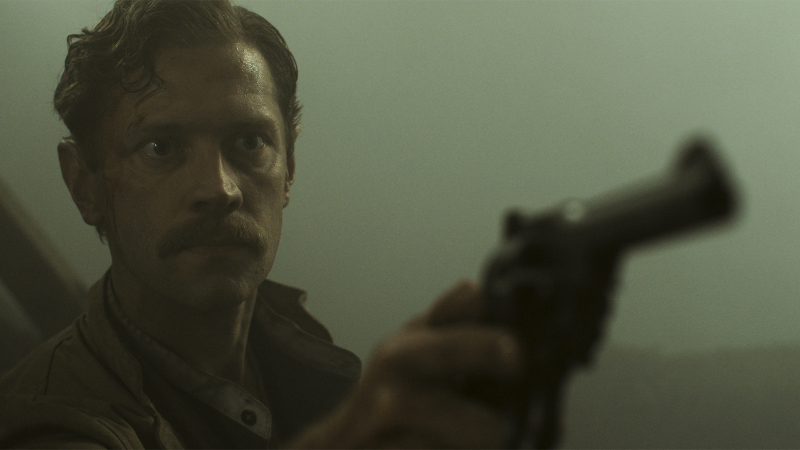
Half-way through the movie, we’ll realise this sequence was a flash-forward. Perhaps the screenplay could have delivered a better oening (this one feels like it came out of the editing).
August 22nd 1917. Four privates inside an industrial metal structure, playing cards, argueing. One of them, Ernest (Ernest Hans Braedy – Nadav Burstein) is sketching a bird from memory. Their C.O., who we’ll later learn is Lieutenant Hill (David Dobson from Spitfire Over Berlin, 2022; Lancaster Skies, 2019; Fray Bentos, short, 2014, all Callum Burn), introduces a senior officer Captain Richardson (Vin Hawke from Battle Over Britain, Callum Burn, 2023) who is joining them today.
They man the guns and “start ‘er up”.
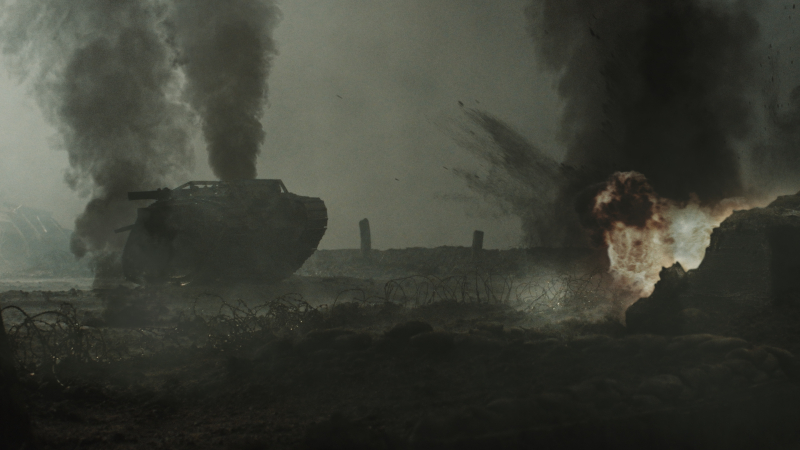
The battlefield. A stationary tank is on fire. Panning across the desolate landscape, we pick up two tanks, slowly advancing. Inside ours, one of the men prays aloud to God for protection against the Devil.
The navigator can view the battlefield ahead through a viewing slit maybe eight inches wide. Richardson has a portable periscope device he can poke through the small hole in the roof, enabling him to see 360° as he turns. He suggests 3 O’clock, where there’s a trench in which they might make a nuisance of themselves. They go in, firing heavy shells. They take out a gun emplacement.
Suddenly, Richardson has tiny pieces of shrapnel in his hand. And on his forehead above his right eye. The gunner, calling for successive shells to be loaded, can’t seem to take out the next emplacement. He gets a wound on his ear, but this only makes him more determined. Richardson halts the tank to give him the chance of a better shot. It does the trick. But the job isn’t over yet.
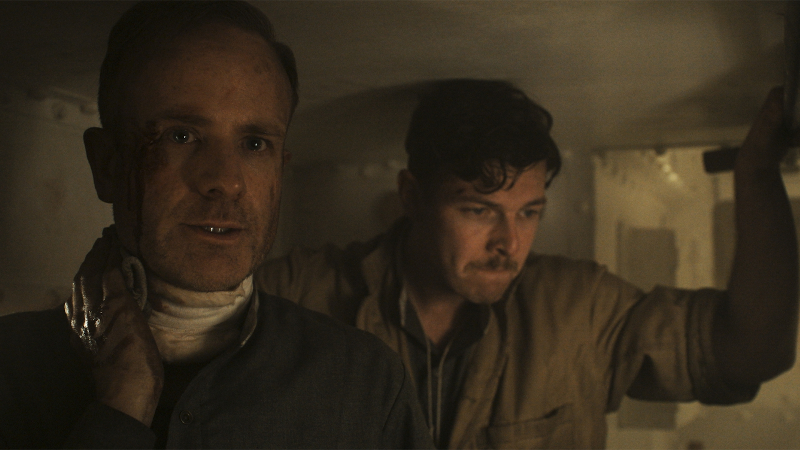
Then they enter into an area of heavy smoke, low to no visibility. Then they are hit by an explosive and topple maybe 40° into a shell crater. One of them is badly wounded in the sudden descent. Unable to get thei vehicle out of the drop, Richardson orders two of the crew to ditch. And out they go, with orders to keep their heads down. Braedy (finally referred to by name) gets shot in the throat. The other can’t reach him, and is ordered back inside…
Tensions mount inside the tank. Lt. Hill gives encouragement to the wounded man, who is subject to vomiting. As the religious soldier recites the 23rd Psalm (“yea, though I walk through the valley of the shadow of Death, I will fear no evil”), a discussion ensues about whether anyone believes this stuff. Richardson prefers to put his faith in his gun. He ditches on the grounds that, if we’re blind, so are they. He can see where Han’s body has been dragged from the top of the tank. He shoots at a lone German holding a nasty looking spiked cudgel before the man can see him. He gets back inside as the tank comes under fire.
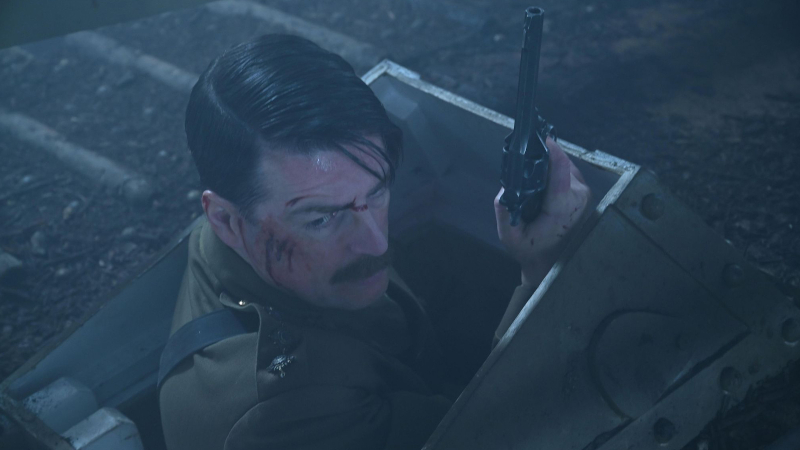
Private Morrey (Jack Sherlock from Hedda, Nia DaCosta, 2025) talks about twats with pips on their shoulders being in control rather than God – who fucked off years ago – and is threatened with a charge of insubordination or p[ossibly a bullet by Richardson if he doesbn’t stop. The Christian private who prays goes out to try and get help, despite Morrey’s protests that it’s suicie to do so.
They must contend with three grenades which suddenly find their way inside the tank. One of the crew has a vivid nightmare in which he’s outside fixing the immobilised tank. As tensions flare between Morrey and Richardson, who wants to shoot the incessantly screaming, wounded man, Richardson collapses.
Now Richardson, with his handgun, is outside the tank in the murk, looking for lone soldiers. (Is this a dream?) It’s certainly the point where we came in. Occasional troops passd behind him, unseen by him and perhaps unseeing of him, it’s hard to tell. Eventually, the German, in his gas mask, slugs Richardson with his cudgel. And now Richardson is awake, and it’s the 24th.
A German officer (Jeffrey Mundell from Battle Over Britain, Spitfire Over Berlin, Lancaster Skies) appears and tries to negotiate their leaving the tank in exchange for Braedy, who they claim to be holding captive. Richardson refuses. The other will stand his men down for an hour, in case Richardson decides to accept his offer. After a while, there follows a battle between the tank crew outside their vehicle and the enemy…
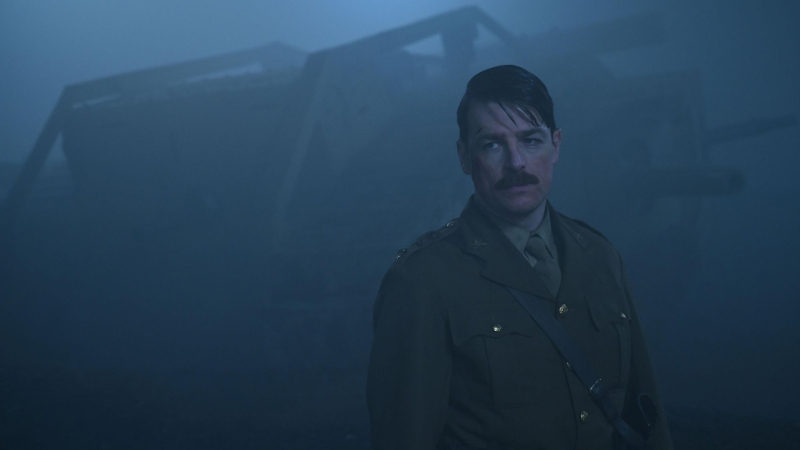
This never worries about setting the scene, how tanks came to be developed by the British and the French as a means to break the deadlock on the Western Front. Instead, the narrative plunges straight in to a scenario on the Western Front with a couple of tanks heading to enemy territory to inflict damage. This very quickly changes to one tank and a whole sequence in which we observe the men inside the tank on the one hand and the tank making its way though the landscape on the other.
The interior is little more than a cramped, functional and purpose-built industrial space with various rudimentary viewing slits and openings for poking handguns through. There is a small machine gun and a bigger gun which fires shells. The first ten or so minutes, with its interiors and actors on the one hand and vehicular exteriors moving through the battlefield on the other, consequently has the feel of a Gerry & Sylvia Anderson puppet TV series such as Thunderbirds (1965-66), Captain Scarlet and the Mysterons (1967-68) and UFO (1970-71).
However, once the tank gets stuck in a shell crater, that dynamic changes, with the drama and interaction between the various members of the small crew becoming the element that propels the story forward as the crew attempt to extract themselves from their predicament before they either find a way to get back behind British lines, or become overrun by enemy infantry, or surrender.
The cinematography exteriors have a murky look, an attempt to reproduce the inability to see much in parts of the battlefield. As it happens, the less historicist and more fantastical Rogue Trooper (Duncan Jones, 2026), which this writer saw in Annecy, achives something similar with far greater effectiveness, although there’s no denying the photography in Landship does its job more than adequately. There’s a definite feeling that Landship is trying to make something on minimal resources (Rogue Trooper could be reasonably described as low budget, yet I suspect Landship was made on a comparative shoestring to even that film.)
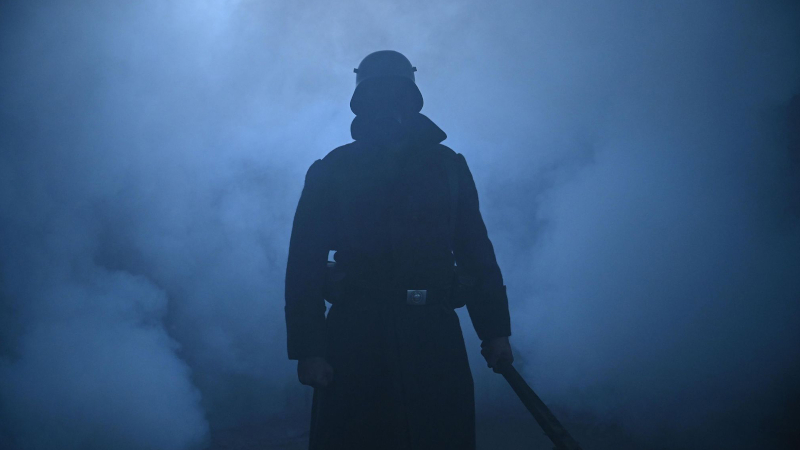
A recurring motif when Richardson goes outside the tank, and on occasion in his dreaming when he drops off to sleep exhausted, is the enemy German soldier with a cudgel who could have been a threatening, iconic figure straight out of a horror movie. There are moments when the film seems to rely on this visual conceit a little too heavily for its own good, although it nevertheless remains an efective little device for showing how Richardson imagines (personifies, dehumanises, demonises) the enemy as an archetypal bogeyman.
Surprisingly, perhaps, Landship’s real strengths lie where it matters most: in the script and casting. The script by the director and his producer father Andrew Burn (the team behind Spitfire Over Berlin, 2022; Lancaster Skies, 2019; Fray Bentos, short, 2014) focuses on the handful of men who comprise the tank crew and their temporary commander, and how they deal with one another up close in the confined space of the tank under extreme, life-threatening pressure. One of them falls back on his (Christian) religion, believing (presumably, although this is never explicitly stated) that the Allies are fighting a Just War against the Dark Forces of Evil as representerd by the Germans.
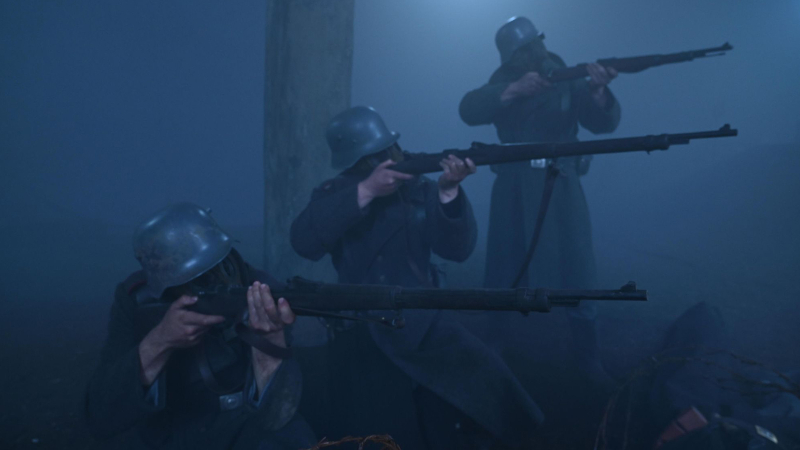
Others don’t subscribe to such myths, preferring to be watched over, as it were, by their trusty weaponry. And there is much antagonism between onme, highly opinionatd soldier and his C.O., the fomer believing that the latter, though not knowing what he was doing, has got them into the awful situation in which they now find themselves. Yet, as the narrative progresses, even such antogonistic forces as these come to a mutual appreciation of each others virtues and strengths.
All in all, a hugely effective projectile of a movie. It’s not without its shortcomings, but considering how little the film was likely made for, such errors are understandable, and the elements of the film that work really well more than compensate for those that don’t. Ultimately, Landship aims to convey the feeling of life in a working WW1 British tank, warts and all, and succeeds admirably in doing so.
Landship is out in cinemas in the UK and Ireland on Friday, June 26th.
Trailer: