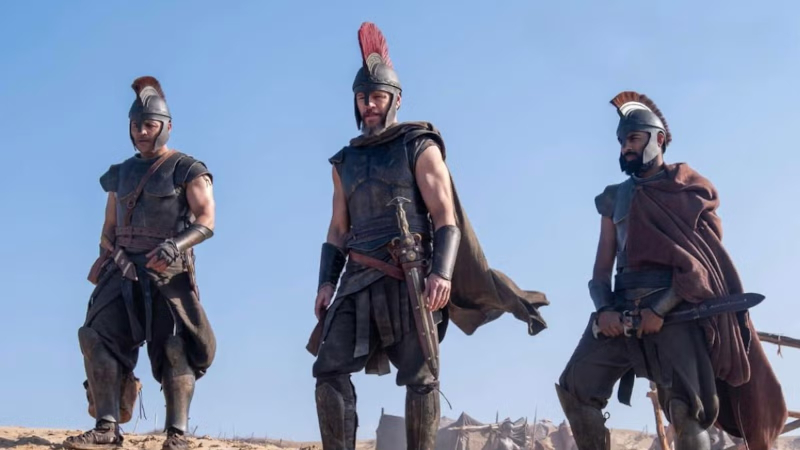
Director – Christopher Nolan – 2026 – US – Cert. 15 – 172m
**** (regular cinema version, not the 70mm IMAX print)
While Odysseus is lost presumed dead returning home from the Trojan Wars to his island Kingdom of Ithaca, his wife is confronted with multiple suitors – out in UK cinemas on Friday, July 17th
For anyone unfamiliar with the classical Greek literature source, Homer’s Odyssey is about a journey (with which meaning the word odyssey is synonymous in modern parlance). Odysseus (Matt Damon) fights for ten years (a time span unclear in the new film) in the Trojan Wars, then spends another ten getting home to his island Kingdom of Ithaca (the film is clear that he’s away a total of 20 years).
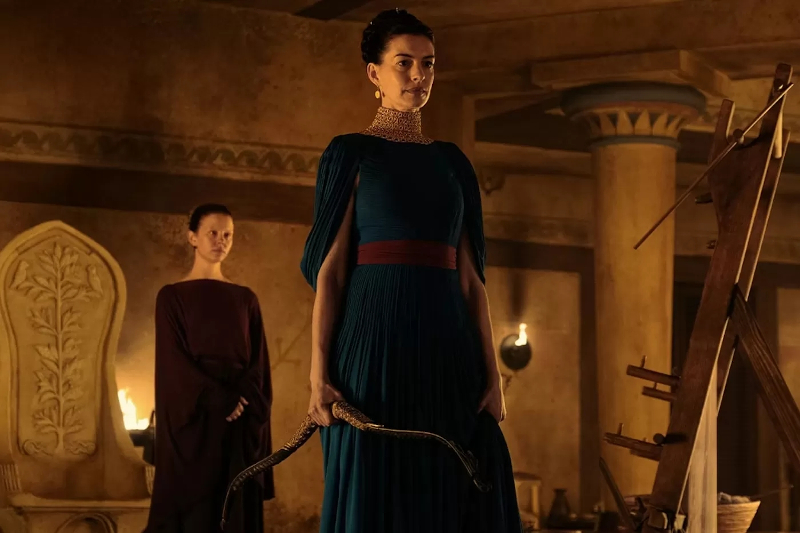
Homer doesn’t play out his narrative in linear form, but goes back and forth, for instance using flashbacks. Nolan’s screenplay uses a framing device of Odysseus’ wife Penelope (Anne Hathaway) holding out against numerous suitors hoping she’ll marry one of them and make him king, remarkably similar to that other recent, inferior adaptation of (the Ithaca bits of) the Odyssey, The Return (Umberto Pasolini, 2024), except that Nolan’s instincts for casting are a lot stronger and he has a bigger crew and budget with which to play.
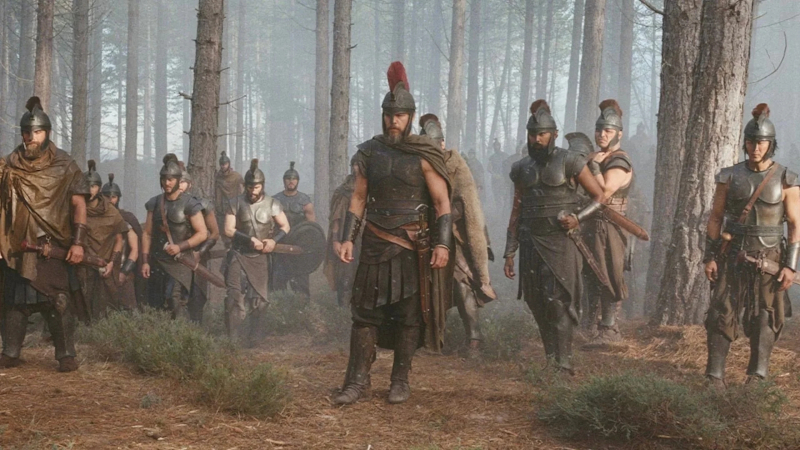
These sections of the film work more effectively in Nolan’s version than Pasolini’s, and it helps that Nolan has not cut out the action spectacular / special effects-y bits that recall such Ray Harryhausen Greek myth outings as Jason and the Argonauts (1963). Like Powell and Pressburger in “i know where i’m going!”, he is as interested in navigating past a whirlpool as he is in getting his actors to explore what motivates their characters.
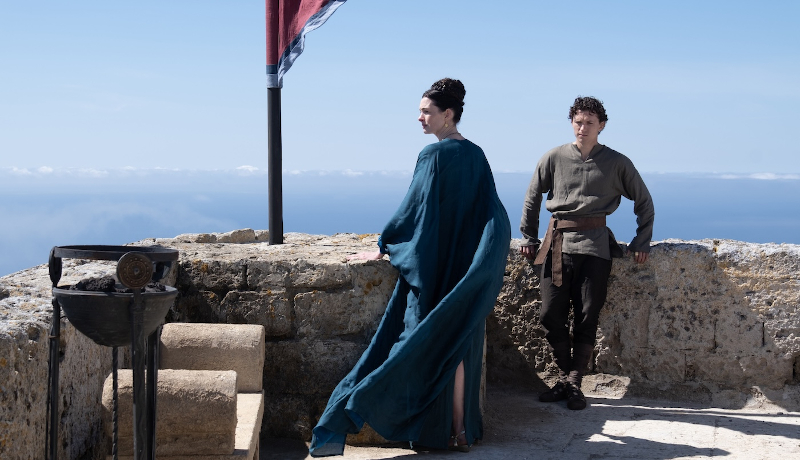
The movie thus moves back and forth between the drama on Ithaca and nearby, on the one hand, and Odysseus’ attempts to get back home to Ithaca on the other.
Departing from Ithaca, Odysseus’ son Telemachus (Tom Holland, bringing just the right mix of youthful enthusiasm and small time, regal gravitas) visits Menelaus (Jon Bernthal) in nearby Sparta, whose legendarily beautiful wife is Helen (Lupito N’yongo), in the hope of hearing some news about his vanished father. (Sparta is known for its militarily-oriented regime, but I can’t say as I really noticed that here.) What Telemarchus gets instead is stories of his father’s war service and confirmation that Odysseus has vanished.
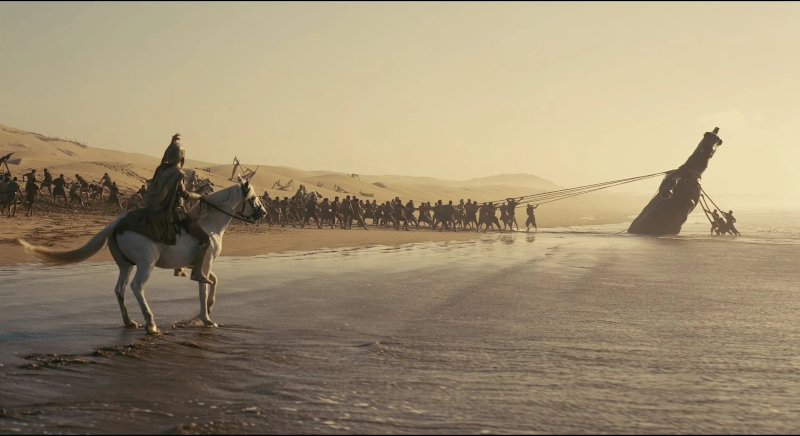
The story of the Wooden Horse of Troy – the decisive strategy that won the Greeks the Trojan War – thus comes fairly early on, and swiftly becomes the catalyst for Odysseus’ self-doubt since It violates the principle of hospitality at the very heart of ancient Greek culture, which concept runs thought the heart of the film.
Another layer of reality is provided by Odysseus’ seven-year sojourn on the island of Ogygia where resident nymph Calypso (Charlize Theron), nurses him back to health after a shipwreck while feeding him lotus-flowers to help him forget his past (and wife and family). The sometimes dreamlike editing keep bringing us back to this episode, as if Odysseus is trying to remember where he is. The lotus-flowers recall a separate episode in Homer that didn’t make it into Nolan’s film. Zendaya convinces as Odysseus’ guide the Goddess Athena, who crops up periodically to advise him.
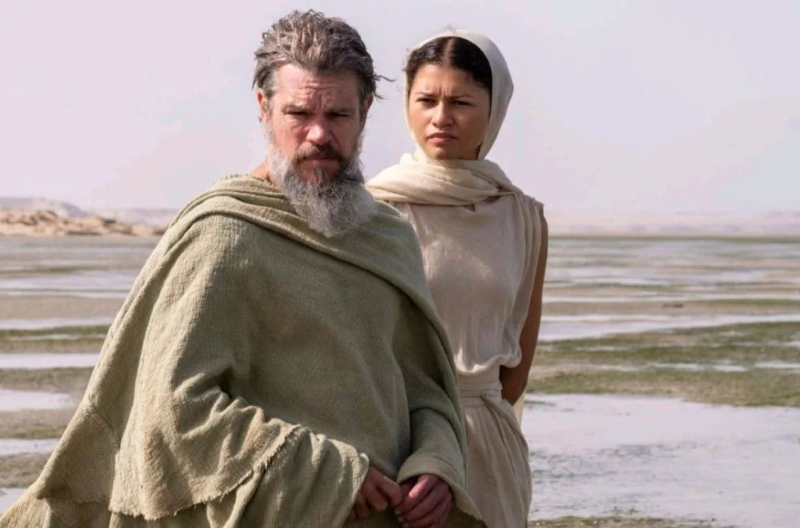
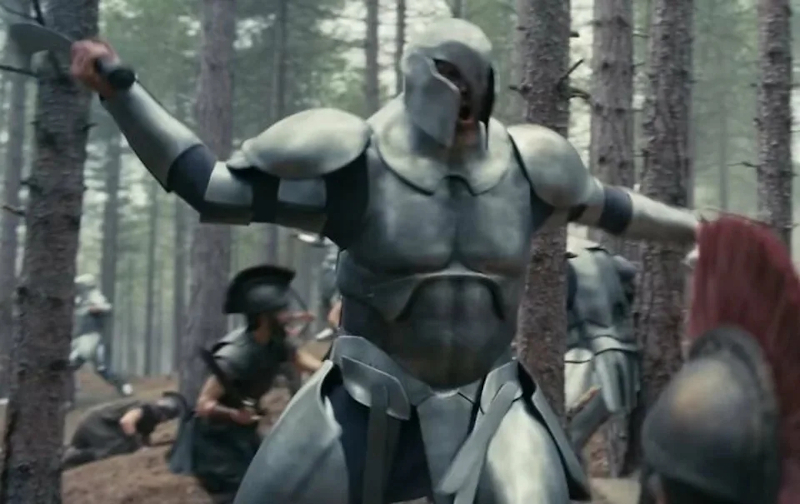
Plenty of Homer’s other episodes of Odysseus and his men’s adventures are to be found here – some of his adversaries recall stop-frame animated monsters in Ray Harryhausen films, such as a cyclops, a hostile race of giants, and a six-headed sea monster, to which Nolan brings his very different and particular brand of photorealistic special effects. Cyclops shepherd Polyphemous (Bill Irwin), has one eye looking as if it were placed skewed on his head by some cinematic equivalent of photomontage.
When his ship, the crew’s hearing blocked by wax stuffed in their ears, passes the island of the Sirens with Odysseus, lashed to the mast with ears unblocked, the creatures are mere objects in the distance, with the lure of their song brilliantly conjured by Matt Damon’s agonised acting. The duplicitous sorceress Circe, who turns men into pigs, is given a full-blown character by Samantha Morton in a performance which may be the highlight of the film.
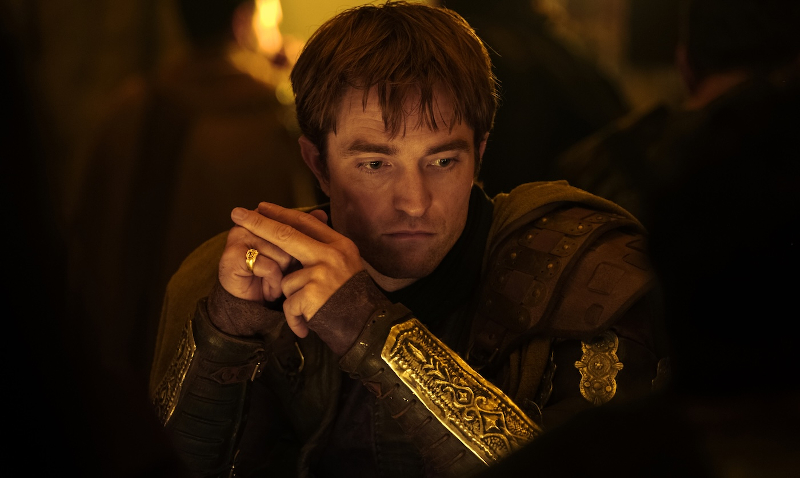
Despite a cast peppered with the charismatic John Leguizamo as the hero’s faithful, near-blind swineherd Eumaeus and the ever-watchable Robert Pattinson as Antinous, the chief contender for the disinterested Penelope’s affections, it’s the female cast members (Morton, Hathaway, Theron, Nyong’o) who impress more than the male, with the minor part of treacherous servant girl Melantho (Mia Goth) as a bonus.
Watching the regular cinema version framed at 2:39:1, you sense that the framing probably works rather better in the IMAX physical print version (70mm) which is framed at 1.43:1. than it does in this one, where the action often feels like the viewer is losing essential visual information of the top and / or bottom of the image, which is consequently hard to read visually. Try and ignore this issue as you might, in the regular version it plagues maybe 70% of the film, with the less spectacular sequences on Ithaca or those with Calypso or Circe not too badly affected. It was the regular version which I watched for this review (albeit on a very nice, big screen – London’s Picturehouse Finsbury Park) – which is the one most people will see – and in that format I couldn’t in all honesty give the film overall more than four stars, because there were too many places where I felt as if I was watching only half of the movie.
The Odyssey is out in cinemas in the UK on Friday, July 17th.
Trailer: