
Director – Steven Spielberg – 2026 – US – Cert. 12A – 145m
The first two hours *****
The last half hour ***
Hoping to reveal to mankind the hitherto censored truth about aliens visiting Earth, a man and a woman flee their pursuers across the United States – out in UK cinemas on Wednesday, June 10th
The plot is in the title. This is the day we find out. The day when everything is revealed. As in the film’s posters. The man (Josh O’Connor from Rebuilding, Max Walker-Silverman, 2025; The History of Sound, Oilver Hermanus, 2025; La Chimera, Alice Rohrwacher, 2023) and the woman (Emily Blunt from The Fall Guy, David Leitch, 2024; Oppenheimer, Christopher Nolan, 2023; A Quiet Place, John Krasinski, 2018)) saw a deer and a bird. The implication is that that encounter caused them to see and understand; the title further suggests that they want to disseminate that understanding to the wider world. All this sounds very evangelical to me: receive the message, get the word out. You shall know the Truth, and the Truth shall set you free.
Daniel (O’Connor) has been caught with a rucksack containing a bunch of objects. My first thought was that they were small mobile phones. Towards the movie’s end when he uploads information from these objects to a TV network for worldwide, open broadcast, you’ll work out that these objects are data sticks. At this early stage, though, they’re collectively the MacGuffin, the information which must not be disclosed to the world at large. Which is all they need to be to keep the plot rolling along at a sometimes furious pace. And Daniel’s job, as he sees it, is to somehow ensure that that disclosure is carried out. This motivation establishes the momentum necessary to propel the narrative towards the eponymous day – with the ever-present possibility that antagonistic forces in the form of the black suits might yet succeed in preventing that from happening.
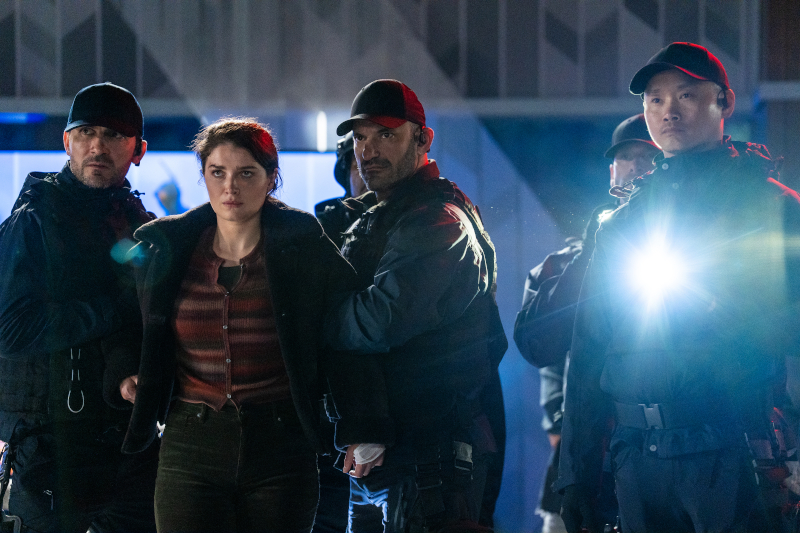
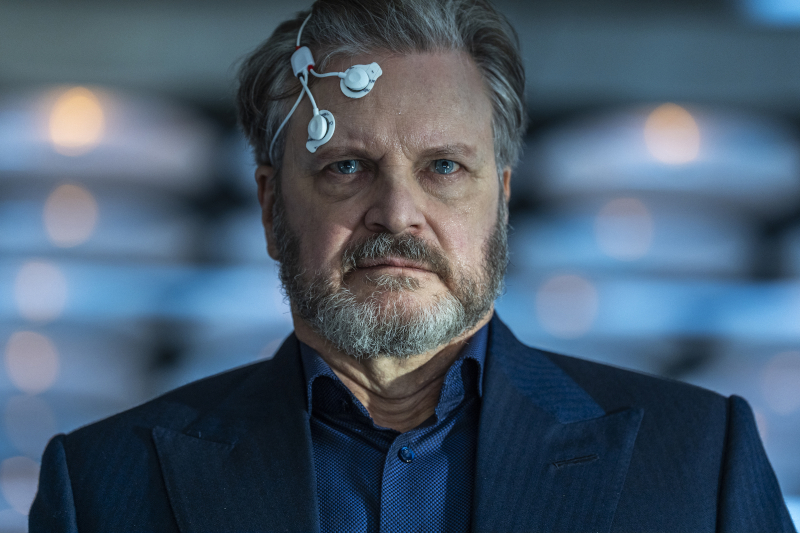
Daniel’s captors are an organisation consisting of black suits, who travel around in a procession of five or so black SUVs, headed by the ruthless Scanlon (Colin Firth from Bridget Jones: Mad About the Boy, Michael Morris, 2025; Operation Mincemeat, John Madden, 2021; Apartment Zero, Martin Donovan, 1988) who sees it as his job to get back the rucksack contents which have been stolen from the corporation he heads up. As leverage to that end, Scanlon has kidnapped Daniel’s girlfriend Jane (Eve Hewson from Flora and Son, John Carney, 2023; Bridge of Spies, Steven Spielberg, 2015) – not the woman in the movie poster, although they both have dark hair, which is a little confusing to start with – but Daniel isn’t going to give in so easily. Wielding a palm-of-the-hand-sized weapon known simply as ‘the device’ he is able to keep Scanlon at bay and rescue Jane. As the couple go on the run in a car, Daniel’s conversations on a smartphone connect him to a splinter organisation which informs him that, while he was expecting someone else to take the rucksack contents to safety, it has been decided that he, Daniel, is the man for the job.
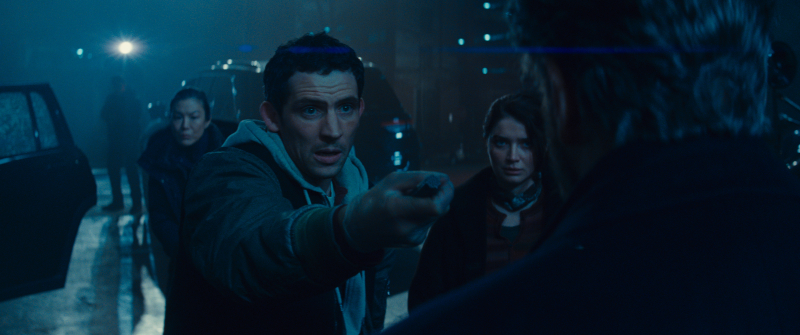
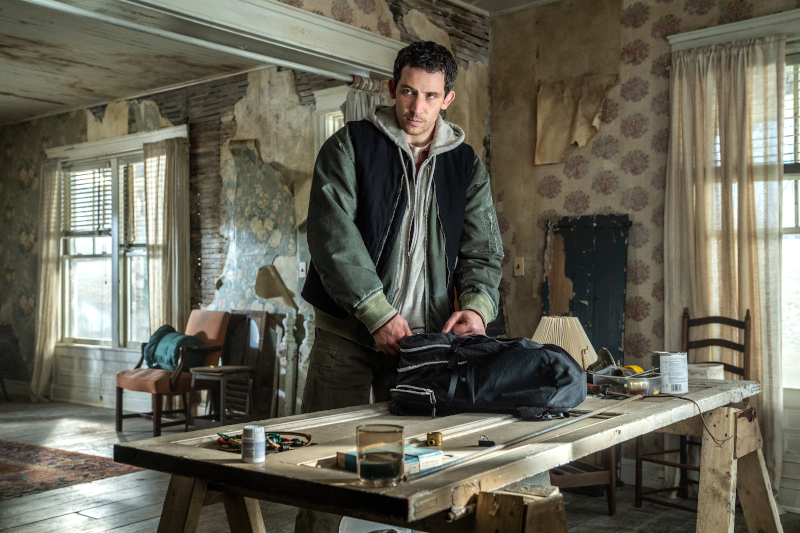
With the couple in need of somewhere to hide, preferably somewhere Daniel has never been before, Jane takes him to the convent at which she spent three years as a novice. This element of her background is news to Daniel, as Jane tends not to mention it in everyday conversation on the grounds that it complicates things too much. They are met and cared for by Sister Maura (Elizabeth Marvel from The Colour Purple, Blitz Bazawule, 2023; Lincoln, Steven Spielberg, 2012; True Grit, Ethan Coen, Joel Coen, 2010), the sister in charge, who appears not only calm and unflappable but also extremely wise. Their next stop is an abandoned farmhouse, where his collaborators have Daniel watch a video on his smartphone of a weather woman losing it live on air in Kansas.
Meanwhile, Margaret Fairchild (Blunt), a Kansas City TV weather lady is visited along with her partner Jackson (Wyatt Russell from The Woman in the Window, Joe Wright, 2021; Cowboys & Aliens, Jon Favreau, 2011; Escape From L.A., John Carpenter, 1996) in their loft apartment by the red bird. Margaret is entranced; Jackson shoos it away, Margaret has to get to the TV station for a broadcast deadline, but reckless driving gets her pulled over by a traffic cop (Jim Parrack from Fast & Furious 9, Justin Lim, 2023; Suicide Squad, David Ayer, 2016; Battle: Los Angeles, Jonathan Liebesman, 2011), a scene which echoes the heroine’s being pulled over by a cop in Psycho (Alfred Hitchcock, 1960). The clock is ticking. She and we are equally surprised when she suddenly starts talking to him about aspects if his personal life only he would know. It’s almost as if it’s not her talking, but someone else has taken control of her. Almost like spirit possession. Not that her voice has changed, or anything, but there’s an empathy to it not previously noticeable. Deeply affected, the confused cop lets her go.
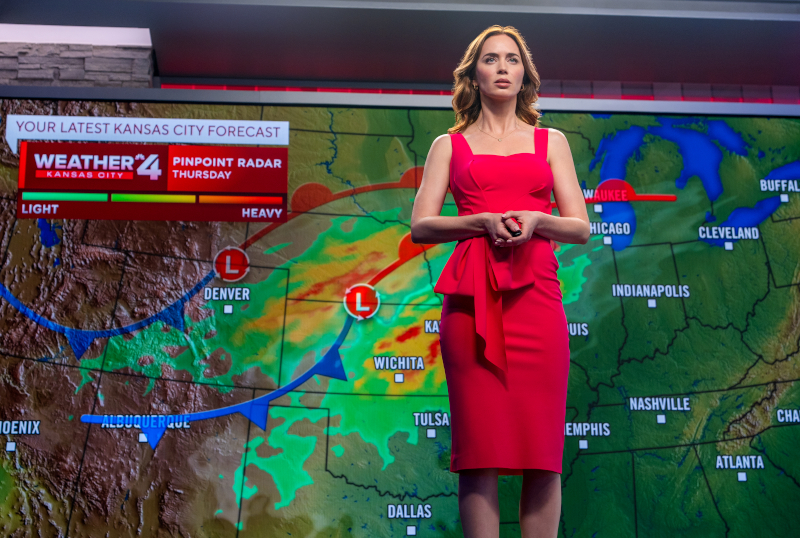
On air, she undergoes what seems to be a mental collapse and starts talking in clicking sounds before physically collapsing. This is the video which Daniel watches out in the fields near the farmhouse, and which he hears as Margaret talking intelligibly in English. But no-one else – not his collaborators, not Jane – can hear anything other than the strange clicking.
Scanlon, in a lab deep within the vast premises of his organisation WARDEX (Waived Reporting, Development and Extraction), sits in a chair using the device against the distant Daniel, but it doesn’t work because Daniel has a defence against it which results in Scanlon feeling like he’s received a debilitating, physical blow. So Scanlon turns his offensive against Jane, alone in the farmhouse kitchen, where he appears before her, seated at the table, to ask her questions she finds it difficult not to evade. She tries to fight him psychically, though, using her Christian faith as a defence, first praying silently gripping the crucifix that hangs round her neck, then, when that proves not to be effective enough, pressing one end of its cross into the palm of her hand so strongly that it pierces her skin and draws blood in a mark resembling religious stigmata.
The result of all of this is that Daniel is warned not to return to the farmhouse, steals an SUV from the incoming WARDEX convoy to rescue Jane, and the pair make their escape.
Margaret, meanwhile, finds herself under observation in a hospital where she is alarmed to see black suits observing her along with the medical staff, and gets Jackson to leave with her via a backroom window. Now this couple too are on the run, with Margaret receiving a phone call from the same sources working with Daniel who advise her to trust her instinct in terms of destination, as well as to destroy her regular, consumer mobile phone because its location is traceable. She has difficulties persuading Jackson to run her phone over, after which it’s only a matter of time before she abandons him at the first opportunity.
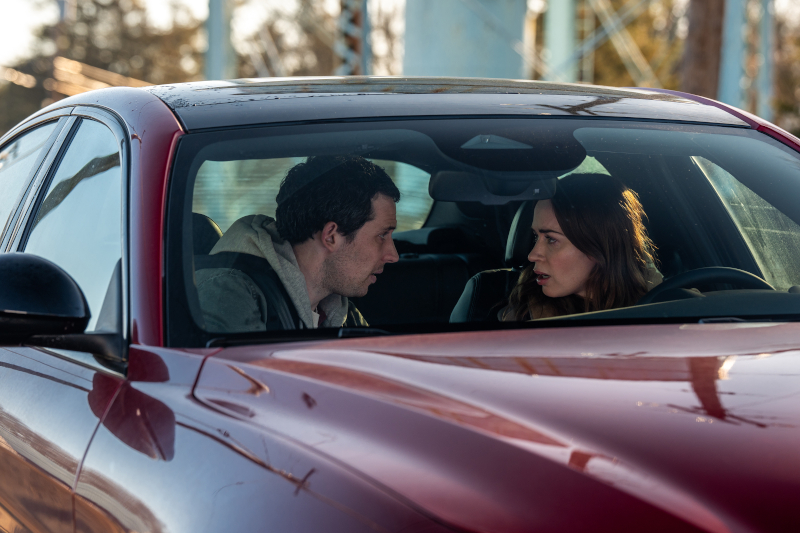
The irritating Jackson and the genuinely fascinating Jane drop out of the two couple-on-the-run parallel narratives, in which, in both cases, only one person of each couple is really on the run with the other merely an unlucky passenger along for the ride. Thus, the narrative about two couples – one dominated by the man, the other dominated by the woman – on the run across the US turns into one about one couple – the dominant man and the dominant woman – on the run across the US. From this point onward, the thrown-together Daniel and Margaret feel a lot like the thrown-together couple at the centre of North by Northwest (Alfred Hitchcock, 1959).
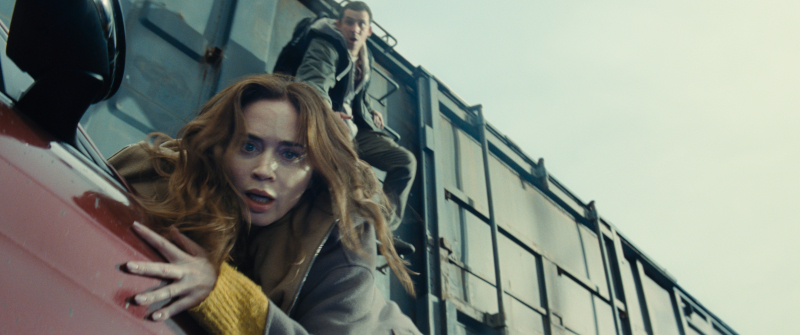
Curiously however, given that a train journey is at the heart of North by Northwest, a bravura action set piece has Scanlon’s henchman Casper Boyd (Henry Lloyd Hughes from Killing Eve, TV series, 2019; Anna Karenina, Joe Wright, 2012) tailgates Daniel and Margaret’s car towards a passing goods train at a level crossing, trapping its bonnet underneath a wagon so that it’s pulled along beside the train with our hero and heroine still inside, turns into a scenario which recalls nothing so much as the sequence in which James Bond boards a moving train from a moving car in Octopussy (John Glen, 1983), with, thrown in for good measure, the briefest of moments in which the sight of train tracks passing below us are presented as a threat to us were we to fall onto them, an image straight out of the terrifying finale of Shadow of a Doubt (Alfred Hitchcock, 1943).
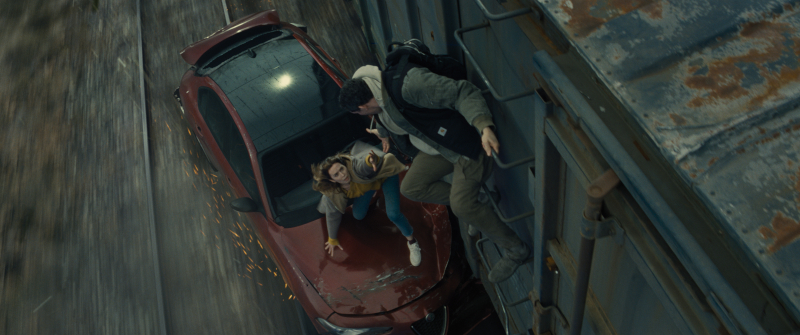
Apparently, Spielberg originally wanted to shoot this sequence for Duel (Spielberg, 1971), so its genesis goes back well before the Bond sequence. Movie technology has come a long way since these other movies were made, and with Spielberg at the top of his game, the construction and execution of this sequence (and, indeed, everything else in the movie) is very much contemporary, state of the art.
However, this writer couldn’t but help notice the references. A further Bond reference occurs when Santiago (Tommy Martinez from Bosch: Legacy, 2025; Laid, 2024; Good Trouble, 2019-24; all TV series), a driver who helps Daniel and Jane escape at the beginning, turns up in a fire truck “because everybody gets out of the way of fire trucks”, briefly recalling the stunt sequence involving a fire truck in A View to a Kill (John Glen, 1985).
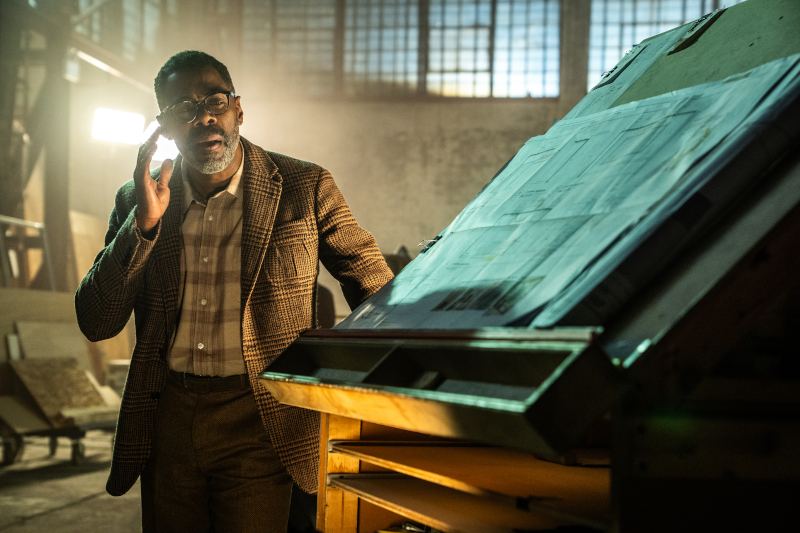
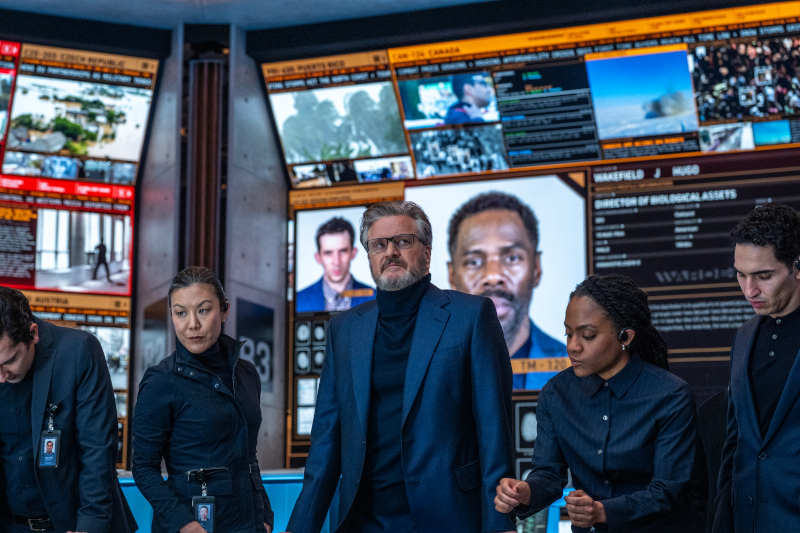
The splinter group off from the bad guys is headed up by Hugo Wakefield (Colman Domingo from The Running Man, Edgar Wright, 2025; If Beale Street Could Talk, Barry Jenkins, 2018; Selma, Ava DuVernay, 2014; Lincoln), a former colleague of Scanlon’s who decided not to turn up one morning so as to set up his own counter-organisation with a number of other colleagues he takes with him. Although the actor is largely given the thankless role of “the contact man at the other end of the telephone”, he’s given a fair amount of screen time and manages to develop the character into a believable presence. His other colleagues, however, with the exception of the driver Santiago, are little more than names working in the background of his control centre, which must be a frustrating scenario for the actors involved.
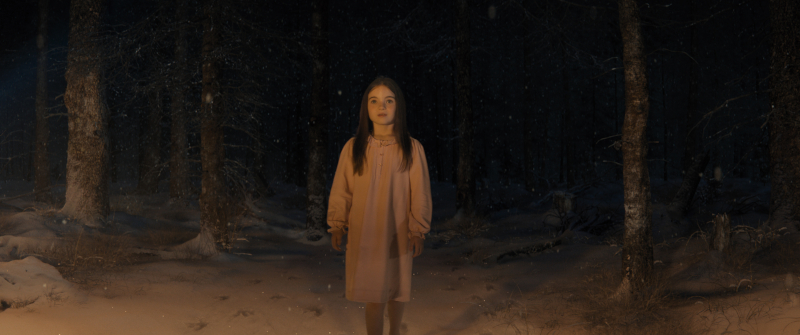
I confess to finding the first two hours enthralling as they play out like a version of North by Northwest with aliens. The last half hour, however, lost me. This may relate to the genesis of the film, which was originally written as an outline by Spielberg himself, who according to the production notes knew his end point, worked out a movie journey to get him there, and then brought in screenwriter David Koepp (War of the Worlds, 2005; Jurassic Park, 1993, both Spielberg; Mission Impossible, Brian De Palma, 1996; Apartment Zero, Martin Donovan, 1988) to flesh out the earlier part of the narrative. The corporate operatives in suits and cars recall in their agenda the government men in E.T. – the Extra-Terrestrial (Spielberg, 1982), and the final half hour which includes, as well as the small red bird, a fox and a deer, makes you feel that the current movie turned into the 1982 one. Spielberg himself describes the movie as a thematic bookend to Close Encounters of the Third Kind (Spielberg, 1977).
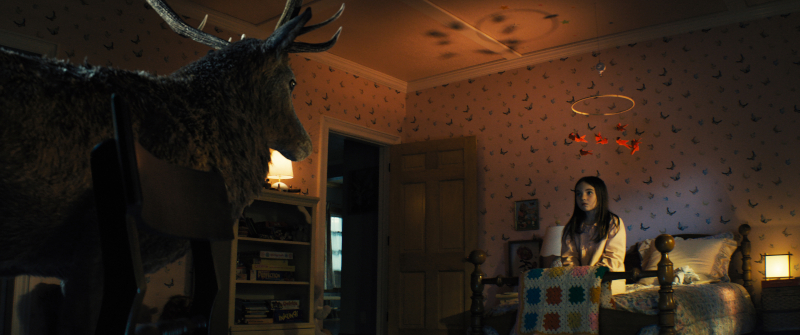
The current movie feels like it starts to go wrong from the scene where the WARDEX people invade the warehouse of the splinter group only to find that the house the latter have recreated from Margaret’s dreams, in which both she and Daniels had an encounter with the three animals – an experience they’ve both subsequently suppressed – is invisible. And yet, although Hugo and co. went to all this trouble to make this house invisible, apparently none of them thought to make its heat signature invisible at the same time, so the bad guys find it easily enough.
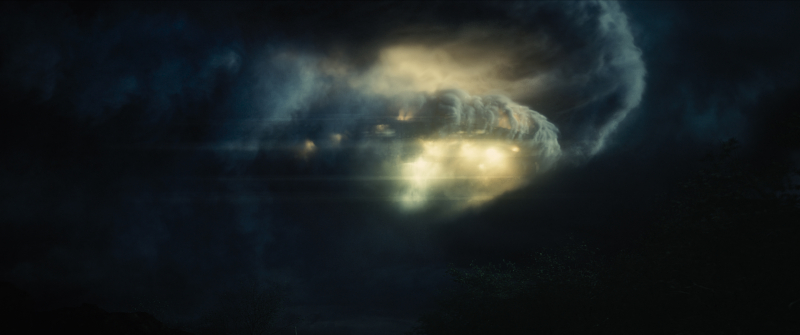
Spielberg goes full-on UFO conspiracy theory shortly after this point, showing us footage (presumably made for his movie) of various covered up activities involving alien sightings, crash landings, lab experiments and more while everyone on the planet stares at these images on their mobile phones. Moments where TV employees try to get things done on impossible schedules against a ticking clock brought to mind behind-the-scenes-at-a-TV-station drama Broadcast News (James L. Brooks, 1987).
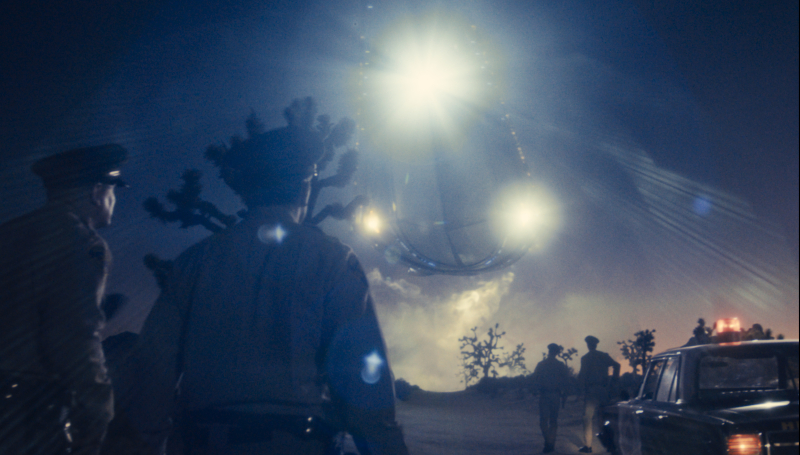
The problem for me was that, having been utterly entranced by the movie up to the point where the fire trucks bring the couple on the run safely into the good scientists’ base, it completely changed tone to the point where I suddenly didn’t believe it any more. I’d been hooked by the good characters and the villain, fascinated by the plot’s subtle probings around Christianity, and thrilled by the bravura action set pieces. Then it turns into this saccharine-y, sugary piece in which Margaret, possessed of the ability to transparently read other human beings, quite literally disarms all the bad guys by appearing in front of them as the person who meant the most to each other in turn – often the deceased partner or parent. The world in which we all live can be a complicated, messy place, and the movie switches from a complex thriller where part of the viewing compulsion comes from the fact that you’re constantly trying to work out what’s going on even as the ground shifts beneath you to a sickly sweet confection where all the loose ends are tied up and everything is served up in an over-simplified form for the viewer.
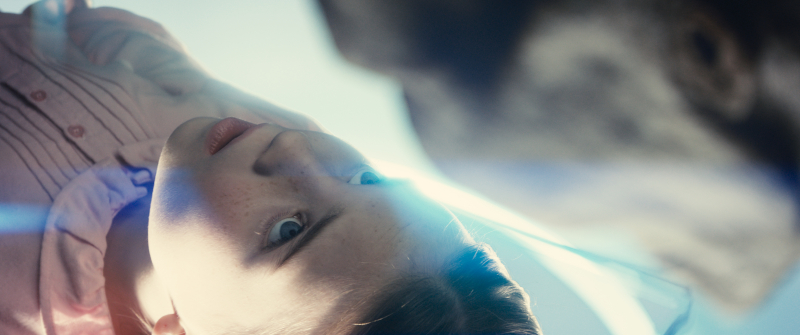
When Hitchcock used microfilm as his MacGuffin in North by Northwest, it was no more than a contrivance to get the plot moving. He was much more interested in his characters and their relationships. Spielberg, however, is much more interested in his MacGuffin – what’s on the microfilm, if you will – so the end of his movie plunges into a cacophony of suppressed UFO and alien imagery as the information is finally made available to all. However, that’s far less rich and strange than the interactions between the narrative’s characters. Which is why North by Northwest is ultimately a masterwork while Disclosure Day is flawed.
Disclosure Day is out in cinemas in the UK on Wednesday, June 10th.
Trailer: