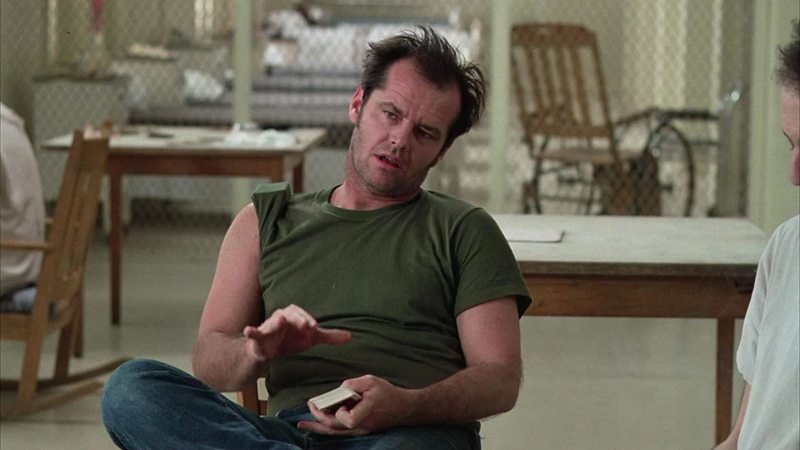
Director – Milos Forman – 1975 – US – Cert. 18 – 133m
*****
An unpredictable new inmate unsettles the controlling nurse presiding over a hospital ward’s mental patients– out now in the UK on 4K UHD and 4K UHD Steelbook
A state hospital for the mentally ill, a live-in ward presided over by Miss Ratched (Louise Fletcher). For reasons that are never entirely clear, RP McMurphy (Jack Nicholson) arrives for a stay to evaluate his mental health. It’s also not clear whether there is anything actually wrong with him; the prison that sent him thinks he was faking it to get out of a work detail.
McMurphy finds himself on Miss Ratched’s ward, which she runs in a highly regimented fashion. He doesn’t like that, and the scene is set for a battle of the wills.
The film was originally a 1962 novel by Ken Kesey which became a play within a year with Kirk Douglas playing McMurphy. That ran on Broadway for six months, and Douglas was so taken with it that he spent most of the 1960s trying to make the film, eventually deciding on Forman as director and sending him a copy of the novel. Forman never received the book as it was seized by the Czech authorities.
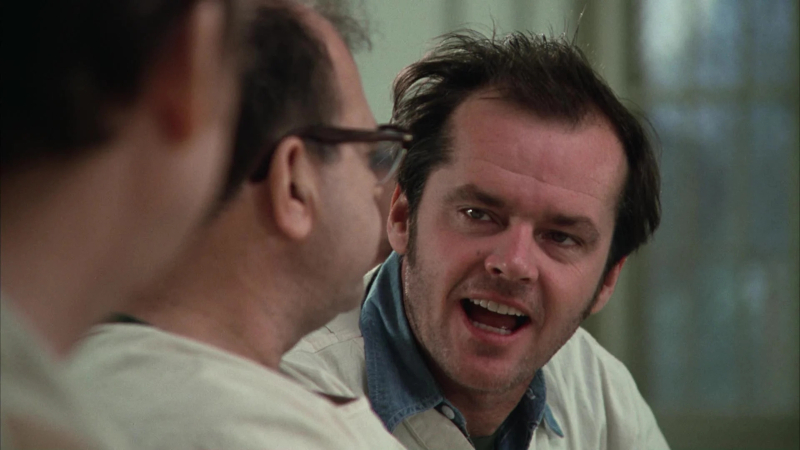
Douglas’ son Michael, then a young, jobbing actor, had seen the play as a youngster and was equally enamoured of it. In 1971, he persuaded his father to let him try and produce it, looking at a number of possible directors before sending the script to Forman, now a mentally ill recluse living in the Chelsea Hotel. His detailed reaction to the script, which he considered one of the best he’d ever read, convinced Michael Douglas and fellow producer Saul Zaentz that he was their man.
Forman was less than keen on Kirk Douglas as lead, as he felt the latter’s star persona would get in the way of conveying the character on screen and wanted someone less well-known. Michael assured him his father was no longer involved. Fellow director Hal Ashby told him to look at Jack Nicholson in The Last Detail (Hal Ashby, 1973) which hinted at what the actor might be able to bring to the project.
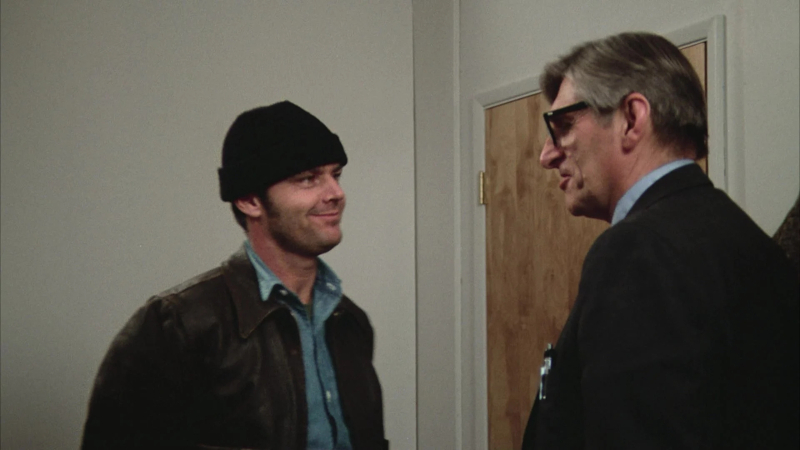
Although largely interior-based, this was shot not in a studio with fabricated sets in keeping with the wisdom of the day, but rather on location at the Oregon State Hospital, with the participation of the staff and patients, many of whom appear in the film or worked on the crew. Dr. Spivey, the head of the hospital, was played by Dean R. Brooks, the real life man in charge of the place. Likewise, a scene half way through with Spivey and two executives deciding whether McMurphy should stay at the hospital or be transferred elsewhere is shot with two of his real life executives.
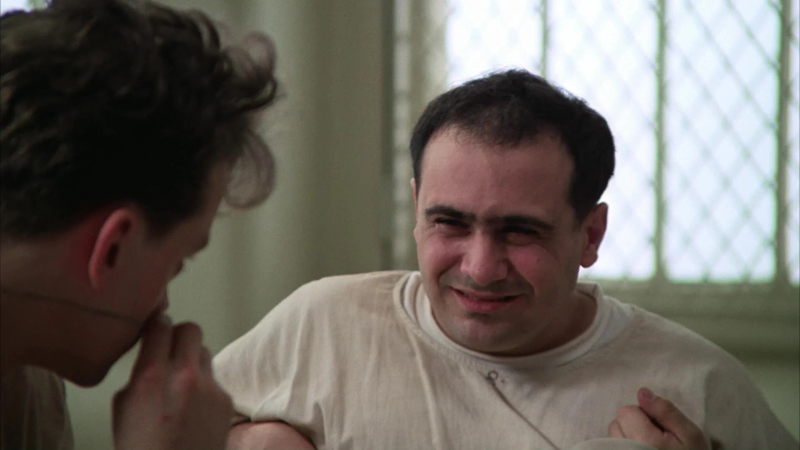
Aside from a pre-stardom Danny DeVito, who had played one of the inmates, Martini, in a recent Cuckoo’s Nest stage production seen by Michael Douglas, the actors were chosen from a lengthy workshopping process which whittled down the numbers of actors via rehearsals of group therapy sessions which produced an amazing cast that included a number of actors who had had or would would go on to have lengthy and in some cases high-profile Hollywood careers: Michael Berryman, Scatman Crothers, Brad Dourif, Louise Fletcher, Sydney Lassick, Christopher Lloyd, William Redfield, Philip Roth, Will Samson, Vincent Schiavelli. For most if not all of these, along with Louisa Moritz and Mews Small who play the two girls McMurphy brings to the hospital for an impromptu party later on, this film would be an undeniable career high if not the best thing they every did.
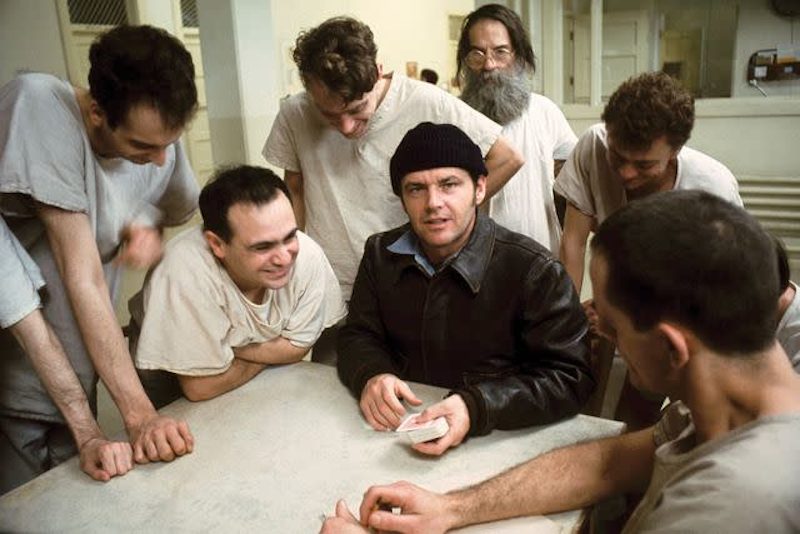
The workshopping group therapy process also feeds into the actual hospital location, with actors and inmates performances bouncing off both one another and the location, something it’s hard to imagine happening in quite the same way in a studio set.

What you remember fundamentally are the characters, the actors, and their performances. The film was nominated for nine Oscars and won five, including both its leads. Nicholson would go on to many more high profile roles, yet a case could be made for this film as his finest work. Fletcher too went on to a lengthy career, yet was never offered another role with the potential of this one, which probably speaks volumes about the sexism of Hollywood back in the day, itself a reflection of wider US and Western society.
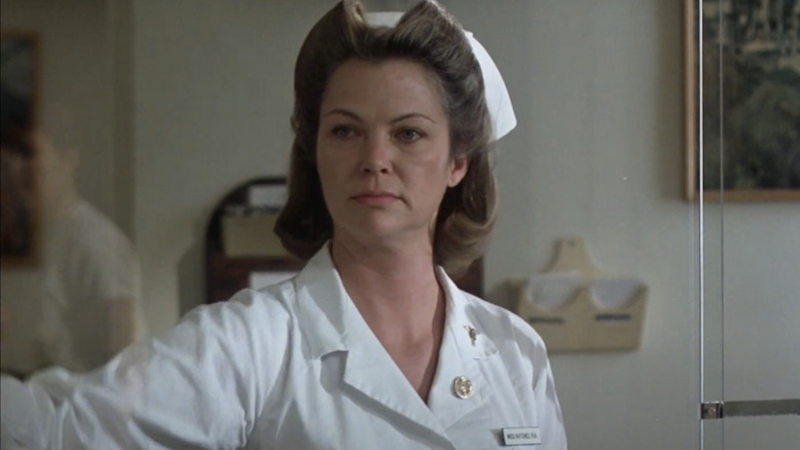
The original plan was to cast Nurse Ratched as more of a horror villain, but Fletcher plays it straight, as a sexually repressed control freak who can feel McMurphy attempting to unravel all her carefully constructed systems designed to keep the patients in line. Her whole manner of speech is designed to control people, and she isn’t going to let some newcomer wrest that control away.
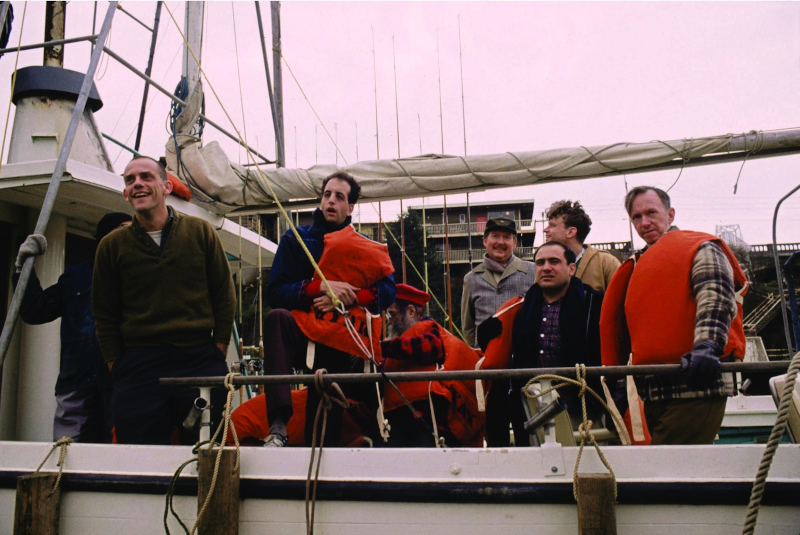
There is ensemble magic too between many of the other patients, whether at McMurphy’s card game (in which everyone else happily loses their money to him, to the subsequent consternation of Nurse Ratched), or other events put together by McMurphy such as his attempts to get people to vote for watching the World Series football game on television, his illegal trip outside to character a fishing boat to give the residents a day out, or his night time Christmas party (complete with booze and two girls) towards the end. (Yes! – it’s a Christmas movie.)
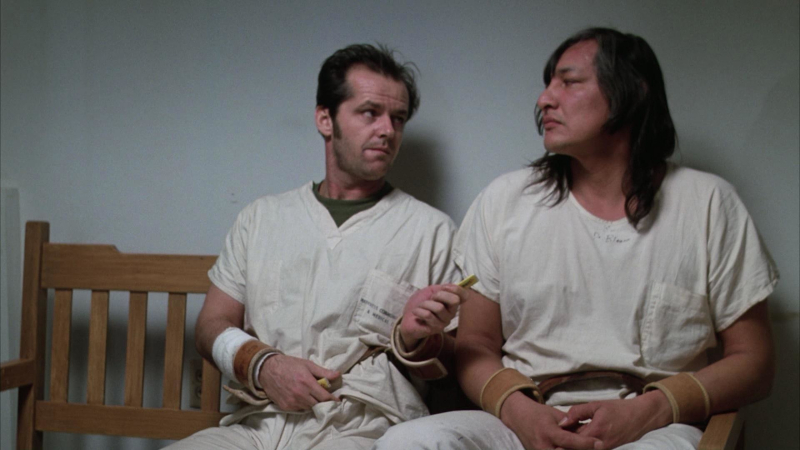
As for the other patients, the role of the Chief, a towering, silent Indian proved impossible to cast until the producers’ network of contacts stumbled upon Will Samson, who proved the perfect fit. His immobile yet imposing serenity proves the perfect foil to Nicholson’s manic energy constantly trying to upset the status quo, and magic occurs between the pair of them onscreen.
All this looks great in 4K UHD, not least because the performances are so crucial to what makes the film special that you want to be able to see them in all their detailed glory. Fifty years on, it remains one of the greatest ensemble acting movies ever filmed.

The new disc comes with some revelatory extras, which informed some of the current review, two of which are newly produced featurettes Conversations on Cuckoo, about ten minutes each, in which producer Michael Douglas and cast members DeVito, Lloyd and Dourif talk extensively about the making of the film. A little of their footage – but not so much as to become irritating – crops up again in the much longer, and likewise informative, documentary Completely Cuckoo (Charles Kieselyak, 1997).
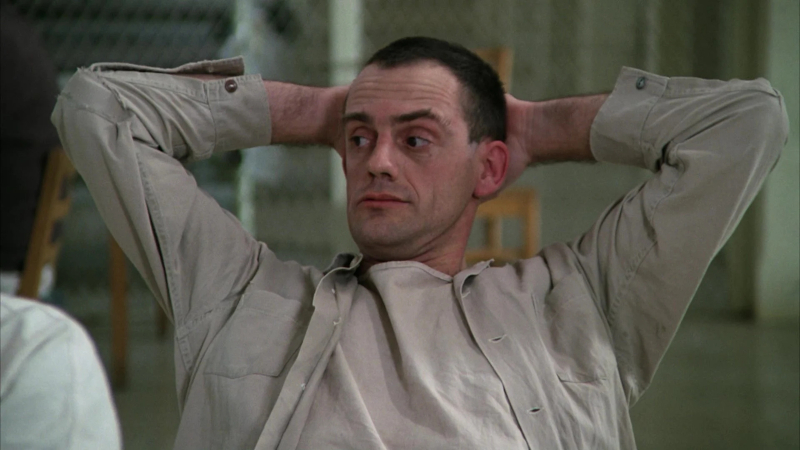
Some of the deleted scenes on the disc are genuinely fascinating. Pecking Party foregrounds the idea of lobotomy – a central theme in the film – rather too obviously, and while the film is probably better off for its excision, it’s nice to be able to see it. Conversely, The First Group Session has McMurphy trying to tell Nurse Ratched that Ellis (Michael Berryman) is peeing himself; it’s a great scene which makes you wonder why it was cut (probably to get the length down) and what else was cut (if anything) that didn’t make it onto the disc but would have improved the movie.
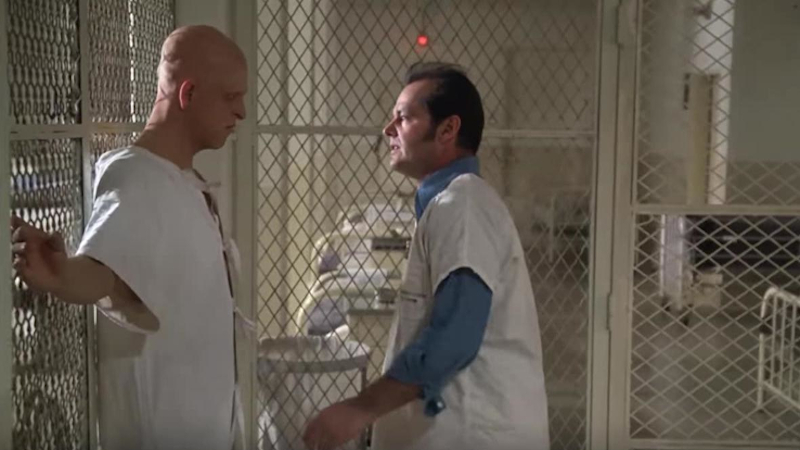
The production harks back to a time – before Star Wars (George Lucas, 1977) and its blockbuster ilk – when Hollywood movies could and often did address serious issues without feeling at all Oscar-bait-ey. In this case, people are simply trying to tell a story they think worth telling, and putting some remarkable ensemble acting on the screen in the process. While fascinating in terms of caring for the mentally ill, it also functions as a broader picture of how repression and totalitarianism work.
In addition, it boasts a radical, battle of the sexes subtext in which a repressed and repressive woman seeks to control a group of men, at least one of whom is a wild card who refuses to be controlled. As such, on some levels it may play to some viewers very differently today from the way it played fifty years ago, and I daresay when audiences revisit it in another fifty years time, it may well play differently again. Although I don’t doubt that it will stand that additional test of time just as well as it has thus far.
One Flew Over the Cuckoo’s Nest is out now in the UK on 4K UHD and 4K UHD Steelbook.
Trailer: