Director – Fei Zhenxiang, Guan Hu – 2025 – China – Cert. 15 – 133m
The first hour and a half **1/2
The last half hour ****1/2
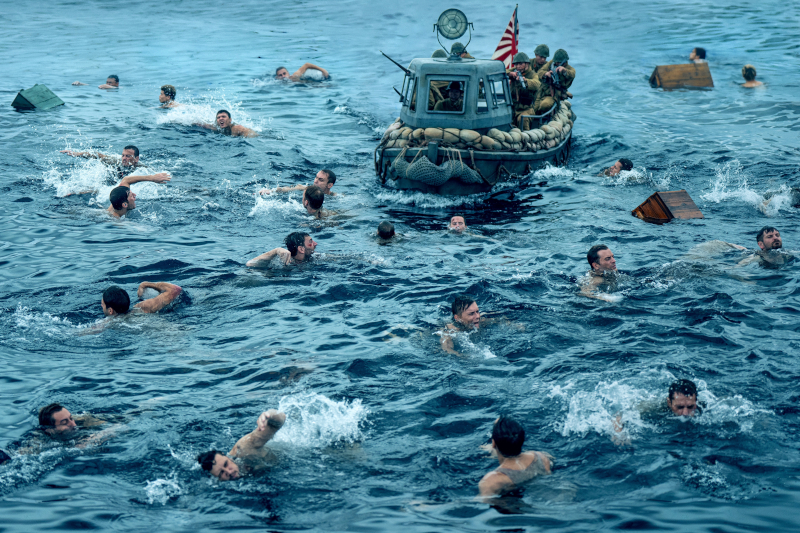
Chinese islanders under Japanese Occupation in WW2 set out to rescue a thousand plus British prisoners from a sinking, torpedoed ship – out in UK cinemas on Friday, August 22nd
An announcement in English on the BBC, from October 1st, 1942: “On September 27th 1942, the Japanese transport ship Lisbon Maru carrying 1,816 British prisoners of war departed Hong Kong for Japan. On October 1st, she was struck by a torpedo from American submarine USS Grouper and began to sink off the Eastern coast of China. Just two miles South West of the site lies a small island known to the Chinese as Dongji Island… This information comes overwhelmingly fast at the start, accompanied by CG images of the incident. Anyway, you get the drift.
And then, as if to suggest at least one of the directors’ true interests lie somewhere else altogether, there follow breathtaking images of an island, vast spaces with grasses blowing in the wind. And more verbal exposition: two young boys were rescued from the sea by Old Wu, but then the Northern islanders banished the boys to the Southern part of the island, believing them to have “pirate blood”. The two, who have grown to adulthood, witness the torpedo going through the water towards its unsuspecting target. The younger Ah Dang (Wu Lei) attempts to pick up a British survivor, while the older Ah Bei (Zhu Yilong from Only the River Flows, Wei Shujun, 2023; Lost in the Stars, Cui Rui, Liu Xiang, 2022) wants nothing to do with it, as it would mean trouble, given that the island is under Japanese occupation.
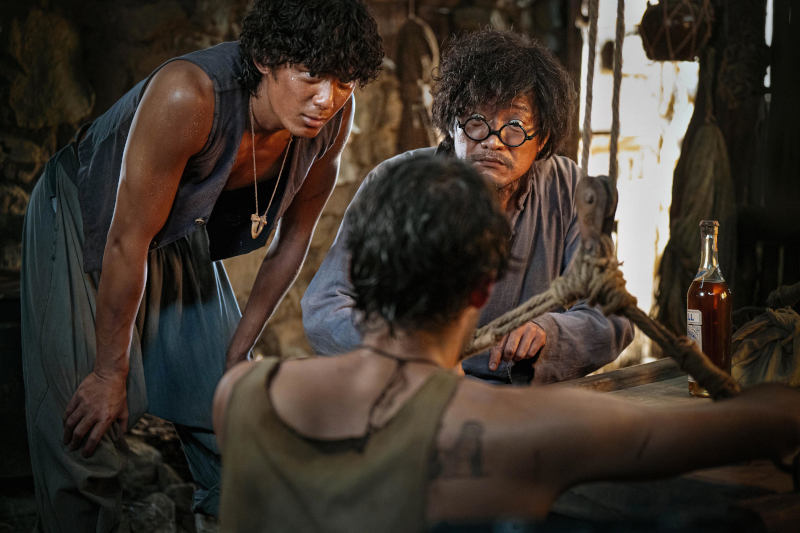
Nevertheless, they bring the half-drowned man back to their humble house where they learn from the non-Mandarin-speaking Brit that his name is Thomas Newman (William Franklyn-Miller from Four Kids and It, Andy de Emmony, 2020), which they misunderstand to be New Man. There’s a struggle when he takes a blade from the fire, but it turns out that he wants to cauterise his leg wound. He says he is from Birmingham, despite displaying a complete lack of anything resembling a Brummie accent. That error notwithstanding, it’s nice to have a rare, halfway decent performance from a Brit in a big budget Chinese epic.

Ah Bei, who is in a romantic liaison with the ostracised Ah Hua (Ni Ni from Shock Wave 2, Herman Yau, 2020; Lost in the Stars) – a woman Old Wu rescued as a child – and hopes to one day take her to Shanghai, heads North to consult the almost comatose Old Wu (Ni Dahong from The Assassin, Hou Hsiao-hsien, 2015; To Live, Zhang Yimou, 1994), who is now little more than a figurehead with no real power, only to be captured in a net by the superstitious villagers. After making an escape, he finds Newman with Ah Dang and attempts to make the Brit jump off a cliff. The Japanese, meanwhile, believing a blue-eyed, blonde Brit to be loose on the island (a stereotype which Newman doesn’t at all fit), bayonet a number of Northern villagers (including a young boy and Old Wu) when they won’t – or, more accurately, can’t – reveal the escaped Brit’s whereabouts.

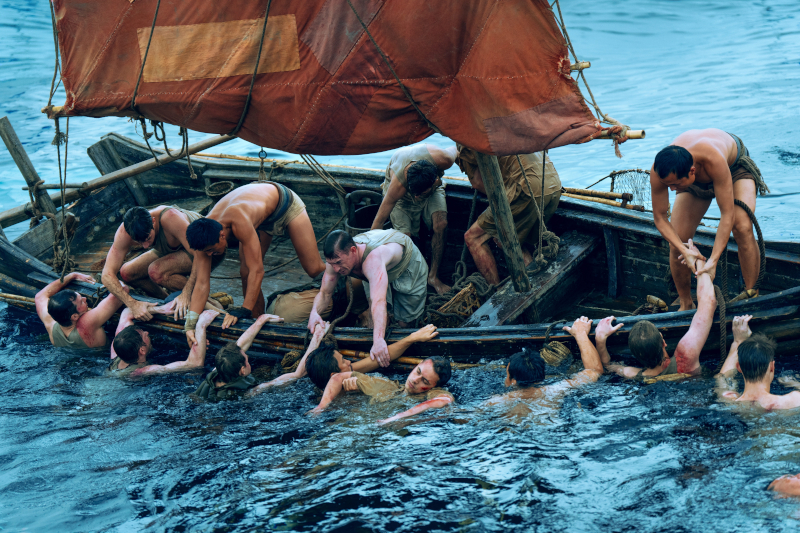
As tensions escalate, a Japanese sniper picks off members of a coastal path funeral procession, the Imperial Army vows to kill all the Chinese on the island to prevent the story of the atrocities committed thus far getting out to the outside world. The local teacher Chen (Chen Minghao), who has acquired a reputation as a coward who actions in the past have tended to be directed towards saving his own neck rather than helping fight the enemy, gets a chance to make good. But Ah Hua has other ideas, leading a flotilla of fishing boats out to the still sinking Lisbon Maru in an attempt to rescue the Brit POWs trapped on board.
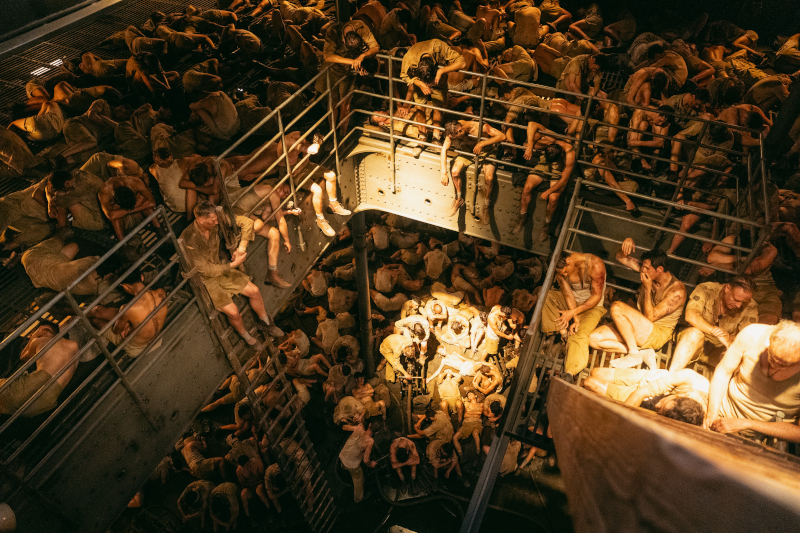
The rescue scenes take up the closing half hour, but you have to wade through the first three quarters of the film to get to them, with the prior narrative delivering only intermittent snatches of the trapped Brits (who at one point launch into notable wartime marching song It’s a Long Way to Tipperary). It’s not like Dunkirk (Christopher Nolan, 2017) where the slow build up by land, sea and air forces slowly and compellingly builds to a dramatic climax: this feels more like the budget wasn’t there to show much of the trapped Brits prior to the no-holds barred finale (which is pretty odd, because for the final half-hour, the hitherto unsatisfactory film suddenly pulls out all the stops to deliver genuinely impressive spectacle).

The movie is based on a true WW2 incident, and the end credits feature tantalising documentary vox pop fragments from real life Chinese survivors and British descendants of the POWs they rescued. Which demonstrates that this is an incident worth turning into a film and makes you wish the production team had insisted on a much better developed script to tell the story or different director or directors at the helm, because it might be mismatched directors rather than the screenplay that’s the problem here.
That shouldn’t have happened, though, given that one of the directors, Guan Hu previously made The Eight Hundred (2020), arguably the Best Chinese war movie of the last decade, as well as Black Dog (2024). The other, Fei Zhenxiang, is also an actor whose credits include an episode of TV series The Three Body Problem (2023) and Farewell My Concubine (Chen Kaige, 1993).
Still, this is worth seeing for the spectacular, final half hour. Such a pity it takes so long to get going before that.
Dongji Rescue is out in cinemas in the UK on Friday, August 22nd.
Trailer: