
Directors – Maïlys Vallade & Liane-Cho Han – 2025 – France – Cert. PG – 77m
*****
A Belgian diplomat’s baby daughter growing up in Japan comes to realise, by her third birthday, that she is not God – plays in the Annecy International Animation Festival 2026 which runs from Sunday, 21st June to Saturday 27th June.
In the beginning was God. At least, that’s how the new-born Amélie (French language version voice: Loïse Charpentier) sees herself. She is, essentially, a tube which swallows, digests and ejects (as per the film’s French language title). She has a perfect command of verbal language, so sees no need to say anything. That said, she makes great use of voice-over throughout the piece. She remains motionless, practising “the gift of serenity”. “Your child is a vegetable”, proclaims a doctor to the child’s parents. She remains in this state until her second birthday, when life is interrupted by an earthquake – nothing significant in the wider scheme of things, but a momentous event in the interior life of a small child. She attempts to speak, but to her horror the words in her head don’t emerge, only baby noises.

Amelie is the third child of Patrick (French voice: Marc Arnaud) and Danièle (French voice: Laetitia Coryn), and has two older siblings, Juliette (French voice: Haylee Issembourg) and André (French voice: Isaac Schoumsky). Patrick is a Belgian diplomat posted to Japan, which setting is clear from the décor of the house in which the family live, surrounded by ornamental gardens, which they rent off austere landlady neighbour Kashima-san (French voice: Yumi Fujimori from the French dub of Pocahontas, Mike Gabriel, Eric Goldberg, 1995), who recommends a younger woman as a housekeeper.

When the doorbell rings, it signals the arrival of not only the expected Nishio-san (French voice: Victoria Grosbois) but, first, Patrick’s mother Claude (French voice: Cathy Cerda) who has just flown in from Belgium having promised to visit for months. Told that Amélie is upstairs – the two older kids having pretty much given up on her thanks to her lack of interaction, although André has taken to sitting on her for hours on end while he reads comics – she rushes up to see “my little angel” and, confronted with the grumpy toddler peering out from her cave-like cot sheets, feeds her white, Belgian chocolate. The effect upon Amélie is both immediate and transcendent – the most exquisite taste she has ever experienced – and, indeed transformative.

She is now two-and-a-half, and resolves to catch up, walking, running, and saying her first word, “vacuum cleaner”, the ability of which machine to disappear small objects off the carpet makes her designate it a fellow god. Ideas of divinity are, however, swiftly forgotten as she keeps the rest of the family happy by saying their names, except her out-of-favour brother who she doesn’t verbally name until following the later occasion when, during a family trip to the beach, he informs mum and dad that she has gone missing, facilitating her rescue from drowning.

Apart from her grandma, whom she adores and at whose subsequent departure back to Brussels – around the other side of the world – , Amélie doesn’t interact that much with the rest of the family. She does, however, open up to housekeeper Nishio-san, who introduces her imagination to monstrous Yokusai via the magical world of picture books, shows her how to write the shortened version of her name, the two-syllabled Ame (the Japanese character for ‘rain’) and takes her to see carp during a family trip to the Festival for the Month of Boys, who are symbolised by carp. The little girl is understandably put out that no equivalent ceremony exists for girls, but gratified by the fact that carp are ugly.

It turns out the Kashima-san lost her husband during the war, while Nishio-san was the only member of her own family to survive a bombing raid. Nishio-san has Amélie accompany her to a lantern festival commemorating the dead. Unbeknownst to the little girl, this latter incident hones a tension between housekeeper and employer, since Kashima-san doesn’t think it appropriate for foreigners to attend this ceremony.
While films about children are common enough, those portraying the interior world of very small children, such as Ponette (Jacques Doillon, 1996), are a rarity. Like that film, both My Neighbour Totoro (Hayao Miyazaki, 1988) and Grave of the Fireflies (Isao Takhata, 1988) feature four-year-olds, although in both these films, but not Ponette, the elder sibling plays a significant narrative role. Little Amélie, however, features a character who for most of the film is aged between two-and-a-half and three. There are grown up situations that she doesn’t fully understand, with which she must attempt to come to terms. These include her beloved grandmother’s return to Brussels from Japan, the fact of her subsequent death which means she’s never coming back, and, towards the end, the family’s impending return to Brussels when all she has even known is Japan.

Amélie doesn’t really understand her father’s crying (after he has heard that his mother has died), nor the animosity between the different post-war attitudes to foreigners of the dour Kashima-san and the more accommodating Nishio-san. Given that she almost drowns twice – once near a beach, once in a pond) she has no real sense of danger about anything either, only a child-like sense of wonder. Deep in the pond, she encounters the spirit of her departed grandma, who tells the little girl that unlike herself, Amélie isn’t quite dead so shouldn’t actually be there.

This sense of wonder is where the film really delivers. Using the medium of 2D animation, it succinctly captures, in brilliant colours, the toddler’s exciting new world in which she finds herself. Like drawing, like painting, like much illustrated visual material in children’s picture books, yet unlike the naturalism of photography, such imagery is not so much real as hyper-real and larger than life. Something similar is achieved in the animated sequences of the otherwise live action àma GLORIA (Marie Amachoukeli, 2023). After Amélie’s self-imposed isolation from the outside world is disrupted by the earthquake, first the house, then the gardens beyond, and finally the wider world as experienced in family days out, become new worlds to the little girl, ripe for exploration and discovery.
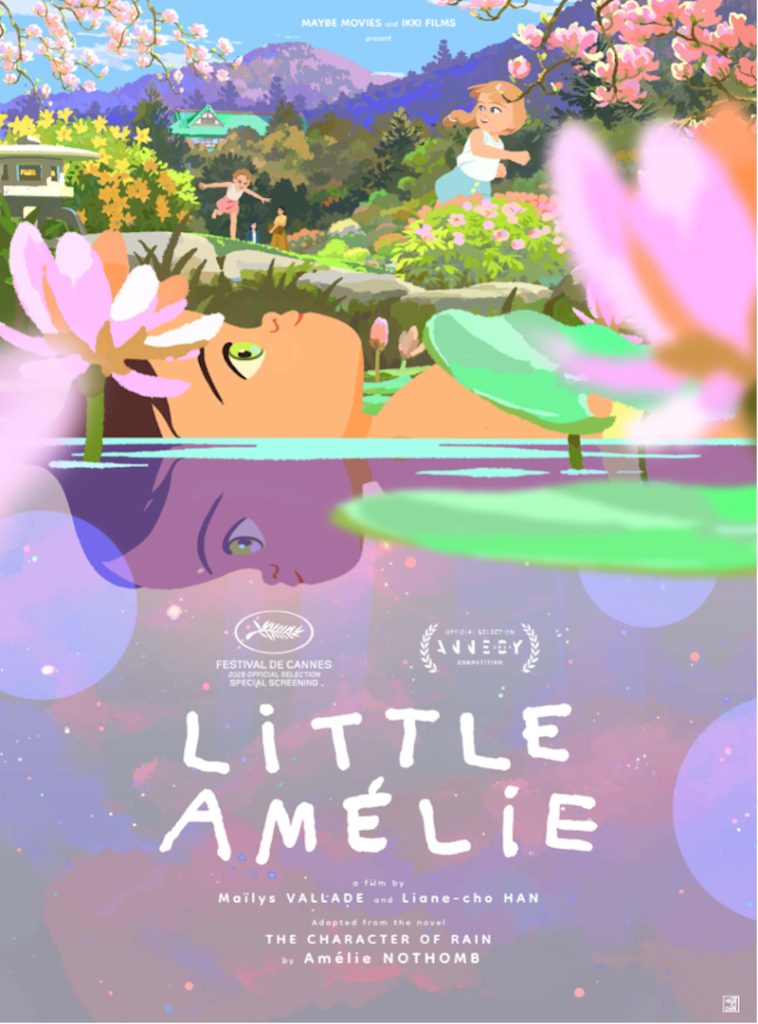
The potential of such visuals allows the directors, through their team of designers and artists, to have a field day, as can be seen in the superb stills accompanying this review, with the idea of the toddler’s interior world as perfectly captured by the UK poster as it is by the film itself. Taking Amélie Nothomb’s novel Métaphysique des Tubes / The Character of Rain 2000 / 2002 as its starting point, and examining a child’s development in between two cultures (the novel apparently also contains material about growing up bilingual, something the film doesn’t attempt to tackle), it transcends the specifics of its time and place to deliver a universal tale about the earliest years of childhood. An absolute must-see.
Little Amélie or The Character of Rain plays in the Annecy International Animation Festival 2026 which runs from Sunday, 21st June to Saturday 27th June following its release in cinemas in the UK on Friday, February 13th 2025.
This review was written after seeing the French, subtitled version.
Oscar nominations – 1
Maïlys Vallade, Liane-Cho Han, Nidia Santiago and Henri Magalon – Amimated Feature Film
Trailer: