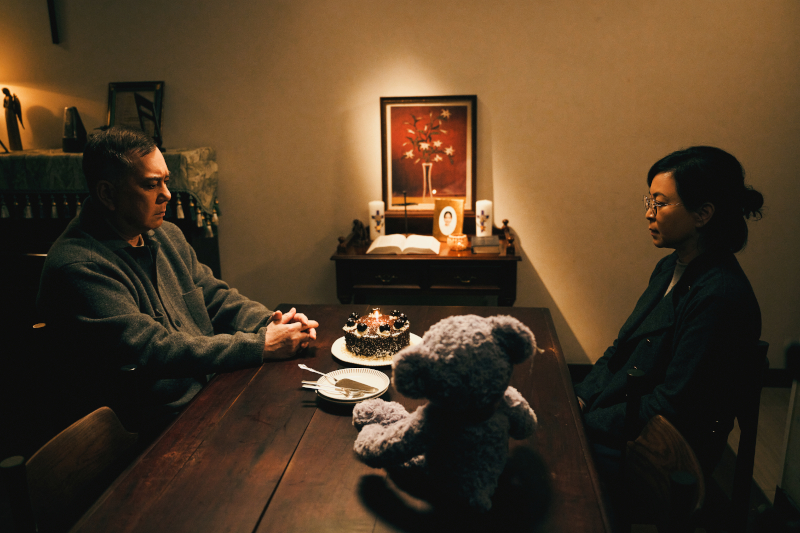
Directors – Jeffrey Lam Sen & Antonio Tam – 2024 – Hong Kong, China – Cert. 15 – 84m
***1/2
The lives of a Christian pastor and his wife become intertwined with that of a youth who believes himself responsible for their teenage daughter’s suicide some years ago – out in UK cinemas on Friday, November 14th
For roughly its first half, this delivers a narrative that sits squarely in an evangelical Christian framework. Unable to keep that up, it shifts focus in its second half to fire off in a number of directions.
Pastor Leung (Anthony Wong) and visits an old lady named Chan who is dying in hospital, asking her on her deathbed to accept Jesus as her Saviour. As he’s leaving, the nurse with him spots her grandson coming in, chained between two police officers. His granny is unconscious, and he finds her clasping a crucifix tight in one hand.
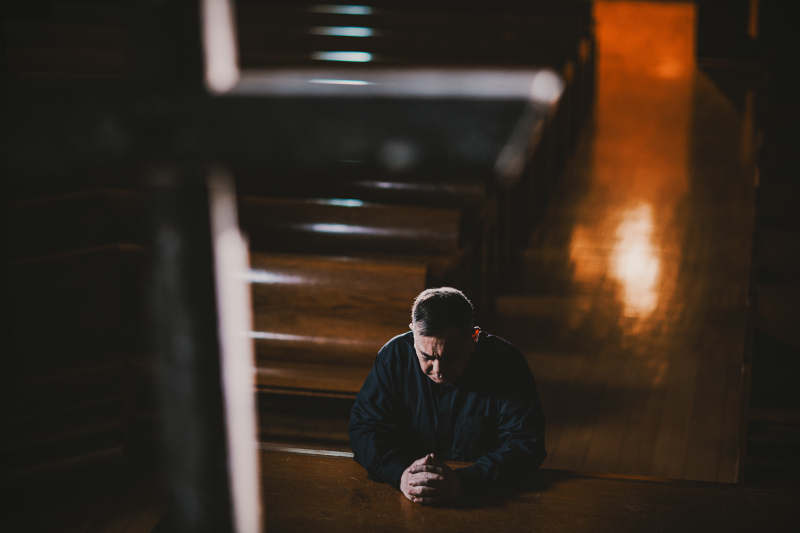
Praying alone, the Pastor talks about ”joining in the sufferings of Christ” as well he might: when interviewed by a lady journalist (Amber Van Cheung) about suffering and his experiences, something he is known for speaking about widely, it’s apparent that he and his family – pictured on a cupboard top photo as father, mother and daughter – suffered terrible grief a few years back. Judging by the noisy moving around their apartment by his wife (Louisa So) who then goes out while his interview is being conducted, she doesn’t think too highly of her husband’s Christian sentiments and popular writings.
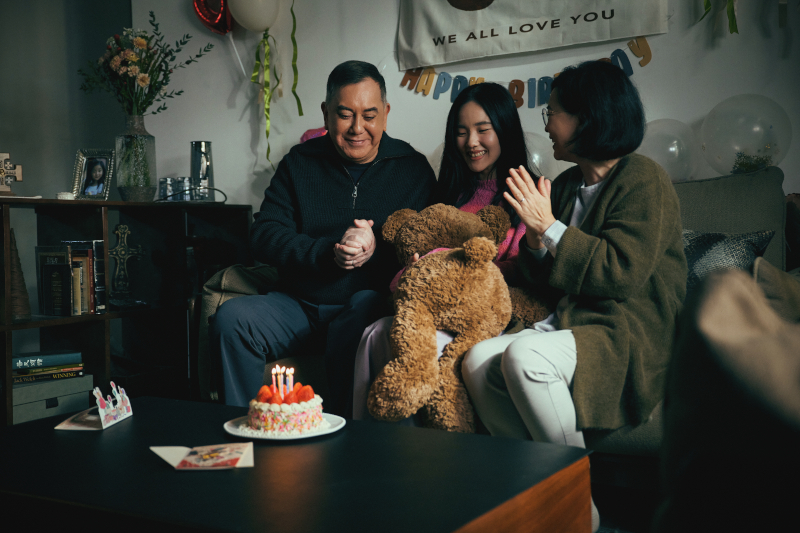
In the hospital where she works, the wife visits her sick father (Cho Ying-fat) before going out to the teddy bear shop to buy a present their daughter Ching (Sheena Chan), who turns up seemingly out of nowhere to ask her mum to buy her a large purple bear. Back home, mother and dad give the teenage Ching her birthday present – a brown teddy bear.
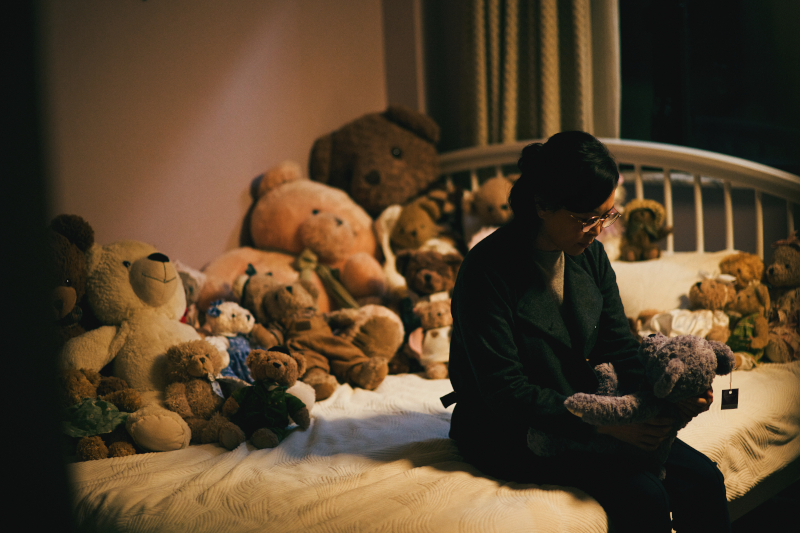
The girl’s room, which looks neat but unused, has maybe 30 teddies on the bed, some small, some bigger. It could almost be a shrine. It stands in marked contrast to the rest of the flat, which is sparsely decorated with Christian artefacts. The most notable of these, affixed to the outside of the front door, is the circular, wreath-like relief depicting the crown of thorns and some nails.
Mrs. Chan’s grandson walks outside the perimeter of a prison. The Pastor is out doing the homeless persons food run when one of his team, Miss Yung (Wing Mo), runs into Mrs. Chan’s grandson, who introduces himself as Lok (George Au) and explains he is homeless because his grandmother’s flat has been repossessed. She immediately offers him a place to stay on church premises, so he moves into a large storage room containing, among numerous other items, pinball machines, a drum kit and a prominent nativity set. And piles of an issue of a magazine featuring Pastor Leung.
Lok texts Ching, only to discover that her mother is on the other end of the phone since Ching took her life some years ago. Later, on the church’s premises, he starts the first of many conversations about the Christian faith with Pastor Leung, who seems strangely distant, and asks such peculiar questions as, “How did you find up in prison” and “if you saw that person, wheat would you say?” The young man responds with genuine questions of faith, albeit of a distinctly evangelical variety: “Can a person like me believe in the Lord Jesus Christ.” “You can start by reading the Bible”, comes the reply.
In a later conversation, Lok asks the Pastor for help because “I hurt someone. I thought things would be fine as I came out of prison.” And in a later one still, the Pastor says to him, suggesting that he might be ever so slightly loopy, “I want you to die. But not just to die. For whoever loses his life will save it… This is evangelical orthodoxy framed by the idea that the speaker might be a killer.

The Pastor reveals a bizarre take on the faith by making Lok carry a full-sized cross along some dunes barefoot. Perhaps this is a dream (although we see the young man through his window later on with the same cross , so perhaps it’s not a dream).
About half-way through the proceedings, the image of blood trickling down a water channel – recalling both Carrie (Brian De Palma, 1976) and, more importantly, its source Psycho (Alfred Hitchcock, 1960) signals the change of tone. Not that the film changes to a De Palmeresque or Hitchcockian thriller – far from it – but it becomes less concerned with pushing the evangelical party line (without making any of the usual, misunderstanding Christianity-type blunders which the movies so often make).
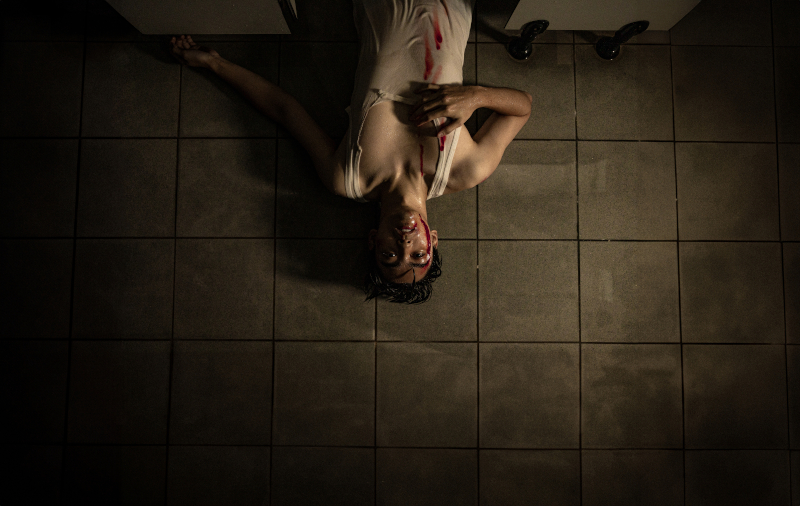
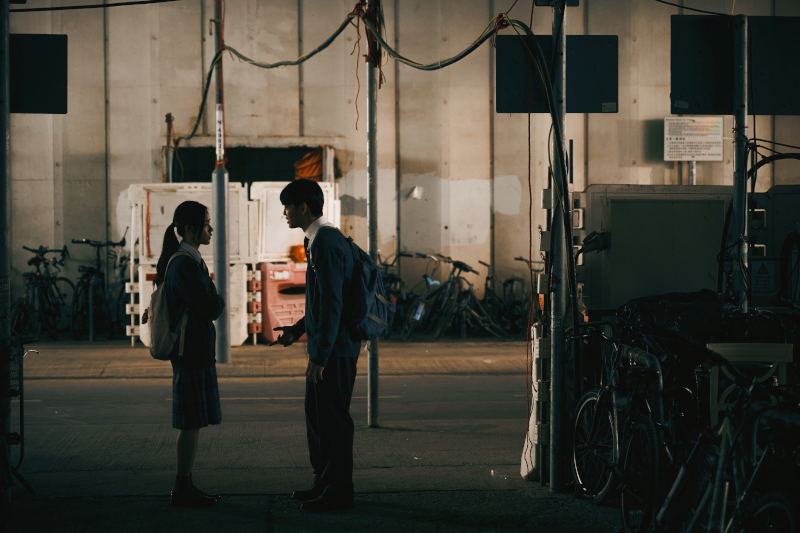
In schooldays flashbacks, It borrows further from Carrie with Lok’s being beaten up in the school toilets by a gang of bullies led by Jack (Timothy Choi Tsz Hin) and a too-good to be true romance with Ching, later revealed, contrary to what her teddy bear collection might have us believe, to be a nasty bit of work.
In fact, Lok is haunted by what he did to Ching (which put him in prison), the film positing another flashback here he drags the struggling girl through a stairwell doorway near her family home apartment and the camera slowly pulls away from the doorway much as it does from the doorway to a stairwell beyond which a man is raping and killing his second victim in Frenzy (Alfred Hitchcock, 1972).
It seemed to much to ask that Anthony Wong – who plays the chef serving up the remains of his murder victims in his restaurant in Bunman: The Untold Story (Danny Lee, Herman Yau, 1993) and the sole gangster lacking any moral code in Hard Boiled (John Woo, 1992) – would play a clergyman straight, but for the first half all you get his hints: the pastor scarcely ever smiles (except in flashbacks to his happier past) and the apartment looks distinctly austere. Towards the end, however, he has a scene in his church baptising Lok , to which the narrative builds with a sense of impending dread on which the baptism scene itself ultimately delivers.
A girl ironically named Grace (Summer Chan) has got herself pregnant and wants to know if the pastor’s church and Jesus will forgive her – Pastor Leung’s answer is an unequivocal “no” – while a further subplot concerns the pastor’s wife who, following her daughter’s suicide, has lost her Christian faith, a scenario here explored with the spiritual rigour of Winter Light (Ingmar Bergman, 1963).
A very mixed bag, then: a solidly evangelical Christian drama for its first half, a cocktail of unexpected new directions in its second half. Perhaps its most impressive achievement is the way it deals with bereavement and its accompanying memories. Ching’s appearance in the present, once you work out what’s going on, is played like a very subtle ghost story, which may well constitute the movie’s strongest asset.
Valley of the Shadow of Death is out in cinemas in the UK on Friday, November 14th.
Trailer: